For a while, it seemed Elizabeth Holmes was everywhere.
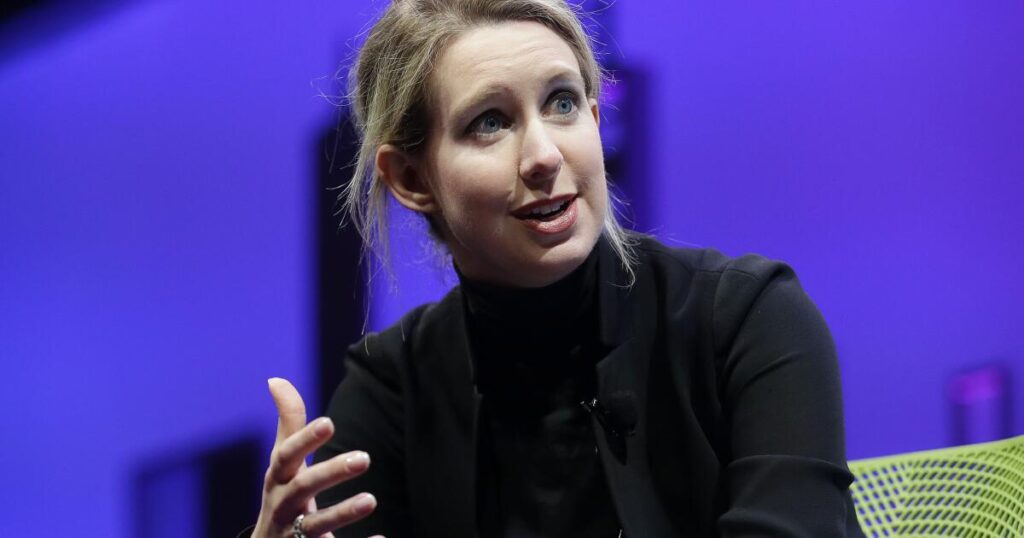
Peering wide-eyed and black-turtlenecked from a shelf load of magazine covers. Honored as a “Woman of the Year” by Glamour. Touted as one of Time’s “100 Most Influential People.”
At age 30, Holmes was regarded as a preternatural business talent — and, more impressively, described as the youngest self-made female billionaire in history — owing to her founding and stewardship of Theranos, a Silicon Valley start-up that promised to revolutionize healthcare by diagnosing a host of maladies with just a pinprick’s worth of blood.
It was all a big con job.
Her medical claims were a sham. Theranos’ technology was bogus. Even the husky TED-talking voice Holmes used to invest herself with greater seriousness and authority was a put-on. (The turtlenecks were an austere affectation she cribbed from Steve Jobs.)
In January 2022, a San Jose jury convicted Holmes on four counts of fraud and conspiracy. At age 37, she became a case study in gullibility and greed. Months later, Holmes — by then a mother of two — was sentenced to 11 years and three months in prison. She began serving her termin May 2023, at a women’s prison camp outside Houston.
Now, Holmes — who spawned a best-selling book, podcasts, a documentary, a TV miniseriesand, not incidentally, stole hundreds of millions of dollars from investors — is lobbying for a pardon from President Trump.
And why not?
Game knows game. Grift knows grift.
Of all the powers a president wields, few match his awesome pardon authority.
It is sweeping and life-changing. Idiosyncratic, resting wholly on personal whim, and irrevocable. Once granted, it is impossible to reverse.
The power to pardon is also, like any grant of authority, subject to mismanagement and abuse.
Just about every president “has issued his share of controversial pardons and more than that, perhaps, pardons that just were in terrible taste, that violated all sense of reason and propriety,” said Larry Gerston, a San José State political science professor emeritus and longtime student of Silicon Valley.
Excess being Trump’s signature, the president has, true to form, taken his pardon power to indecent and unholy extremes.
As soon as he settled back into the Oval Office, Trump pardoned more than 1,500 criminal defendants tied to the Jan. 6, 2021, attack on the U.S. Capitol, including some who beat and pepper-sprayed law enforcement officers.
Other malefactors he’s let off the hook include Changpeng Zhao, the money-laundering former CEO of Binance, which has ties to the Trump family’s cryptocurrency business; disgraced former congressman and embezzler George Santos; and Illinois’ politically corrupt former governor, Rod Blagojevich.
Just last week, Trump pardoned former Honduran President Juan Orlando Hernández, a convicted drug trafficker who, according to prosecutors, “paved a cocaine superhighway” to the United States. This at the same time the U.S. military ramps up its presence in Latin America and blows boats out of the Caribbean in a professed fight against drug smuggling in the region.
If you can square those actions with Hernández’s pardon and not throw your back out in the process you’re either more pliable than most or willfully obtuse.
Or try reconciling Trump’s supposed tough-on-crime stance with his pardon of crypto cult hero Ross Ulbricht.
Ulbricht, whom a judge described as “the kingpin of a worldwide digital drug-trafficking enterprise,” was sentenced in 2015 to life in prison for running Silk Road, a dark web marketplace where criminals used Bitcoin to conduct hundreds of millions of dollars in illicit trade.
Acting from behind bars, with help from family and supporters, Ulbricht mounted a social media campaign clamoring for his release. Among those who took note was Trump, who championed Ulbricht’s cause during the 2024 campaign as a way to woo libertarian-minded voters. A day after his inauguration, the president granted Ulbricht a full, unconditional pardon.
Apparently, Holmes also took note.
From her minimum security lockup, she’s begun mounting her own social media blitz in an apparent attempt to win Trump’s favor and get sprung from prison and freed from accountability for her epic swindle.
Holmes cannot access the internet or social media, the U.S. Bureau of Prisons told the San Jose Mercury News. So her postings, she explains on X, are “mostly my words, posted by others.” (Her biography reads: “Building a better world for my two children. Inventor. Founder and former CEO @Theranos.” Somewhere Thomas Edison is blushing.)
Holmes’ feed is a babbling stream of self-help epigrams, ankle-deep reflections and many, many photos of herself. “I gave my life to fighting for our basic human right to health information,” says the would-be Joan of Arc.
Of course, there is also plenty of Trump flattery along with paeans to Robert F. Kennedy Jr. and his cockamamie make-America-sick-again agenda, as one medical charlatan nods to another.
Nowhere does Holmes offer the slightest expression of guilt or remorse for her considerable ill-gotten gains. At one point, she even likens herself to a Holocaust survivor, displaying both staggeringly poor taste and utter cluelessness.
All of which makes Holmes an ideal candidate for a pardon from Trump, who’s turned self-dealing and victimization into an art form. Maybe if Holmes is freed from jail she can find a job somewhere in his administration.
The post She’s a liar, swindler and cheat. So why wouldn’t Trump pardon her? appeared first on Los Angeles Times.