Radiation levels have not increased outside the Chernobyl power plant, the Ukrainian site of the world’s worst-ever nuclear disaster, even though the authorities have been unable to fix the damage from a Russian drone that punctured the protective shield at the complex in February, officials said on Sunday.
On Friday, the International Atomic Energy Agency confirmed that the steel shell was still not functioning as designed — a problem that first became public in March after the full extent of the damage from the drone strike became clear. This means the shield can no longer prevent radiation from escaping, particularly radioactive dust.
This is crucial not because of radiation fears now, but because of what might happen in the future, nuclear experts said.
The shield, an immense dome called the New Safe Confinement, was designed to work for 100 years and allow workers to dismantle the damaged Reactor No. 4 inside and safely dispose of the radioactive waste. The shell also covers a temporary “sarcophagus” built by Soviet engineers to protect the reactor after the 1986 explosion at the plant.
“If there was to be some event inside the shelter that would release radioactive materials into the space inside the New Safe Confinement, because this facility is no longer sealed to the outside environment, there’s the potential for radiation to come out,” said Shaun Burnie, a senior nuclear specialist at Greenpeace who has monitored nuclear power plants in Ukraine since 2022 and last visited Chernobyl on Oct. 31.
“I have to say I don’t think that’s a particularly serious issue at the moment, because they’re not actively decommissioning the actual sarcophagus.”
The I.A.E.A. also said there was no permanent damage to the shield’s load-bearing structures or monitoring systems. A spokesman for the agency, Fredrik Dahl, said in a text message on Sunday that radiation levels were similar to what they were before the Russian drone hit.
“Radiation monitoring carried out by Ukraine and independently by the I.A.E.A. continue to show that radiation levels outside of the New Safe Confinement have remained normal compared with measurements conducted before the event in February,” he said.
The explosion at Chernobyl in 1986 sent a cloud of radioactive material into the air and caused a public health emergency across Europe.
The Soviets initially hid the extent of the disaster, hastily building a concrete-and-steel emergency sarcophagus to encase the damaged reactor. The Soviets also set up a 1,000-square-mile “exclusion zone” where no one was allowed to live. People still are not allowed to live there.
It took decades to come up with a permanent plan to clean up Chernobyl.
More than 45 countries and organizations spent almost $1.7 billion building the steel shell, which was slid into place over the reactor on railroad tracks in 2016. The shell is the world’s largest movable structure, as tall as a football field and as heavy as a battleship.
The authorities had planned to dismantle the damaged reactor inside and safely dispose of the radioactive waste. Then the Russians invaded Ukraine in February 2022, delaying the start of the planned cleanup.
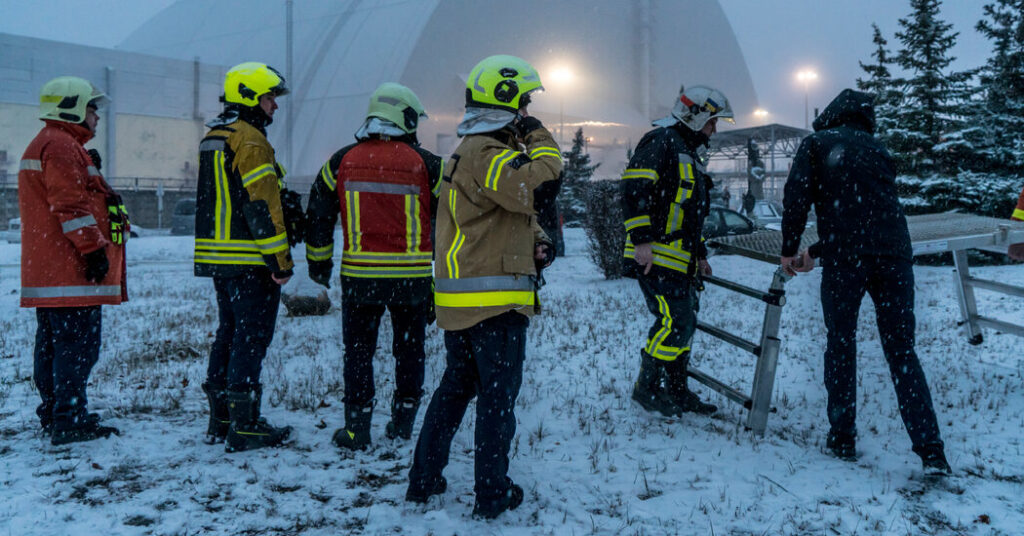
After the drone hit on Feb. 14, an initial fire was quickly extinguished. But a waterproof membrane inside the insulation of the shield burned and smoldered for almost three weeks. Emergency workers in mountain-climbing equipment knocked holes into the shield’s outer layer, hunting for the fire and spraying water inside the structure.
The holes, and the initial puncture from the drone strike, have been temporarily patched. International and Ukrainian experts are now trying to figure out a more permanent solution, which is challenging. Workers most likely won’t be able to fix the shield where it now is because of radiation levels. Moving the shield also carries risks.
“Timely and comprehensive restoration remains essential to prevent further degradation and ensure long-term nuclear safety,” said Rafael Grossi, the director general of the I.A.E.A.
Kim Barker is a Times reporter writing in-depth stories about the war in Ukraine.
The post Russian Drone Strike on Chernobyl Hasn’t Led to Rise in Radiation Levels appeared first on New York Times.