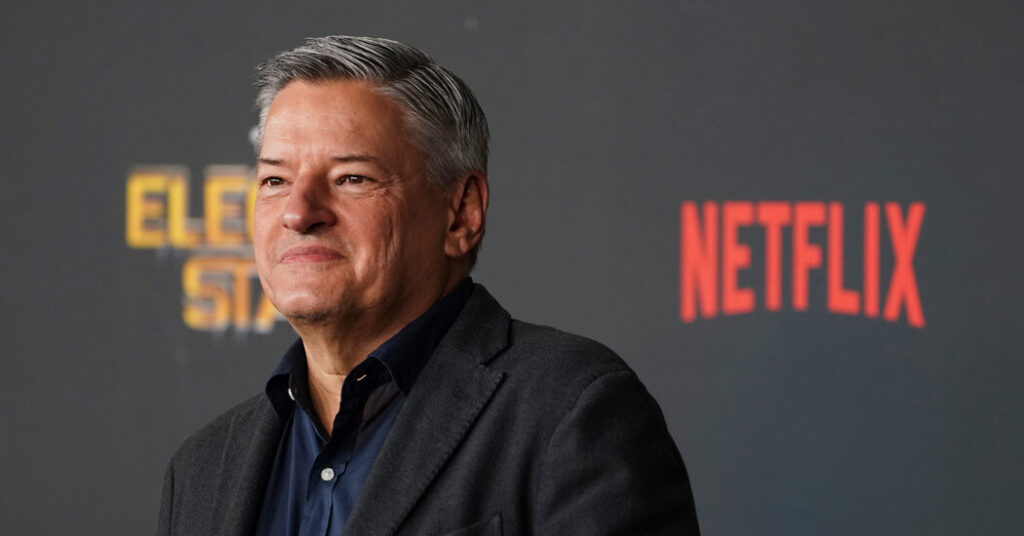
Ted Sarandos has long coveted HBO programming.
Back in 2010, when Netflix was still shipping tens of millions of DVDs by mail, Mr. Sarandos, a top executive, was intent on getting some older HBO shows on its nascent streaming service. Other studios had eagerly licensed movies and back episodes of series to Netflix’s digital service in exchange for a boatload of cash.
But HBO, the envy of the industry for the quality of its programming, was not interested. The network rejected offer after offer, even for retired series like “Six Feet Under” and “Deadwood.”
“They were very tough — like, they did not want to sell,” Mr. Sarandos said at an event earlier this year.
HBO’s refusal led Mr. Sarandos to a critical decision: Netflix had to make original programs of its own. “We better get good at this ourselves,” he recalled.
That decision ultimately ignited the streaming revolution, upended Hollywood and turned Mr. Sarandos, now the co-chief executive of Netflix, into one of the most powerful people in entertainment. It also made HBO a major rival, with the two companies bitterly competing over talent deals, TV series and Emmy Awards.
Soon, though, there will be another major twist in their long and complicated relationship. HBO will be not just sharing shows with Mr. Sarandos, but reporting to him.
Netflix’s blockbuster $83 billion deal to buy the studio and streaming businesses of Warner Bros. Discovery, announced on Friday, sent shock waves through Hollywood. The deal set off concerns about the future of theatrical releases. It also left many questions about the future of the storied HBO brand.
On Friday, Mr. Sarandos sought to reassure a jittery entertainment industry, telling investors that HBO would keep “operating largely as it is.”
“We think that the HBO model itself is working and quite beloved by consumers,” he continued. “And we want to keep investing in that.”
But how will HBO’s programming be presented under Netflix ownership? Will HBO Max remain a separate app for long? Will HBO series be prominently displayed within Netflix? Will there ever be a point when HBO’s programs eventually just become “Netflix originals?”
Netflix executives were not ready to speak about any of that yet. “We think it’s quite early to get into the specifics of how we’re going to tailor this offering for consumers,” Greg Peters, Netflix’s other chief executive, said on Friday.
All of this left HBO employees with mixed emotions. Some dreaded the possible end of the brand as they knew it. Others took a longer view. The transaction may not even close because of significant regulatory hurdles, or another company could present an even richer offer. And even if the deal does go through, given the length of time it would take to get there — Netflix said it would take 12 to 18 months to close — it could be several years before the streaming behemoth gets a chance to muck with its business.
HBO employees, of course, have been through this before. HBO’s parent company, Time Warner, merged with AOL in 2001, a deal that has long been assailed as one of the worst media deals in business history. Time Warner announced a sale to AT&T in 2016, a deal that took nearly two years to close, and was also widely viewed as another disaster. And then when HBO became part of Warner Bros. Discovery in 2022, it was folded into a company burdened by a huge debt load that had limited spending power from the start.
And through it all, HBO remained HBO. The company kept piling up Emmys, and kept delivering new hits, including “Succession,” “The White Lotus” and “Euphoria.”
Still, the deals took a toll. Each transaction “took you in a more corporatized direction, and each step made programming decisions a little more complicated, threw a few more factors in,” Carolyn Strauss, a former top programming executive at HBO, said in 2022.
This would be the first deal, though, that pairs HBO with a rival. That rivalry effectively kicked off in the early 2010s when Jeffrey Bewkes, then the chief executive of Time Warner, dismissed Netflix as an insignificant upstart. “It’s a little bit like, is the Albanian army going to take over the world?” he told The New York Times. “I don’t think so.”
Reed Hastings, a founder of Netflix, promptly turned that into a rallying cry, handing out camouflage green berets stitched with an image of the Albanian national flag to executives. “That’s the kind of thing that was super motivating to people,” Cindy Holland, a former top Netflix executive, once said.
In 2012, Mr. Sarandos took it a step further and said that “the goal is to become HBO faster than HBO can become us.”
In the end, Netflix did not become HBO — it became something much larger and more influential. Netflix has more than 300 million subscribers globally and makes more original TV series and movies than any other company in the world. It also has the most engagement of any subscription streaming service in the United States, assuming 8 percent of total television viewing time in October, according to Nielsen.
“To Netflix’s credit, as the first mover, they have become a utility,” Casey Bloys, HBO’s chairman, said last month. “For consumers, it is the basic cable of today.”
HBO, on the other hand, has had an extremely bumpy ride through the streaming wars. It has struggled to get subscribers to turn on its app more than once or twice a week, and it has cycled through head-spinning brand changes. Over the years, its streaming service has been known as HBO Go, HBO Now, HBO Max, Max and, then once again, HBO Max.
HBO Max, which has far fewer subscribers than Netflix, only had 1.3 percent of television viewing time in October, a smaller share than many streaming services, including Peacock, Disney’s streaming services and Amazon Prime Video.
Nevertheless, even with a significantly smaller budget and far fewer programs, HBO continued to master something that Netflix has struggled with: consistently creating hit prestige television series.
Over the past decade, HBO and HBO Max has won the best drama award at the Emmy Awards eight times, including this year when “The Pitt” bested Netflix’s “The Diplomat.” Netflix has won the award — television’s most prestigious prize — just once.
HBO often wins over talent by arguing that the network’s celebrated development process and its seasoned executives will take better care in shepherding an idea successfully to TV screens than its competitors, Netflix included.
When Mr. Sarandos talked about the deal on Friday, he acknowledged that the Warner Bros. “development infrastructure” would be a much-needed asset to the company.
And as soon as a year from now, Mr. Sarandos could control that development process, as well as “Deadwood,” “Six Feet Under” and a whole lot more.
John Koblin covers the television industry for The Times.
The post Netflix Always Wanted Some HBO Shows. Now It Gets All of HBO Instead. appeared first on New York Times.