For a long time, when the world of contemporary art commanded greater cultural cachet, Art Basel Miami Beach was the country’s premier appointment for buying new art, meeting colleagues from around the world, and drinking as much brand-sponsored tequila as early December allowed.
It was a delightful oxymoron: a wild-child American stepsister to a staid Swiss trade fair, a warm-weather winter complement to Basel’s summer offering. By day, you could see art of higher quality — and buy it at higher prices — than at homegrown fairs in New York or Chicago. By night you could attend (or crash) a carnivalesque offering of dinners and parties, if you could reach them through the Collins Avenue gridlock.
But this year’s edition of Art Basel Miami Beach opened under what you might call, following the yellow flags on the beach, a medium hazard. The softening market for modern and contemporary art, which saw the closure in 2025 of significant galleries in New York and Los Angeles, was only the half of it (although auctions in November suggested an incipient recovery at the highest end). There’s also been a supersaturation of the cultural calendar, and there’s only so much good art to go around.
Art Basel, founded by three Swiss art dealers in 1970, now presents four full-scale fairs each year, spanning Asia, Europe and the United States. The rival Frieze Art Fair has five, and both have Middle Eastern editions on the way (Art Basel’s will be in Doha, Qatar). These days you pick your poison, and my chosen strain comes from Europe’s pharmaceutical capital; I go every year to Switzerland for what we sometimes repetitiously call “Art Basel in Basel.” But Miami had fallen off my radar since 2020 — galleries I admired had been pulling out, and a post-pandemic influx of tax-avoidant cryptocollectors left me a little wary of South Florida in December.
It was time, I felt, for a Basel brush up. This year, for the first time, I completed the superfecta, attending all four editions of Switzerland’s little exposition that could: Hong Kong in March, Basel in June, Paris in October and now Miami Beach, which closes Sunday. Even for me, a critic who treats jet lag as a Zen state, this was a lot. Add them all up and I scrutinized over 1,000 fair booths, hung with multimillion-dollar masterpieces of 20th-century art or modest scribbles by young artists for a thousandth the price. My notebook is stained with $8 convention center espressos, and my phone’s pedometer records an average of 20,000 steps on each of the four opening days. (Miami Beach scored highest.)
What did I conclude?
-
That Art Basel remains the world’s most reliable venue to watch where painting, sculpture, photography and the rest are headed — for good or ill.
-
That a culture that seemed to be homogenizing across the globe, with difference sanded down by finance and technology, is fragmenting and re-regionalizing — for good or ill.
-
That the international art market, even with recent floods of corporate capital, retains pockets of cultural independence — certainly more than Hollywood has.
-
That money can’t buy you taste. But an art adviser can help.
-
And that the gallery system from which Art Basel arose has changed beyond recognition, and needs to be nurtured for both to survive.
Some critics, wary of the big bad market, refuse to enter the doors of an art fair. Artists, who see their work turn from an act of creativity into a commodity for sale, often don’t like going inside either. But the fairs, for a nonparticipant in the market like me, offer a priceless speed run past countless new or not-so-new works of art, as well as an X-ray of trends — goodbye, 2010s paint-by-numbers portraiture! We will not miss you! — and a crash course in high-net-worth sociology.
The original fair in Switzerland remains the most blue-chip, and the audience skews to industry professionals and discreet collectors from western Europe. The young Paris fair, held beneath the vaulted-glass ceiling of the 125-year-old Grand Palais, has quickly become the glamour child — drawing many of the world’s richest and most ravenous collectors (who would rather eat and shop in the French capital than a mid-sized Swiss city), and therefore encouraging dealers to bring finer works.
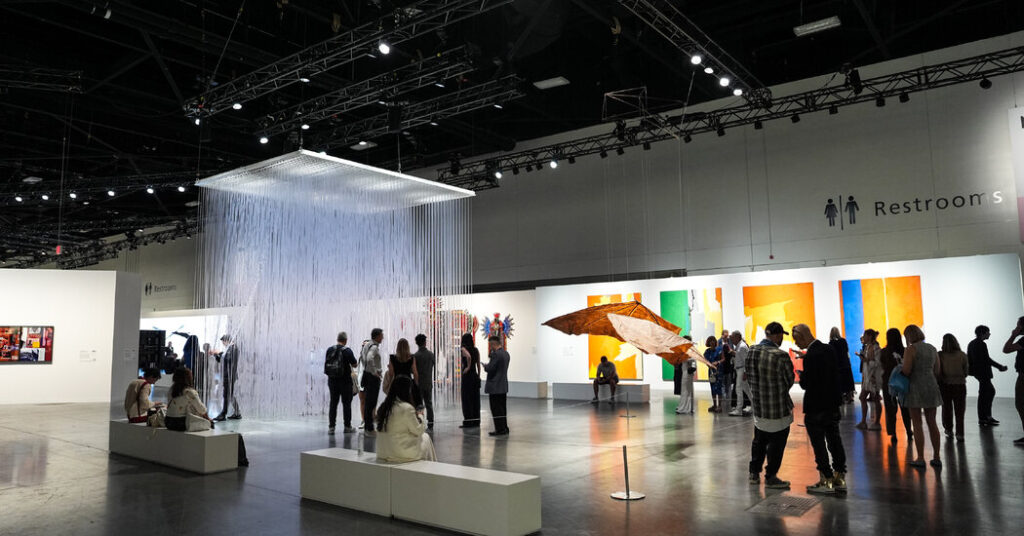
Miami Beach now feels, like Hong Kong, to be a regional edition, directly targeted to American collectors as Hong Kong targets Asia’s, with a mix of good-but-not-life-changing historical work (you could go home this year with a two-inch-tall Frida Kahlo self-portrait, beneath glass, at the booth of San Francisco’s Weinstein Gallery) and South Beach-validated vulgar pop. In both Hong Kong and Miami Beach I saw the same 8-foot, busty, gold-plated “sexy robot,” sculpted by the Japanese artist Hajime Sorayama and floating in a mirrored box. I can’t tell you the repeat encounter merited the carbon emissions.
To each his chosen Basel, to each her chosen vibe. At all four editions you will encounter promotions from private jet furnishers and manufacturers of seven-figure watches (Hopp Schwiiz!); all have pushcarts selling official sponsor champagne, though only the Swiss venue has a fondue station. Wearing a tie helps in Paris; in Basel some Germanophones wear gentleman-farmer felt jackets; Hong Kong requires layering, as you move from humid megacity to air-conditioned show; Miami Beach welcomes both big logos and little lap dogs. But in all four the most prevalent footwear is springy On tennis shoes — favored also by Roger Federer, the most famous Basel resident since Erasmus.
I mock because I love; I also wore On tennis shoes throughout my Basel world tour, even if my net worth is a rounding error to the similarly shod, and needed them this year as I loped from convention center to convention center. This year Paris’s first days were the rowdiest, while Miami Beach was pleasantly manageable during opening hours: Nothing like the running of the bulls I remember from my early years.
I was impressed, in Miami this year, by showcases of the painters Wifredo Lam (at the booth of the Italian gallery Mazzoleni) and surprising portraits of athletes by Emma Amos that integrate painting and weaving (at Ryan Lee). But of risk, throughout, there was little sign; those halcyon 2000s days, when punkier dealers like Michele Maccarone or Gavin Brown would provoke with near-empty booths or even let an artist trash the joint, are long gone. And it was hard not to feel the absence of many ambitious midsize dealers who’ve stopped participating (it just costs too much, with shipping and insurance), and their replacement by newcomers who aren’t exactly varsity grade. Art Basel has tried to celebrate this year’s “largest cohort of new exhibitors in over a decade,” which is a bit of a weird flex. They used to celebrate how many exhibitors were returning.
Even the future looks different from one fair to the other. Only Miami Beach has a sector devoted to digital art, regrettably full of algorithmically produced slop, enticing a Florida-first tech crowd with low intellectual demands at low prices. The digital section is lorded over by the NFT class clown Beeple. “Regular Animals” is a dogpen of yipping, twitching canine robots, each affixed with chimerical heads — Elon Musk, Jeff Bezos, or Andy Warhol. They skitter and stutter and defecate QR codes allowing phone-wielding admirers to buy dematerialized shares. Alchemists since King Midas have tried to turn excrement into gold, though at least they knew which one was which.
When it opened in 2002 (dealers postponed the first by a year after the attacks of Sept. 11, 2001), Art Basel Miami Beach was scrappy enough that young galleries were showing in shipping containers plopped on the beach. A young Mark Bradford, who would go on to represent the U.S. at the Venice Biennale, converted one into a replica of his mother’s beauty salon and styled fairgoers’ hair. The whole thing matured quickly into a beachside bacchanal for the art-adjacent and the general public, who could attend a dozen satellite fairs (or none at all) as they caroused in seaside hotels. By 2013, Jay-Z would be rapping that he parked “twin Bugattis outside the Art Basel”: sensibly enough, given the appalling traffic.
I first came in 2005, and appreciated Miami Basel especially for my first introductions to the leading galleries of Brazil, Colombia and Mexico. In the convention center aisles you could see A-list celebrities, B-tier Real Housewives, and, 10 years ago, an attempted murder that some flabbergasted fairgoers mistook for a performance.
A few of the parties were great (if I saw you on the dance floor of Le Baron circa 2009, I miss you and I miss our youth), though many more were just seaside sponcon. What mattered were the dealers inside the convention center, who collectively upheld the quality of painting, sculpture and new media that came to market. Art Basel Miami Beach offered me my first exposure to Brazil’s Letícia Parente, the Mexican artist and tattooist Dr. Lakra, and many more Latin American names I would not encounter in museums in the United States until years later. Art Basel Miami Beach was where the conceptual harlequin Maurizio Cattelan first deployed “Comedian,” comprising a banana and a piece of duct tape, which — on my honor — I believe to be a significant work of contemporary sculpture. The art came first, even when the spectacle seemed to consume it.
But on my 2025 fair pilgrimage I felt a risk that Art Basel and Frieze may be achieving some sort of escape velocity from the galleries they rely upon. The fairs’ original business model, in which visitors bought tickets and galleries paid for wall space, has become just one of so many revenue streams: A.I.-powered apps, dubious blockchain initiatives, and, this year, the offer of a limited-edition Art Basel Labubu figurine. Galleries, especially those far from the biggest capitals, need fairs to meet audiences they cannot reach alone. But fairs need galleries just as much, to fill their cavernous spaces with the new and the overlooked.
For where else can art get on equal footing with the behemoths of mass entertainment? By assembling hundreds of galleries under one roof for one week, or one week times four, these fairs still do what no other institutions can: They permit the world’s most significant artists to hold our attention in a cultural economy now structured around events, experiences, influencers, spectacles.
The commercial gallery remains, still, our culture’s principal discovery mechanism for the art we do not know yet, putting in front of us what’s meaningful or beautiful — and the fair, when the party’s over, is key to their survival. The commercial sector is not the whole picture of art, and never will be, but someone has to put their money where their mouth is.
Jason Farago, a critic at large for The Times, writes about art and culture in the U.S. and abroad.
The post I Hit the Art Basel Superfecta appeared first on New York Times.