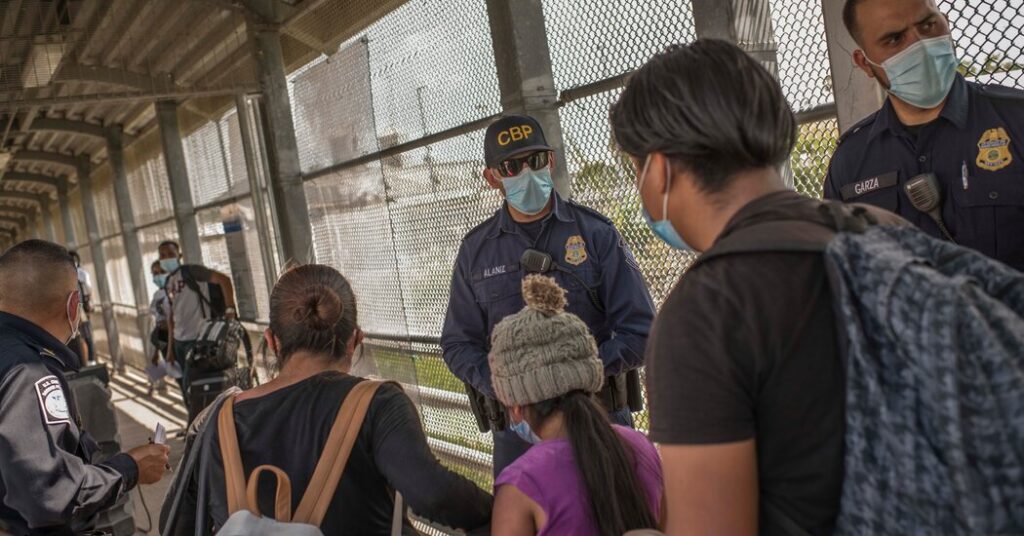
In the weeks after Joseph R. Biden Jr. was elected president, advisers delivered a warning: His approach to immigration could prove disastrous.
Mr. Biden had pledged to treat unauthorized immigrants more humanely than President Donald J. Trump, who generated widespread backlash by separating migrant children from their parents.
But Mr. Biden was now president-elect, and his positions threatened to drastically increase border crossings, experts advising his transition team warned in a Zoom briefing in the final weeks of 2020, according to people with direct knowledge of that briefing. That jump, they said, could provoke a political crisis.
“Chaos” was the word the advisers had used in a memo during the campaign.
They offered a range of options to avert that crisis, by better deterring migrants. Mr. Biden seemed to grasp the risk. But he and his top aides failed to act on those recommendations.
The warnings came true, and then some. After Mr. Biden became president, migrant encounters at the southern border quickly doubled, then kept rising. New arrivals overwhelmed border stations, then border towns, and eventually major cities like New York and Denver.
Anger over illegal migration helped return Mr. Trump to the presidency, and he has enacted even more aggressive policies than those Mr. Biden first campaigned against. Mr. Trump has drawn outrage from Democrats by sending masked agents to target immigrants, often aided by National Guard soldiers.
But a New York Times examination of Mr. Biden’s record found that he and his closest advisers repeatedly rebuffed recommendations that could have addressed the border crisis faster, and eased what became a potent issue for Mr. Trump as he sought to return to the White House and justify the aggressive tactics roiling American cities today.
Former Biden administration officials told The Times that Mr. Biden and his circle of close confidants — including Ron Klain, who was chief of staff during the president’s first two years, Mike Donilon, Jennifer O’Malley Dillon and Anita Dunn — made two crucial errors.
First, they underestimated the scale of migration that was coming. Second, they failed to appreciate the political reaction to that migration — believing that stronger enforcement would alienate Latino and progressive voters, and also that a border surge would not be an important issue to most voters. Those calculations would later prove to be mistaken, with many voters, including Latinos, citing immigration as a reason for supporting Mr. Trump in 2024.
“Everybody was reacting to the excesses of the Trump administration,” said Cecilia Muñoz, who helped shape immigration policy in the Obama administration and oversaw domestic and economic policy for the Biden transition team.
Yet as public concern over border security grew, partly in response to Mr. Biden’s own actions, his administration proved catastrophically slow to change course, former aides said. The president and his closest aides treated immigration as a distraction from other issues, such as the coronavirus pandemic and the economy.
Aides stressed that the Biden administration faced a steep challenge addressing a border crisis while adhering to outdated immigration laws. But they lamented that Mr. Biden never articulated a clear vision or pushed his cabinet secretaries to coordinate their efforts on immigration in the way that Mr. Trump has.
Mr. Biden created new legal pathways for migration to ease pressure at the border, under which more than one million people were allowed into the United States, fueling public resistance. And he failed to convince Congress to change immigration laws, dragging his feet on a crucial Senate border deal, according to the lead Republican negotiator, who said the effort might have otherwise succeeded.
The shooting in Washington last month that killed one National Guard soldier and left another critically injured has renewed scrutiny of Mr. Biden’s immigration programs. The suspect arrived through Operation Allies Welcome, which offered entry to Afghans fleeing the Taliban in 2021.
A spokeswoman for Mr. Biden declined to make him available for an interview. She provided a statement that blamed Republicans for blocking additional funding for hiring more border agents, deploying more security technology and processing immigration cases more quickly. The statement also blamed Republicans for walking away from the proposed border bill “because Donald Trump told them to.”
“When it became clear Congress wouldn’t act, Biden took decisive action on his own,” the statement said.
Mr. Klain defended the administration’s actions on immigration as part of a broader set of priorities.
“We came in during an economic collapse and 3,000 Americans dying each day from Covid. We focused on those first and got both turned around quickly,” he said. “We ended the cruelty of Trump’s immigration policies but hit a wall on building a sensible asylum system when Republicans blocked action on needed legislation.”
But former advisers said the problem ran deeper than Republican obstruction.
The Biden White House “had no strategy, because they had no goal,” said Scott Shuchart, who joined the administration in 2022 as a senior adviser at Immigration and Customs Enforcement. “All they had was wishing the problem would go away so that they could focus on the things they cared about.”
Year 1: Chaos, Then Paralysis
Mr. Biden’s policy advisers sounded the alarm before he even won the election.
In August of 2020, several aides wrote a memo cautioning Mr. Biden’s inner circle that his promises — coupled with pent-up demand from the Trump years and economic hardship from Covid — could provoke a spike in border crossings.
“A potential surge could create chaos and a humanitarian crisis, overwhelm processing capacities, and imperil the agenda of the new administration,” the advisers wrote, according to a copy of the memo viewed by The Times.
Mr. Biden was confronting challenges that had been years in the making. Migrants had increasingly turned to claiming asylum. By saying they were fleeing persecution, many had been permitted to live and work in the United States for years until their claims could be heard.
Asylum
The Refugee Act of 1980 gives people the right to request asylum in the United States because of persecution or a fear of persecution in their home country on account of race, religion, nationality, membership in a particular social group or political opinion. The law gives people the ability to claim asylum when they arrive at the border or once they’re already in the country. President Trump and President Biden took steps to restrict that ability; those steps have been challenged in court.
President Trump had tried deterring asylum seekers. His administration separated children from their parents. He created the “Remain in Mexico” program, forcing asylum claimants to wait in Mexico until their cases were heard. During the pandemic, he invoked a public health rule, Title 42, to turn back migrants.
The memo from Mr. Biden’s advisers offered a range of options, including making it easier to quickly reject asylum claims; holding people in “reception centers” until their cases could be heard; transferring some migrants to other countries; and continuing to make some asylum seekers wait in Mexico, while ensuring they had access to shelter.
Title 42
Title 42 is a legal provision that lets the government block the entry of people who risk introducing a communicable disease into the country. The Trump administration began applying the rule to migrants in 2020, at the start of the Covid pandemic.
Once in office, Mr. Biden had to decide between the more permissive approach that Democrats demanded and the warnings from some policy advisers to tack to the center.
He wasted no time answering.
Soon after being sworn in, Mr. Biden issued a 100-day pause on deportations. He drastically narrowed the categories of unauthorized immigrants targeted for arrest. He directed his government to stop building the border wall, a centerpiece of Mr. Trump’s agenda. He suspended Remain in Mexico. He sent draft legislation to Congress to create a citizenship pathway for people in the country illegally. He kept Title 42 in place, but stopped using it to turn back children who crossed the border alone.
Remain in Mexico
At the beginning of 2019, the Trump administration started the Migrant Protection Protocols, also known as “Remain in Mexico.” Under that program, people who arrived at the border seeking asylum were given a date to appear in immigration court then sent to wait in Mexico, often for six months or longer.
The speed of Mr. Biden’s actions masked deep disagreements on his team.
Some advisers warned that he was moving too quickly. Others worried that Latino voters would object if the new president softened support for migrants.
“The president and others made a decision that he wasn’t going to lose that community,” said Roberta Jacobson, the border czar for the first three months of the administration.
Mr. Biden’s policy changes, some of which were halted by the courts, were not the only causes of that early surge. The draw of the U.S. economy, which bounced back quickly from Covid, mattered too. But the changes signaled to migrants that the border was opening again, former aides said.
The crisis foretold by Mr. Biden’s border advisers quickly emerged.
In January, the month Mr. Biden took office, the U.S. Border Patrol reported 75,316 encounters with migrants along the southwest border. By March, that number passed 169,000 — far higher than at any point during the Trump administration. Many arrivals were children, jammed into border stations ill-equipped to hold them.
The perception of chaos began to erode the pro-immigrant sentiment that had shaped Mr. Biden’s campaign promises. In March, 40 percent of Americans said they worried about illegal immigration “a great deal” — the highest number Gallup had registered in a decade.
Two months into his term, Mr. Biden assigned Vice President Kamala Harris with reducing illegal migration, especially from Central America, by working on the “root causes” of that migration.
Republicans labeled Ms. Harris the president’s border czar. But none of the former officials who spoke to The Times described her as a central decision maker on border policy. A spokeswoman for Ms. Harris did not respond to requests for comment.
Many former aides complained about the administration’s reluctance to push foreign governments harder to slow the movement of migrants or accept more deportation flights, as Mr. Trump has done in his second term.
Aides described Mr. Biden as having no strong positions on immigration beyond two key areas. He resisted anything that looked like Mr. Trump’s Remain in Mexico policy. And he did not want to send children back across the border.
As border crossings jumped, advisers across the administration kept offering ideas to deter migrants. But political concerns remained.
“They were a little too sensitive to criticisms from the left,” Ms. Muñoz said.
The result was paralysis. Andrea Flores was director for transborder security at the National Security Council early in the administration. Her first assignment, she said, was to help prepare a memo for Mr. Klain offering additional ideas for deterring migrants.
Officials could not agree on what options to present, she said, “so the memo died.”
Some Biden aides believed that the less the president said about immigration, the better. In June, the White House planned for Mr. Biden to give a speech on the border. Officials circulated the president’s remarks, Ms. Flores said, only to change their minds at the last minute.
Angela Kelley, who was then a senior immigration adviser at the Department of Homeland Security, described a collision between Mr. Biden’s campaign promises and “reality on the ground.”
“We didn’t really have a grip on it,” Ms. Kelley said.
The problem was about to get worse.
Year 2: The Border Moves North
One April day in 2022, a bus pulled up near the U.S. Capitol. It was carrying 12 Venezuelans, four Colombians, four Cubans and four Nicaraguans — and the start of a new phase in the immigration debate.
The bus had been chartered by the Texas Division of Emergency Management. “By busing migrants to Washington, D.C., the Biden administration will be able to more immediately meet the needs of the people they are allowing to cross our border,” Greg Abbott, the state’s Republican governor, said in a statement at the time.
The busing campaign had been under consideration since the previous summer, when local officials met with Mr. Abbott in the small border town of Del Rio seeking help with the growing flow of migrants, according to two former senior Abbott officials who spoke on the condition that they not be identified.
Initially, the buses all went to Washington, “to take the border to the president,” the officials said. In August, Mr. Abbott began sending busloads of migrants to New York City. A few weeks later, buses began heading to Chicago, then Philadelphia.
By the end of 2022, Texas had sent more than 16,000 migrants to those cities, according to data obtained by The Times last year through a records request.
The Biden administration accused Mr. Abbott of a cruel stunt. But the campaign worked. Until then, the White House viewed the migration crisis mainly as a problem for border states, former aides said. When migrants began making headlines in places like New York, that view changed.
Many Biden officials came to view Mr. Abbott’s campaign as the point Democrats lost the debate.
“I don’t think we ever recovered,” said Deborah Fleischaker, then the assistant director for policy at ICE.
Mr. Abbott’s campaign echoed an idea that some Biden officials had been advocating for internally: using federal resources to help migrants reach their destinations, but in coordination with the cities receiving them.
Jason Houser, then the chief of staff at ICE, said he had pushed the idea partly to help make the movement of migrants more orderly. He said Mr. Biden’s senior advisers refused.
Some officials contended that the Department of Homeland Security lacked congressional authority to transport immigrants not in government custody. Others felt that providing free transportation would draw more migrants.
If the Biden administration had worked to coordinate migrants’ travel in the United States, “it would have made a profound difference,” Mike Johnston, the Democratic mayor of Denver, said in an interview.
As Mr. Abbott’s campaign ramped up, White House officials debated taking executive action on the border, Mr. Klain said in an interview. But Kyrsten Sinema, then a Democratic senator from Arizona, had begun talking to Republican lawmakers about border legislation, he said. Mr. Biden wanted to give that effort a chance.
“We were trying to cut a deal,” Mr. Klain said.
But Democrats were running out of time.
Year 3: Trial and Error
By the halfway mark of Mr. Biden’s term, the failure of his approach was impossible to ignore.
The Border Patrol reported 2.2 million apprehensions along the Mexican border the previous year, up from 400,000 the year Mr. Biden was elected. In 2023, the number of unauthorized migrants in the country who were not detained and were waiting for their cases to be resolved surpassed 6 million, almost doubling since 2020.
The White House began experimenting. In January, the Department of Homeland Security started admitting migrants from Cuba, Haiti, Nicaragua and Venezuela, provided they could find an American sponsor, pass a background check and pay for a plane ticket. By giving those migrants an official way to enter, the program — called C.H.N.V., after the names of the four countries — sought to reduce their incentive to cross the border illegally.
C.H.N.V.
A program introduced by the Biden administration at the start of 2023, awarding two-year residency permits to people from Cuba, Haiti, Nicaragua and Venezuela who had U.S.-based sponsors and passed background checks. More than half a million people entered through the program before President Trump canceled it.
C.H.N.V. was an evolution of more targeted migrant programs introduced earlier in the Biden administration, starting with Operation Allies Welcome, which allowed the suspect in last month’s attack on the National Guard troops into the United States. In 2022, the administration started a similar entry program for Ukrainians fleeing Russia’s invasion of their country.
Republicans accused the administration of letting in unauthorized immigrants. And no one at the Department of Homeland Security was responsible for ensuring that people who entered through C.H.N.V. left the country when they were supposed to, according to a report this year by the agency’s inspector general.
Still, C.H.N.V. succeeded in reducing the number of people from those four countries approaching the border. But overall crossings remained high.
In May 2023, the administration replaced Title 42 with new restrictions. Asylum seekers were supposed to book an appointment through a mobile app, CBP One, which offered a limited number of openings.
CBP One
CBP One was a mobile phone app introduced by the Biden administration in 2023. People trying to file an asylum claim at the border were first directed to get an appointment with U.S. Customs and Border Protection through the app, which could sometimes take months. More than 900,000 people eventually booked appointments using the app; the Trump administration has ordered many of them to leave.
The administration also raised the threshold for asylum for people who did not use the app. But the new restrictions failed to stem the tide. Border encounters fell briefly, then rebounded.
Adding to the pressure, Mr. Abbott expanded his busing campaign. In May, Denver received its first busload from Texas.
Texas eventually sent more than 19,000 migrants to Denver. The city of about 720,000 wound up taking in 43,000 of them.
The influx became a crisis for Mr. Johnston, who was elected mayor three weeks after the first bus arrived. As the numbers grew, he repeatedly asked the Biden administration for money and policy changes to address what he called a “humanitarian crisis.”
The costs spread. The main safety-net hospital spent millions of dollars treating additional patients with no insurance. The school system made room for more than 5,000 additional students. Denver spent almost $100 million trying to manage the crisis.
The city was not alone. By September, Texas had sent tens of thousands of migrants to Chicago, Washington, Philadelphia and New York.
“This issue will destroy New York City,” Mayor Eric Adams told a town hall that month. “The city we knew, we’re about to lose.”
Year 4: The Reckoning
On a Sunday evening in February 2024, Senator Chris Murphy was in his Capitol Hill office, watching the collapse of the Biden administration’s last best chance to manage its immigration problem.
Mr. Murphy, a Democrat from Connecticut, had led his party’s negotiations over a bill to fix the border crisis by giving the government authority to restrict asylum claims. The bill had taken Mr. Murphy and his Republican counterpart, Senator James Lankford of Oklahoma, months to agree upon.
Within hours, as Mr. Murphy watched Republicans attack the bill on social media, he knew it would fail. Early the next day, Mr. Trump delivered the death blow. “This Bill is a great gift to the Democrats,” he wrote on social media. “It takes the HORRIBLE JOB the Democrats have done on Immigration and the Border, absolves them, and puts it all squarely on the shoulders of Republicans. Don’t be STUPID!!!”
“We had our votes on Sunday afternoon,” Mr. Murphy said. “We didn’t have them on Monday morning.”
The bill could have provided what Mr. Biden needed as he ran for re-election: a drop in border crossings, blessed by both parties in Congress, with enough time before Election Day for voters to change their minds about Democrats supporting open borders.
Democrats blamed Mr. Trump for sinking the deal. But Mr. Lankford pointed to another culprit: the Biden administration’s own foot-dragging.
When negotiations had gained momentum the previous fall, the White House had refused to get involved, according to Mr. Murphy and Mr. Lankford. “We don’t want our fingerprints on these negotiations,” Mr. Lankford recalled the White House telling him. Only as border crossings continued to spike did the administration relent, he said.
Looking back, Mr. Lankford said he believed the delay was critical. If Mr. Biden had signed on sooner, he said, the talks could have produced an agreement before the end of 2023. At that point, Mr. Trump, who still faced opposition for the Republican presidential nomination, might not have had the clout to torpedo the deal.
Then Mr. Trump defeated Ron DeSantis in Iowa, and Nikki Haley in New Hampshire. By the time the border deal concluded in February 2024, “it was very clear that Mr. Trump was going to win” the nomination, Mr. Lankford said. And Mr. Trump was eager to score political points off Mr. Biden’s immigration record.
The deal’s failure left Mr. Biden in a bind. Border encounters were still higher than at any point in the Trump administration. The estimated number of unauthorized immigrants in the United States — 11 million when Mr. Biden took office — was approaching 14 million. And the election was nine months away.
Less than three weeks after the Senate deal collapsed, a 22-year-old nursing student, Laken Riley, was killed on the University of Georgia campus. When a Venezuelan man who had entered the country illegally was charged with the murder, her death became shorthand for Democrats’ failures. Mr. Trump met with Ms. Riley’s family and said that she would still be alive “if Joe Biden had not willfully and maliciously eviscerated the borders.”
By June, 55 percent of Americans said total immigration levels should fall, the highest share measured by Gallup since just after the Sept. 11 attacks.
On June 4, 2024, five months before Election Day, Mr. Biden reversed course. He issued an order all but closing the border to asylum applications, a move that was far tougher than the proposals that had been rejected during his first year in office. Border encounters quickly fell.
Why Mr. Biden waited so long to effectively seal the border has become one of the defining questions of his presidency.
Some aides feared that closing the border would be overturned by the courts. Others said that principles mattered. “It was truly believed — deeply, by many, including the president — that that was not in keeping with our values,” said Ms. Jacobson, the former border czar.
Three weeks after closing the border, the president faced off against Mr. Trump in a debate at CNN’s Atlanta studios. Asked why voters should trust him to solve the crisis, Mr. Biden flubbed it.
“What I’ve done — since I’ve changed the law, what’s happened?” said Mr. Biden, who had not changed the law. “I’ve changed it in a way that now you’re in a situation where there are 40 percent fewer people coming across the border illegally.”
Mr. Biden went on: “I’m going to continue to move until we get the total ban on the … the total initiative relative to what we’re going to do with more Border Patrol and more asylum officers.”
“I really don’t know what he said at the end of that sentence,” Mr. Trump responded. “I don’t think he knows what he said either.”
Within a month, Mr. Biden left the race.
On Mr. Trump’s first day back in the White House, he effectively blocked asylum claims entirely. He also shut down Mr. Biden’s border entry app, ordered the military to the border and directed ICE to drastically expand its scope of arrests and deportations.
“The American people deserve a federal government that puts their interests first,” read Mr. Trump’s executive order.
The Biden experiment was over. A very different kind of experiment was just beginning.
Reporting was contributed by Hamed Aleaziz, Robert Draper, Adam Entous, Reid J. Epstein, Shane Goldmacher, Miriam Jordan, J. David Goodman, Zolan Kanno-Youngs, Nicholas Nehamas, Tyler Pager, Michael D. Shear and Eileen Sullivan. Emily Powell and Julie Tate contributed research.
Christopher Flavelle is a Times reporter covering how President Trump is transforming the federal government.
The post How Biden Ignored Warnings and Lost Americans’ Faith in Immigration appeared first on New York Times.