A new president with a bold agenda, determined to exert control over government agencies to carry it out. An agency head who refused to quit, rejecting the president’s demand that he resign and insisting Congress had protected his job to keep it independent from politics.
Long before President Trump declared he had the power to fire independent agency leaders, the United States experienced a nearly identical test of presidential power.
The president then was Franklin D. Roosevelt, who wanted to oust a member of the Federal Trade Commission he believed was an obstacle to his sweeping plan to pull the nation out of the Great Depression.
The Supreme Court ruled against Roosevelt, agreeing that Congress could pass laws shielding independent regulators from being fired by the president for no reason — a precedent that has stood for 90 years.
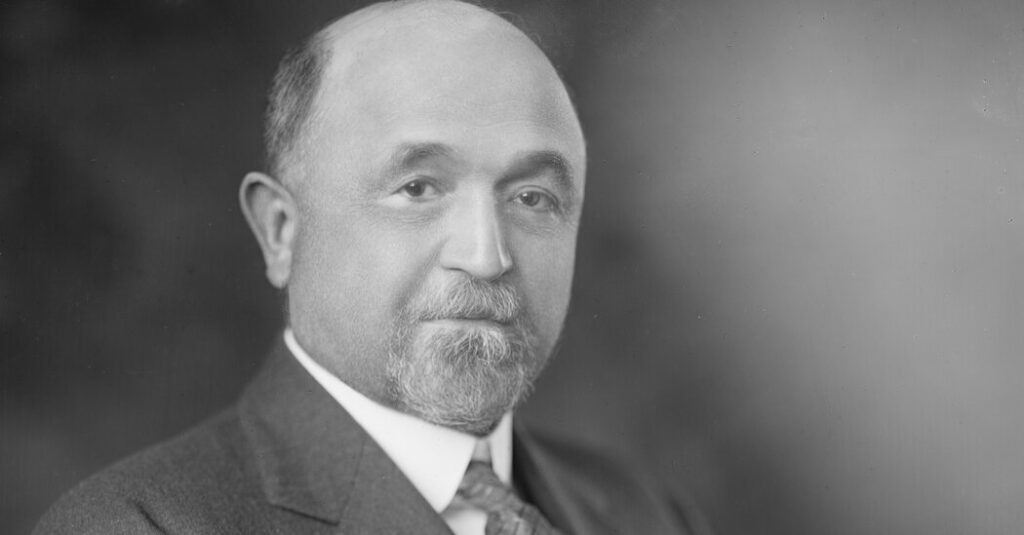
But the battle between Roosevelt and William E. Humphrey, a conservative lawyer who refused to leave his post at the F.T.C., has resurfaced in a blockbuster case the Supreme Court will hear on Monday, as the court decides whether to overturn the nearly century-old Roosevelt-era precedent.
The clash between Roosevelt and Mr. Humphrey, preserved in vivid detail in the archives of the Library of Congress, is more than a historical curiosity. It is a reminder that tests of executive power are nothing new to the United States, nor are presidents who want to assume greater control of the government to execute their agendas.
And as with so many other parts of American law and life, the Trump administration is now testing the limits of what had been thought to be a long-settled debate.
The year was 1933. Americans had just elected Roosevelt, a Democrat carried to the White House on his ambitious promise to return the country to prosperity following a stock market crash and economic calamity. The new president vowed that in his first hundred days in office, he would launch programs aimed at bringing relief to nearly 13 million unemployed people — many in danger of losing farms and homes — and shoring up business and agriculture.
As he moved swiftly to clear obstacles in his way, his attention landed on Mr. Humphrey.
Mr. Humphrey was first appointed to the F.T.C., an independent agency tasked with enforcing laws aimed at preventing unfair competition, in 1925, and was reappointed by Roosevelt’s predecessor, Herbert Hoover.
A Republican, Mr. Humphrey grew up in a small Indiana town and practiced law northwest of Indianapolis before moving west to Seattle. He won a House seat in Washington State in 1902, and served in Congress for several years before losing a 1916 Senate race.
At the F.T.C., Mr. Humphrey voted to dismiss several agency investigations against big businesses — among them companies that made mattresses, shoes, cash registers and soap — and stridently opposed the president’s proposed New Deal programs.
In July 1933, Roosevelt’s first year in office, Mr. Humphrey wrote him an urgent letter.
“My dear Mr. President,” Mr. Humphrey began. “Information comes to me that you are going to ask my resignation. For what reason I do not know.”
He asked the president for “a personal interview” to talk things through. After more than 40 years of public service, he wrote, being forced to resign would “greatly injure” his professional life.
Less than a week later, the president confirmed the rumors, writing that he found “it necessary to ask for your resignation.” In language that would preview Mr. Trump’s when he tried to fire quasi-independent officials this year, Roosevelt said that the agency’s work could “be carried out most effectively with personnel of my own selection.”
It was, he explained, “a definite decision.” He ended by congratulating Mr. Humphrey on his “long and active service.”
Mr. Humphrey shot back a few days later that he was “somewhat disturbed and shocked” by the news.
“I have lost all professional and business connections after being out of practice for nine years,” he wrote to the president. “Naturally I should like to consult my friends as to my future actions.”
He did not agree to quit.
Despite Mr. Humphrey’s distress, Roosevelt responded by telegram three days later. He was, he explained, “accepting” Mr. Humphrey’s “resignation.”
Mr. Humphrey retorted that he would not be going anywhere, citing the statute creating the agency, which said that commissioners could be removed only for “inefficiency, neglect of duty or malfeasance in office.”
If he resigned, he said, he would “stand convicted in the public mind.”
The request for him to step down “for purely political reasons” violated the law, Mr. Humphrey wrote. If a president could fire agency leaders, he said, “the independence, the purpose, character and value of all independent commissions will be destroyed.”
The president tried once more to cajole him.
“You will, I know, realize that I do not feel that your mind and my mind go along together on either the policies or the administering of the Federal Trade Commission, and, frankly, I think it is best for the people of this country that I should have a full confidence,” he wrote on Aug. 31.
Mr. Humphrey remained unmoved.
On Oct. 7, Mr. Roosevelt fired him.
But Mr. Humphrey did not go easily. Instead, he launched a campaign to keep his job, writing to his fellow commissioners that he was still a member of the F.T.C., “ready and willing to exercise the powers and functions” of the office. He showed up at the next commissioner meeting. He fired off a letter to his named successor, George C. Matthews, a liberal Republican economist from Wisconsin, to let him know that “there was no vacancy.”
By November, Mr. Humphrey was focused on getting his case to the Supreme Court, according to his correspondence in the archives of the Library of Congress. Mr. Humphrey wrote at the time that it was “unthinkable” to him that Congress would want leaders of independent agencies to be “in a position where their terms of office would be subject to the caprice of the man who happens, by the chance of politics, to occupy the White House.”
As he continued fighting to keep his job, Mr. Humphrey was also battling illness. In January 1934, his doctor wrote to ask him to delay testifying before a Senate committee exploring whether to appoint a new commissioner in his place.
Weeks later, on Valentine’s Day, Mr. Humphrey died at his home in Washington, D.C. He was 71. News stories at the time reported that he had been in poor health but that he had been expected to recover. The cause of death was reported to be a sudden cerebral hemorrhage.
But Mr. Humphrey’s legal fight did not die with him. Instead, a representative of his estate — “Humphrey’s Executor” — pressed forward, arguing that the deceased commissioner had been illegally fired and that his estate was entitled to his back pay.
The Supreme Court heard arguments in the “Humphrey’s Executor” case on May 1, 1935. A unanimous court sided with Mr. Humphrey’s estate later that month, on May 27, a day that became known as “Black Monday” because the court issued a string of decisions striking down key New Deal programs, a sharp blow to the president’s agenda.
The decisions so enraged the president that they set off another landmark test of executive power — Roosevelt’s doomed plan to pack the Supreme Court.
Julie Tate contributed research.
Abbie VanSickle covers the United States Supreme Court for The Times. She is a lawyer and has an extensive background in investigative reporting.
The post For Landmark Test of Executive Power, Echoes of a 1930s Supreme Court Battle appeared first on New York Times.