In the first public video in 14 years of Israel’s most famous Palestinian prisoner, Marwan Barghouti’s eyes are sunken, his collarbones protruding, and he is being berated by one of Israel’s far-right cabinet members. When Barghouti responds, his words are hard to hear.
The video, posted in August on the social media channels of National Security Minister Itamar Ben Gvir, encapsulates the place that Barghouti, 66, has come to occupy in the Israeli and Palestinian consciousness: a potent symbol but also an enigma; a man whose views are frequently discussed or debated yet rarely heard.
An advocate of a two-state solution who has also backed armed resistance to Israel’s occupation of Palestinian lands, Barghouti consistently outperforms all other Palestinian candidates in polls assessing the popularity of potential leaders, even as he serves five life sentences for his alleged role in attacks on civilians between 2001 and 2002.
He has been seen in just a handful of photographs and videos over the past decade. His last major interview was 12 years ago. More recently, accounts from his family and lawyer suggested that he had been singled out by Israeli prison guards for abuse “to break the will of the prisoners by breaking his will,” his son, Arab, said in a recent interview with The Post.
Then in mid-October, President Donald Trump raised the possibility that, after 24 years in prison, Barghouti might finally be released as part of a prisoner exchange to end the war in Gaza. “I am literally being confronted with that question about 15 minutes before you called,” he told a reporter for Time magazine.
Israel, however, vetoed the decision to release Barghouti in the exchange of Palestinian prisoners for hostages held by Hamas under the terms of the Gaza ceasefire agreement, his family said.
“The Israelis don’t want to release him,” said Khaled Elgindy, a senior fellow at the Quincy Institute for Responsible Statecraft. “They consider him to have blood on his hands. But they’re also aware that he’s a potentially unifying figure. And the very last thing that Netanyahu and his coalition want is to reenergize Palestinians and to give them hope or to give them a sense that they could have a unifying leader.”
More than two years after the Hamas attacks of Oct. 7, 2023, which killed about 1,200 Israelis and sparked a retaliatory military campaign by Israel in Gaza described by the United Nations as genocide, the question of where Barghouti sits in the Palestinian political scene is increasingly pressing. Palestinian factions have not reached consensus on who will govern Gaza, much of which lies in ruins. The highly unpopular head of the Palestinian Authority, Mahmoud Abbas, who governs the occupied West Bank, is 90 years old, and the succession plan in the event of his death remains opaque.
In a recent opinion poll asking whom Palestinians would prefer as their new president, Barghouti won as much support as the second- and third-place candidates combined. Inside prison, he has a rare track record of unifying often opposing Palestinian factions.
Israeli Prime Minister Benjamin Netanyahu’s government strongly opposes Barghouti’s release, arguing that he would pose a danger as a free man. “Calling Barghouti a leader and parliamentarian is like calling Assad a pediatrician,” Netanyahu said in 2017, referring to the Syrian dictator’s earlier role as an eye doctor.
But some in Israel’s security establishment take a different view. “We have to believe that they will have a leader and we will have a leader who believes in two states and who will be ready to negotiate,” said Ami Ayalon, a former director of the Israeli Security Agency, also known as the Shin Bet, and a former commander of Israel’s navy.
“We are always looking to the past, asking: Do they have blood on their hands?” he said. He cited his own service record. “This is what we do,” he said. “You send us to war, not in order to negotiate, in order to kill. The idea that because we have killed, we cannot negotiate or believe in peace, is nonsense.”
For now, the Israeli government’s position shows few signs of changing. “I think it will take an American president to become convinced that this is in the long-term interest of both Israelis and Palestinians and then to expend the political capital,” Elgindy said.
When asked, a U.S. official, speaking on the condition of anonymity because they were not permitted to brief the press, said, “The president hasn’t made a decision.”
An emerging leader
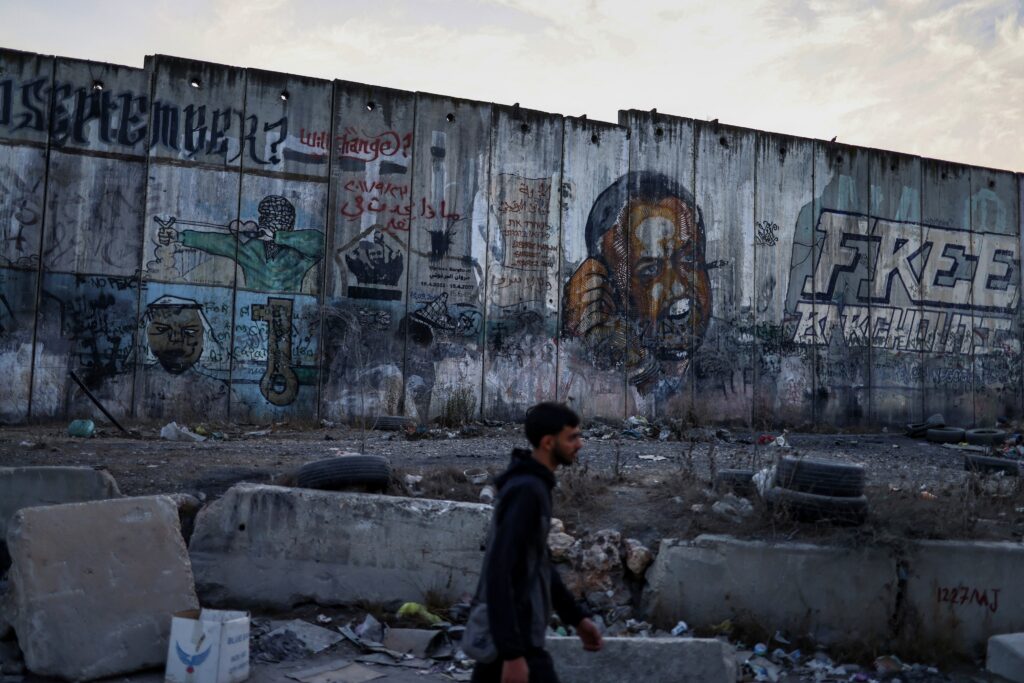
Graffiti of Barghouti’s likeness adorns the walls of the West Bank, from the barrier separating the territory from Israel to those in the village of Kobar, where he was born in 1959. First a student activist and then a political organizer, Barghouti rose to national prominence during the Palestinian uprising known as the first intifada, which began in December 1987.
During the second intifada, which erupted in 2000, Israel accused Barghouti — by then a senior official in Fatah, the Palestinian party dominant in the West Bank — of leading the Al-Aqsa Martyrs Brigades, a collection of Fatah-linked armed groups that carried out attacks on Israelis.
In 2002, he wrote in a Washington Post opinion article that Israel’s occupation was the largest obstacle to establishing the “independent and equal neighbors” of Israel and Palestine. “I reserve the right to protect myself, to resist the Israeli occupation of my country and to fight for my freedom,” he said. “I am not a terrorist, but neither am I a pacifist.”
He was arrested several months later and convicted of murder for alleged involvement in several of the Al-Aqsa Martyrs Brigades’ attacks on civilians. Barghouti said in court he had no connection to the attacks. In a report about the trial, Simon Foreman, a legal expert appointed by the Inter-Parliamentary Union, said that most of his interviewees had believed the verdict was “dictated far more by intense media pressure and political interests than by any rigorous application of procedures.”
Inside prison, Barghouti’s views have stayed relatively consistent, according to his family and supporters. An early clue came in 2006, when he led the drafting of what came to be known as the Palestinian Prisoners Document — signed by detainees of all political factions during escalating tensions between Fatah and Hamas outside prison walls
The document appeared to acknowledge a two-state solution, by referring to the potential establishment of a Palestinian state on territory occupied by Israel in 1967, and endorsed the Palestinians’ right to resist occupation, including through armed struggle against settlers and soldiers, while advocating in parallel for political reforms and a national unity government.
“We really don’t need new documents or frameworks — what we need is to commit to and respect what we’ve already agreed upon,” Barghouti said in an interview from prison 12 years later in 2014, published by The Journal of Palestinian Studies. National unity was a prerequisite for furthering the Palestinian cause, he said.
He said that continuing to hold negotiations with Israel, in the absence of genuine international support to see them through, were of little use, like “a crutch long since devoured by woodworm.” Imprisonment, he said, “has only served to reinforce my belief in the justice of our cause and to strengthen my unwavering conviction regarding our sacred right to Palestine.”
Barghouti was held among the broader prison population throughout much of his detention, dedicating his time to educating himself and others. He read an average of seven or eight books a month, he said in the 2014 interview, and conducted lectures for fellow inmates.
Allegations of abuse
After the Oct. 7 attacks, Barghouti’s treatment in prison worsened, according to his family. “They went to him after Oct. 7 and, in front of other prisoners, the head of Ofer prison asked him to kneel and to put his hands behind his back, which he refused,” said Barghouti’s son Arab in The Post interview. “And that’s where the assault started.” He was kept mostly in solidarity confinement after that, his family said.
Two months ago, international campaigners advocating for his release said that multiple Palestinian prisoners who were freed under the Gaza truce agreement had witnessed Israeli guards violently assaulting Barghouti and that he had been left unconscious. “When he returned to the cell, his clothes were soaked in blood,” said former Palestinian prisoner Ayham Fouad Kammamji, whose testimony was published by the International Campaign to Free Marwan Barghouti.
The U.S. and Middle Eastern governments have previously broached Barghouti’s treatment with the Israeli government. In a statement last year in response to a question about the abuse allegations, the State Department said that Palestinian detainees must be held in “dignified conditions and in accordance with international law.”
Asked about allegations that Barghouti was abused, the Israel Prison Service said in a statement, “All inmates are held according to legal procedures, and their rights including access to medical care, hygiene, and adequate living conditions are upheld by professionally trained staff. We are not aware of the claims mentioned, and to the best of our knowledge, no such incidents have occurred under IPS responsibility.”
Ben Gvir has rejected claims of prisoner abuse, which is widespread, saying that Barghouti’s prison guards have his full support.
“I think you would have to have a different Israeli leadership for something like Barghouti’s release to become viable,” said Elgindy, “a leadership that understands that a unitary Palestinian policy is actually an asset and not threat.”
Karen DeYoung in Washington and Lior Soroka in Tel Aviv contributed to this report.
The post As Palestinians yearn for a leader, top candidate remains behind bars appeared first on Washington Post.