Start the music. Players walk clockwise in a circle. When the music stops, everyone sits in a chair. Big Tech is setting in motion its plans for the next gen of lead designers, engineers, AI chiefs, and even CEOs.
In Cupertino, Apple execs with familiar faces are retiring or reducing responsibilities. Who’s in and who’s out? Well, chief operating officer Jeff Williams retired in November, and the speculation is that CEO Tim Cook could follow in the near term. Lisa Jackson, who has led Apple’s sustainability efforts since 2013, is now set to retire in January too.
There’s also the squad of Apple staffers who have been lured away to work with OpenAI, notably Apple’s former chief design officer Jony Ive after his independent stint at LoveFrom. In 2024, Molly Anderson was named industrial design leader, heading up a team of mostly fresh faces. Others have gone to Meta, such as Apple’s VP of human interface design, Alan Dye, who just this week was poached to head up a new Reality Labs design studio. At Apple, he’s been replaced by long-time UI designer Stephen Lemay. Phew.
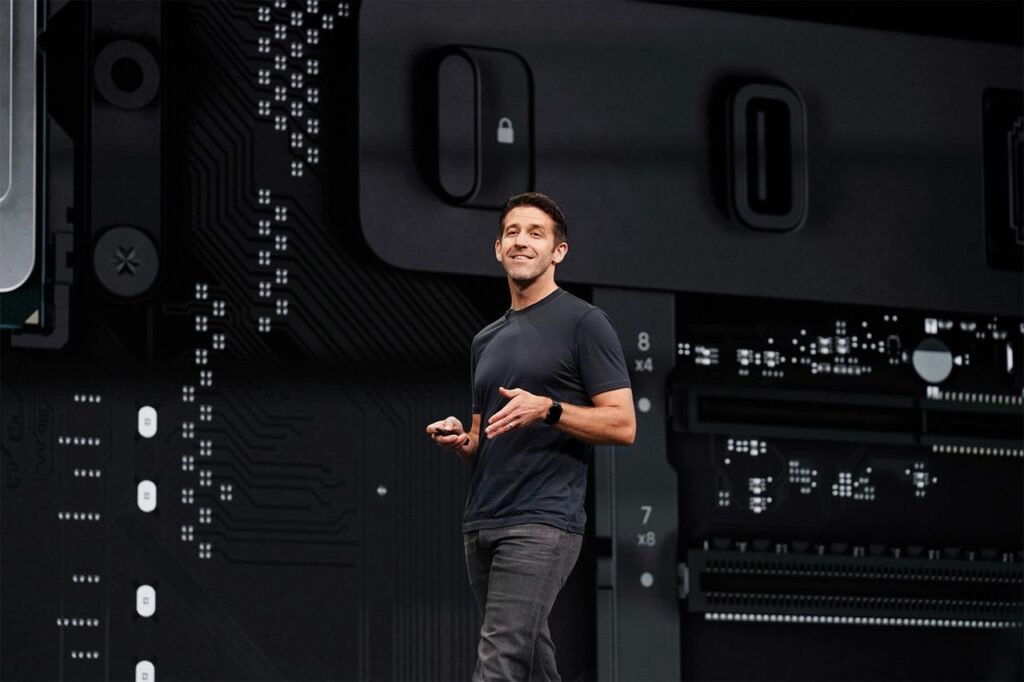
In this swirl of shifting talent, John Ternus, who has worked for Apple since 2001, and served as SVP of hardware engineering for the last four years, reporting directly to Tim Cook, is emerging as the frontrunner to succeed Cook as Apple CEO, reportedly as soon as next year. WIRED asked Apple for comment but didn’t hear back before publication.
Alongside a steady drip of “leaks” on succession planning and Ternus’ position at the front of the pack, since 2023, Ternus has been given more prominence at product launch events. He announced the iPhone Air onstage this past September, and has appeared alongside other senior Apple leaders in press interviews and in-store Apple events.
“I think they’re testing to see what sentiment is like. Apple likes to control the narrative. So these ‘leaks,’ they’re not happening unintentionally,” suggests Anshel Sag, principal analyst at Moor Insights & Strategy. “Apple’s lost a lot of people. I think it might actually be a net positive because it will create a fresh crop of people that have more power now than they did before.”
New Names to Know
It’s always tricky to pick up an individual’s contributions at Apple, beyond the odd detail, such as John Ternus himself reportedly being behind the MacBook’s TouchBar. Bertrand Nepveu worked in the Apple Vision Pro team from 2017 to 2021, after Apple acquired his VR headset startup Vrvana, and now runs Montreal-based VC firm Triptyq Capital. During his three and a half years, mostly working on the Vision Pro’s pass-through capabilities, the team ballooned from 300 to around 1,200. “John Ternus, even though I never worked with him, the feedback I got is that he’s a great product person,” he says, “and I think that’s what is needed for the next phase of Apple, especially with AI and with XR.”
With this future in mind, Nepveu sees the combination of Ternus-as-CEO working well with other personnel moves at Apple, including the news in March that Rockwell was taking over development of Siri from the head of AI, John Giannandrea. In another major future-facing reshuffle, Giannandrea was replaced this week by Amar Subramanya, who spent 16 years at Google, including work on Gemini and DeepMind, before a six-month stint at Microsoft.
“Mike Rockwell, I worked with him in the Vision Pro group, I think he’s the right person for that because they [XR and AI] work in tandem,” says Nepveu. “He used to joke that Siri was crap. I liked him because he didn’t drink the Kool-Aid. I was happy when I saw that he got promoted. I think in tandem with someone who is more product-focused [Ternus], it’s the way to go for Apple.”
So Apple Intelligence + Apple Vision = what, exactly? While people can create apps via Figma for the iPhone, vibe coding on small budgets, for XR the “technical bar is much higher,” with almost game-developer levels of expertise required—people who understand spatial, 3D, Unity: “The promise of AI is to make that more accessible, more user-friendly.”
Another key name is Fletcher Rothkopf, recently promoted to VP of hardware engineering. According to Mark Gurman’s reporting, Rothkopf is “overseeing much of the hardware engineering for upcoming glasses,” after the team shifted from a lighter “Vision Air” headset, following the surprisingly positive response to Meta’s Ray-Ban glasses and Orion prototype. Non-display Apple smartglasses are now rumoured to be set for a 2026 launch, with a 2027 roll-out before we get glasses with a built-in display.
Rothkopf “worked very closely with ID [the Industrial Design team], so he was the point of contact between ID and the Vision Pro group,” says Nepveu. “He was also responsible for all the psychological parts of the device, like making sure nobody gets sick, and the gaze and pinch [gesture].” Rothkopf, with Mike Rockwell and Metaio’s Peter Meier (who left Apple in 2019), was one of “the three amigos” at the beginning of the Vision Pro project. With Rockwell covering Siri, and Dye gone to Meta, Rothkopf is now one of the key people connecting the threads. The Bloomberg reporting also cites Apple insiders offering a critique of John Ternus’ experience in that he has joined existing projects during his tenure rather than originating them; case in point, on Vision Pro, Rockwell reported to Dan Riccio, who semi-retired back in October 2024.
Shift Change at UI and ID
Within UI design, “with Alan Dye leaving, I think that shows the future is hardware, because you see now Meta is pushing for hardware and Google with their TPU,” Nepveu says, of the high-profile Meta coup. Dye, who joined Apple in 2006 from Kate Spade, was instrumental in building out visionOS and the beautiful but polarizing Liquid Glass iOS. Anshel Sag sees a good fit here: “There’s no cohesion across Meta’s ecosystem, and some of those apps have terrible experiences. Meta needs better UI. I think it would be good for them to have someone like Alan Dye who understands interface design, and for him to have the power to say no to people and to have design principles that are followed.”
Dye’s successor as VP of human interaction design is another name to know, the low-profile Stephen Lemay, a UI designer with Apple since 1999. Lemay has worked across all the major operating systems. He’s named on hundreds of Apple patents and was reportedly nicknamed “Margaret” by Steve Jobs to avoid confusion in meetings.
Apple human interface designer Chan Karunamuni posted, following the announcements, “Steve’s been my manager for my entire 15 year career so far at Apple and I could not be more excited for this new era.” And former Apple designer Ben Hylak posted that Lemay is “by far the best designer I have ever met or worked with in my entire life. literally taught me what design is.” And, later: “he’s the guy you’ve all been praying for.”
Daring Fireball’s John Gruber has canvassed Apple designers on the switch, concluding that Lemay is “well liked personally and deeply respected talent-wise” and more focused on interaction than pure visual aesthetics, as compared to Dye, signaling a change in direction for UI leadership.
Within ID, Molly Anderson, who has served as Apple’s industrial design lead since 2024, appeared at September’s event, narrating the iPhone 17 Pro video and wearing an iPhone Air crossbody in the knitted Issey Miyake Pocket. The Brit has been allowed outside the white box a little since her promotion. She’s given interviews about the Apple Watch, where she discussed her “reverence for watches as beautiful objects” and commissioned young designers at this year’s Design Miami | Paris, noting, “It’s a way for us to acknowledge how we in the design team are inspired by the outside world.”
In 2024, Anderson described the design process for the M4 iPad Pro: “We’ve designed it almost like a spine, radiating out … an incredibly beautiful kind of structural backbone which makes it rigid and also distributes the thermals.” Rather than Ive-continuity, it’s less clear what kind of identity Anderson will bring to emerging categories like smart glasses. While it’s mostly a team for Anderson to shape, and Abidur Chowdhury, who helped to develop the iPhone Air, has also recently left Apple ID, old-hand Richard Howarth, who was one of Jony Ive’s first hires at Apple, remains with Anderson on the ID team.
Time for a Product Guy
One common refrain around Apple’s future is that Tim Cook was the right man to lead the company back in 2011. Since then, he has optimized and added to product series, moved into services, expanded the map and made investors lots of money.
But it’s time for a swing back into innovation and for “a product guy,” like hardware engineering bod John Ternus, to take Apple through the next decade. This latest round of high-profile departures and promotions, particularly in design, engineering, and AI teams, makes getting the right leader near-existential.
Karim Rashid, the industrial designer who has worked with over 500 brands in his 40-plus-year career, including Samsung, Sony, and Audi, presses the point. “Few people have such a high ‘aesthetic intelligence’ that they, down to millimeters, know something’s right or something’s wrong,” he says. “It’s a certain sense of perfection that you want to see in everything, be it form, light, proportion, color, all those combinations. Does he [John Ternus] have that innately in him? Or has he been educated well with that?”
Rashid suggests that long-term in-house staffers “tend to have a myopathy about the brand” so that instead of taking risks (and “that was why Apple became what it was”) they tend to stay safe, repeating the vernacular and the way they produce things: “So you look back … when Tim Cook was in, I think Apple didn’t progress whatsoever in regards to creating or pushing the boundary of delivering really beautiful products. It just stayed sort of stagnant. The minor improvements, one object after another, generally are quite banal.”
Tom Emrich, Remix Reality founder and former senior Horizon OS manager at Meta, says Ternus’ background in engineering, design, and hardware “feels like the right mix to me”: “Ternus has been inside the company through major transitions, including the move to Apple silicon … Understanding long product cycles and what it takes to ship complex hardware at scale will matter as Apple moves deeper into spatial computing and AI-driven devices.”
“Operationally, Apple’s pretty much set,” says Sag. “I even think some investors want there to be a hardware person at the helm. Because fundamentally hardware is how a lot of what Apple does gets achieved.”
There are also practical reasons why Ternus makes sense. Apple likes to promote from within; the company leadership doesn’t tend to bring new people in at the highest level. Ternus is relatively young at age 50, but not too young as to seem inexperienced—he’s been with Apple for almost 25 years, striking a difficult balance.
“He’s also around the same age that Tim was when he became CEO,” Sag says. “At that level there’s so much politics involved, like who’s friends with who? Who meshes well with who? But the general consensus is that it’s a green light for most people.”
The New Hotness
The real unknown in this interaction innovation race is OpenAI. As many as 25 former Apple staffers have jumped ship to work with OpenAI and Jony Ive on AI hardware devices, including Evans Hankey and Tang Tan, OpenAI’s chief hardware officer.
The Information reports that OpenAI is targeting a late-2026/2027 launch date and is in talks with suppliers about a range of devices, including a display-less smart speaker, a wearable pin, a digital voice recorder, and smartglasses. Sam Altman and Ive have been vague on which form factors the products will take. At OpenAI’s developer conference in October, Ive said, “I don’t think we have an easy relationship with our technology at the moment.”
OpenAI is “the new hotness,” says Sag, with big hype and big paychecks on offer. This veil of mystery is intentional, in order to reinvigorate people’s sense of curiosity and, in short, “be the new Apple.” One scenario, considering the ‘post-display’ design hints, is an ecosystem of connected wearables, a pin or pendant, say, with smart earbuds and later, a well-designed set of smartglasses.
“OpenAI have said they’re not doing glasses,” says Sag. “But the ecosystem has told me they’re looking [at glasses]. So I think they don’t want to admit that they can’t do a pair of glasses first, or it’s taking longer, or it’s more difficult than they thought.” Nepveu predicts a Humane AI Pin-style gadget “with that Jony Ive magic.” He adds: “Knowing the culture at Apple, I think they’ll release it when it’s perfect or really, really good.”
Visionaries Wanted
On the big-picture next decade of Apple, “I think this streamlined Apple has been more efficient, but when you’re too efficient, you’re less creative,” says Nepveu. “Creativity is messy. Now Apple needs to go back to that.”
This sense of real innovation has been missing elsewhere. “In a lot of corporations, there’s no real ringleader who is the overriding visionary,” says Rashid. “It’s amazing how few of them have somebody specific that has a real emotional philosophy—meaning, how are they connecting with their consumers? But also to take ownership of a brand.”
In its golden age, Apple marshaled masses of creative talent toward a singular goal, and that’s what Rashid believes is needed to repeat the trick: “My argument is, you need a dictator, you need Steve Jobs. Steve was calling all the shots … even picking colors. He was so hands-on because he loved design.”
The question that underlines all this discourse is whether nonfounders can bring the same level of intensity and creativity as—whatever you think of their ethics or politics—the original founders themselves. “Elon Musk is a visionary. Steve Jobs was a visionary. Mark Zuckerberg is a visionary,” says Nepveu. “Will we have one at Apple? We’ll see.”
The post As Key Talent Abandons Apple, Meet the New Generation of Leaders Taking On the Old Guard appeared first on Wired.