In the In Times Past column, David W. Dunlap explores New York Times history through artifacts housed in the Museum at The Times.
Henry Jarvis Raymond (1820-69), the founding editor of The New York Times and a founder of the Republican Party, died two years before the newspaper’s first great exposé: how the Tweed Ring plundered the public treasury during the construction of a new courthouse in Lower Manhattan. It’s safe to say Raymond would have been pleased by this scoop, since he counted himself among the enemies of William M. Tweed. Tweed was the Democratic political boss who all but controlled New York City in the 1860s and early ’70s.
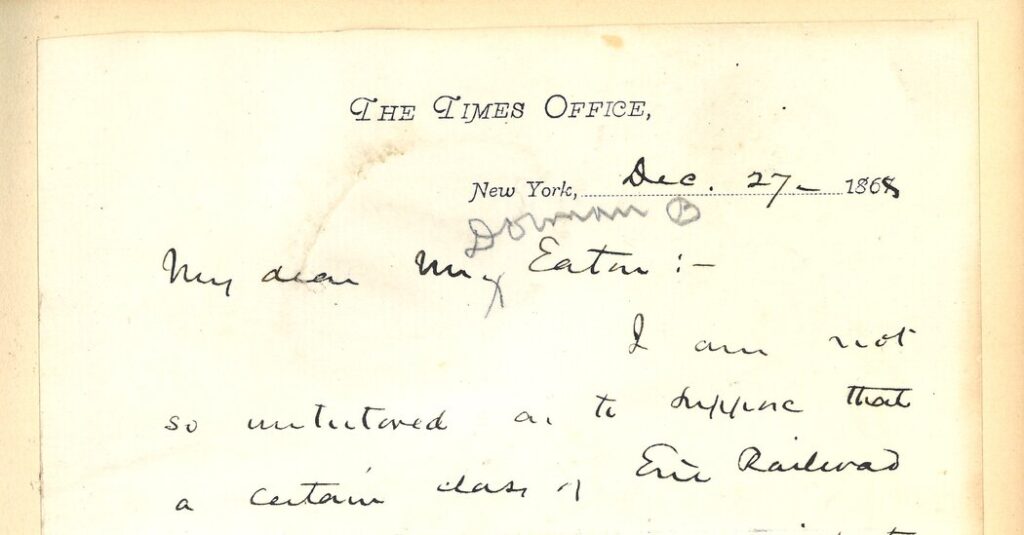
Raymond’s enmity is subtly apparent in a letter he wrote on Dec. 27, 1868, to Dorman B. Eaton. Better known as a proponent of civil service reform, Eaton was then a lawyer for the financier August Belmont Sr. in a court battle over the manipulation of Erie Railway stock. Eaton was pitted against an alliance of Boss Tweed and the robber barons James Fisk Jr. and Jay Gould, who controlled the railroad.
Eaton’s fight attracted Raymond’s appreciative notice. He sent Eaton an excerpt from an essay by the Count de Montalembert, a French politician and historian, praising President Abraham Lincoln — Raymond’s hero — for his honesty, goodness, simplicity, dignity, modesty and magnanimity. Raymond seemed to be drawing a contrast between these admirable qualities and the corruption of Fisk, Gould and Tweed.
“I am not so untutored as to suppose that a certain class of Erie Railroad men would attach any importance to so trifling a memorandum as the one I enclose,” Raymond wrote to Eaton. “But in the first place you do not belong to that class: & in the next I feel under so real & so great an obligation to you for your aid in exposing to just odium a great public wrong that I venture to hope you will allow me to wish you a happy New Year in this form & that you will believe me Yours gratefully H. J. Raymond.”
Raymond’s handwritten letter, on “The Times Office” stationery, is one of very few artifacts in the Museum at The Times from the newspaper’s earliest years. We couldn’t have deciphered it entirely without the help of David Lowenherz, the president of Lion Heart Autographs.
The letter was preserved because Eaton pasted it into his copy of a biography with the unwieldy title: “The Life and Public Services of Abraham Lincoln, 16th President of the United States; Together With His State Papers, Including His Speeches, Addresses, Messages, Letters and Proclamations, and the Closing Scenes Connected With His Life and Death.” The author was Henry J. Raymond.
David W. Dunlap, a retired Times reporter and columnist, is the curator of the Museum at The Times, which houses Times artifacts and historical documents.
The post A Letter of Thanks for Fighting Corruption appeared first on New York Times.