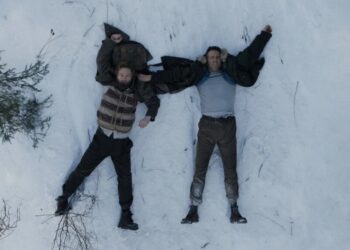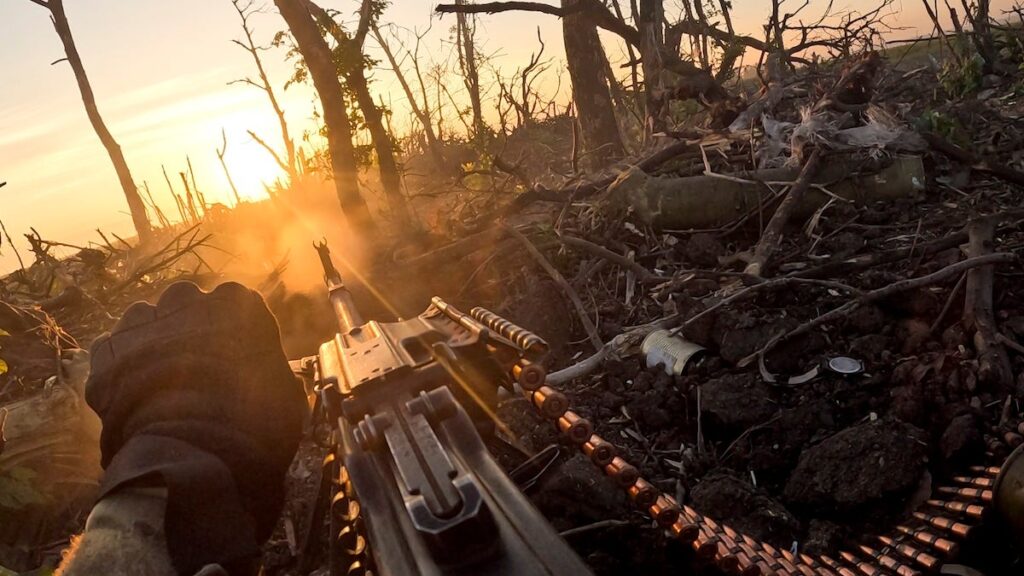
When Ukrainian journalist and filmmaker Mstyslav Chernov won the Academy Award for his documentary “20 Days in Mariupol” in 2024, he was already planning a follow-up movie about the war that continued to rage in his homeland. Whereas “Mariupol” took place inside one city at the beginning of the Russian invasion, “2000 Meters to Andriivka” is focused on a narrow strip of land, barely a mile long, where Ukrainian forces (accompanied by Chernov and his crew) spent a month fighting to regain control of a town that had been reduced to rubble.
Chernov spoke to TheWrap on a hotel rooftop in West Hollywood where, he remembered, he went to celebrate the Oscar victory for “Mariupol.” “I was here on the roof looking at the panorama, and I thought I was at peace for a brief moment,” he said softly, shaking his head and sporting a heavy brace on his left knee. “Then I went back to the war.”
“20 Days in Mariupol” won the Oscar almost two years ago, but at the time you were going back and forth to Ukraine to further document the ongoing war.
After the Oscars, I thought I was at peace for a brief moment. But news from Ukraine kept coming in, and I was already starting to shoot things. This is probably one of the biggest, bitterest parts of being a documentary filmmaker. Most of the time, you’re not seeing the impact of what you do, even if what you do is recognized and watched. The reality of storytelling is that it’s not physical. You cannot stop a bullet with a camera. You cannot stop bleeding with a picture. You can’t stop a war with film. So you keep thinking about that: What is my role with this?
Still, you have to hope that by showing what is happening, you can make some kind of difference.
Yeah, there is hope. In some cases, there are immediate effects. We know that thousands of people got out of Mariupol through the humanitarian corridor, which was opened at least partially because we were able to send pictures out of the city.
But the real battle of documentary journalism starts when the battle is over. When this war is over, the new war will start for memory. That’s where we come in. The truth is a relatively small amount of information in comparison to falsehoods and misinformation. So our only chance is to make sure it survives, to make films and books and other artworks to carry this truth about humanity through time.
But we’re approaching a point where you can’t trust footage you see online, and where people can dismiss reporting they don’t like by labeling it fake news or AI.
Yeah. It’s scary, because it will only take a few months or a couple of years for people to get completely disappointed in visual art in the sense that you will not be able to distinguish truth from generated content. So people will just stop believing in anything. And the scary part is that to start a war or a genocide or the persecution of minorities, whatever crime against humanity we’re talking about, it’s always based on a lie. It starts from a lie. The Ukrainian invasion started from a lie. And we’re now in a world where it hasn’t ever been easier to produce a lie.
That scares me, because we can extrapolate that, from Russia attacking Ukraine to what is happening in the entire world right now. That’s why I think “2000 Meters to Andriivka” is timely. When I was filming, I thought it was going to be a story of soldiers and hopefully this little victory. It was something I could do for these guys because they died fighting for my home. But now I feel that looking at this, we see a horrifying future that is possible for all of us right now – for the United States, for China, for Europe. We see what, God forbid, soldiers all around the world will live through if bigger wars start.
When you finished “Mariupol,” did you know right away that you were going to make another movie about Ukraine?
I was just so sad. I was so sad. After I finished, after we got out (of the city), I was so frustrated. So many people died and we’d only seen 20 days. It went on and on. I went to Bucha to film there, with all the bodies in the streets. Then I went to Kharkiv, which is my hometown, which was bombed heavily. But I really wanted to find a story that could tell about movement in the opposite direction – something where Ukrainians that lost their homes and families and friends were fighting back. Something to show my community not as a victim, but as people who could stand up and fight for their homes.
So with that in my mind, I kept searching. When the counteroffensive of 2023 came about, it was the biggest story in Ukraine, because everything was at stake. And that was my chance. (Producer) Michelle (Mizner) and I learned from making “20 Days” that the closer you zoom in, the more symbolic your story becomes. You want to find a simple story. And this story had such clarity. There was a village at the end of a little forest surrounded by mines, and the soldiers were trying to take back their land.
It also let us break through that uniform and see humans: a student from a rival university, a grandfather who worries about how much he smokes, a warehouse worker who never wanted to be a soldier but is annoyed by this invasion and wants justice.
And yet they are fighting to reclaim a deserted town that has been almost completely destroyed.
Yeah, it’s rubble. But by the time you arrive there, you’ve seen so much. You’ve seen the forest being destroyed but also growing back. When we jumped out of the armored vehicle at the beginning of this forest, it was green. But the entirety of it was destroyed by artillery as Ukrainian soldiers were advancing. And the battle lasted for so long that by the time they got to Andriivka, the beginning of the forest had already started to grow back and become green again.
When I rewatched it, I realized, Oh my God, isn’t that a symbol of hope? So when you get to the town and see there is hardly a place to raise a flag, you know that this is not a fight for the village. It’s a fight for a name, a symbol. For hope and dignity. And my task as a director was to capture that.
When we talked about “Mariupol,” I remember you saying that you couldn’t do anything to tweak or change the sound in any way, because then the film could be accused by Russia of manipulating reality for propaganda purposes. I assume you had the same restrictions on this one.
Yes. Same self-restrictions. Amazing work was done by the postproduction team mixing the sound, because you have a very different quality of sound coming from helmets, coming from professional cameras, coming from phones. Some scenes are built around seven cameras at the same time, seven different perspectives, all with different visual and sound quality. But when you have restrictions, you find your way.
And sometimes, that helps you find creative solutions in another area. In this case, it was Sam Slater’s music. He’s an extraordinary composer, and I went to him and said, “There is an orchestra in the sounds of the battlefield. Could we make music from those sounds?” He took on the role of building the soundscape and the musical themes from things like distorted radio sounds on walkie-talkies or bursts of machine guns inspiring drum sequences. This eerie atmosphere of fear and tension and the proximity of death that you have on the battlefield, we wanted that to be expressed with the music.
They built an instrument that didn’t exist before, with a weird string sound. You hear that throughout the film, and then there’s a harmony that (Slater’s wife, composer) Hildur (Gudnadottir) performs on the cello. She’s an incredible cellist, and her performance was so sensitive that we put it at the end of the film. It’s the only moment in the film where we have harmony, as we see the names of the people who died.
It must be hard to find any sense of harmony when you’re documenting events like these.
When we speak about harmony in the music, it doesn’t mean harmony in the meaning. Harmony in the music brings some sort of resolution, but war doesn’t bring resolution. That’s the thing I’ve been chasing. I’ve been through six wars in the past decade: Ukraine, the Middle East, you name it. And I was not there for thrills, I was not there for adrenaline. I was there to comprehend, What is human nature? And, of course, you never find the answer.
A version of this story first appeared in the Below-the-Line/Documentaries/International issue of TheWrap’s awards magazine. Read more from the issue here.
The post ‘2000 Meters to Andriivka’ Director on the Dangers of Our Time: ‘It Has Never Been Easier to Produce a Lie’ appeared first on TheWrap.