This personal reflection is part of a series called Turning Points, in which writers explore what critical moments from this year might mean for the year ahead. You can read more by visiting the Turning Points series page.
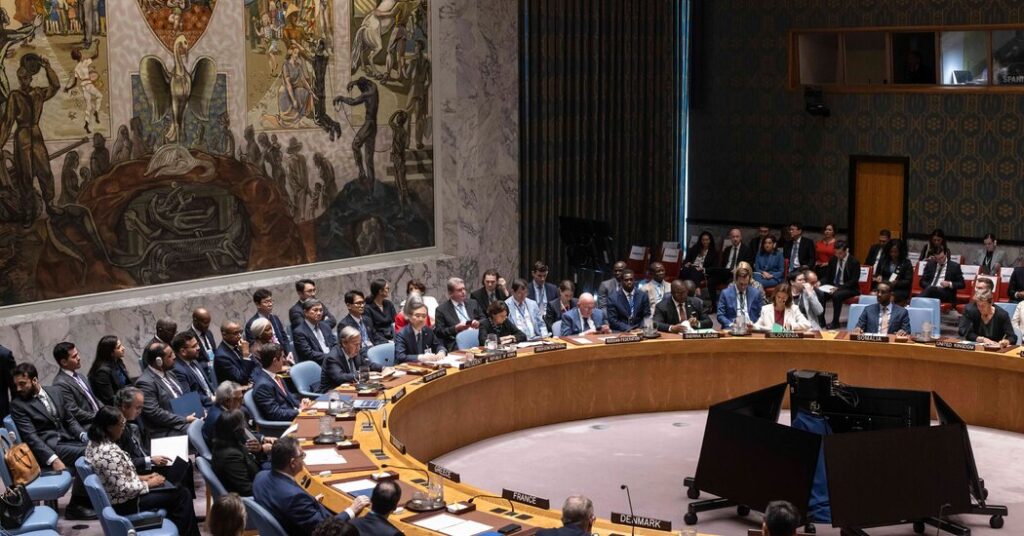
This year marks an extraordinary milestone: 80 years of the United Nations. But this moment is not one for celebration. It is a moment to reflect on the story of this unique organization. At its core, the story of the United Nations is not one of an institution — it is a story of people. It is a story of visionaries who gathered in San Francisco in 1945 and of the thousands of U.N. staff serving in crisis zones, who choose peace over war every day.
Above all, it is a story of people who endure unimaginable suffering in conflicts, who may never have heard of the General Assembly or the Security Council, but who still look to the blue flag of the U.N. for hope. People like those I met at a U.N. refugee camp near Juba, South Sudan.
The camp, which is run by the U.N. refugee agency, was built to house 2,000 people, yet it holds more than 20,000, mainly women and children. These refugees fled across the desert with nothing but the clothes on their backs. Their bodies bore the wounds of violence; their spirits bore deeper scars still. One mother told me she had prayed for death rather than watch her daughter be raped over and over by soldiers. Nevertheless, she said she would not give up hope that someday they will get psychological support in the camp, and her daughter will be able to go to school again.
During my visits to Ukraine, I heard the same call to never give up hope from teenagers I got to know who had been brazenly abducted from their homes and schools by Russian soldiers. Their most important message was not one of anger or revenge, but a simple plea not to give in to Russian aggression. There are so many other children who still have to be brought home, they told me, and the world cannot give up on them.
These are the people the U.N. was built for 80 years ago. These are the people it is so important for the U.N. to continue to deliver for, while not allowing the cynics to use the conflicts we have failed to solve to argue that the U.N. is outdated, irrelevant or a waste of money.
But if we stop doing the right thing because we have not yet succeeded, evil will prevail. If mothers in Sudan and teenagers in Ukraine can endure the darkest hours of their lives and push forward, so can we.
This is why at the start of the General Debate of the 80th session of the U.N. General Assembly in September, I called for us to live up to the story of this institution, which is one of true leadership. It is not a story of easy victories, but rather a story of falling and pulling ourselves and each other back up and trying harder. It is a story of the courage and resolve of the world leaders who met in San Francisco in 1945 who, even while being labeled naïve by some, believed they could build a better future from the ashes of two world wars.
It is true that our world is in pain. There are wars in Ukraine and Sudan. Gaza is still in ruins. Afghan women and girls are denied the most basic human rights by the Taliban. Seas are rising because of climate change. There is inequality, extreme poverty and hunger. All of this is happening while the U.N. is under pressure, politically and financially. It stands at a crossroads and needs deep structural reform. But just imagine how much more pain there would be without the U.N.
The value of the United Nations lies in its ability to mobilize action where no single state can act alone. Take the threat caused by nuclear weapons, for example. Without the Treaty on the Non-Proliferation of Nuclear Weapons, every nation would be free to build and deploy nuclear arms. Similarly, in the case of the Covid-19 pandemic, no state could have faced this shared challenge alone. The virus did not stop at borders. We were only able to fight it globally with the support of the World Health Organization. Likewise, the climate crisis does not care if officials deny it: Carbon emissions anywhere affect people everywhere. Even the richest cities cannot shield themselves from wildfires and floods. How comfortable would parents be with their children using the internet if artificial intelligence were left uncontrolled as the lines between what is real and what is fake start to blur? And how safe would you feel flying if there was no International Civil Aviation Organization — a part of the U.N. that is responsible for setting safety regulations for 5 billion airline passengers each year?
In this globalized, digitalized world, we work together or we suffer alone. Therefore, the theme I chose for this session of the General Assembly is “Better Together: 80 years and more for peace, development and human rights.”
Will it be easy to deliver on the U.N.’s mission to promote peace, development and human rights for another 80 years? Definitely not. Yet the U.N. was not built for easy tasks; it was built in hard times to confront the hardest issues.
To write the next chapter of our common story means having the courage to speak up when the United Nations Charter, international humanitarian law or human rights are being violated, and to hold aggressors accountable. It also means making the U.N. stronger, more agile, cost-effective and fit for the future. It means less duplication and more efficiency within our agencies, having fewer procedures for their own sake and more delivery on substance.
Success requires compromise, compassion and collective consideration of the needs of the many. But above all, it requires commitment from each and every one of us — the kind of commitment shown 80 years ago by the U.N.’s founders in San Francisco, and today by the teenagers in Ukraine, the mothers in Sudan and the millions caught in forgotten crises. We must commit to simply doing the right thing even in the darkest hours.
Annalena Baerbock is the president of the 80th session of the United Nations General Assembly and the former federal minister for foreign affairs of Germany.
The post Writing the Next Chapter of the U.N. appeared first on New York Times.