ACROSS THE COUNTRY
Welcome to Donkey Country, U.S.A.
There’s a place outside Los Angeles where donkeys roam free, stumbling into backyard weddings. The creatures were the cause of headaches, until they became a cause of their own.
WHY WE’RE HERE
We’re exploring how America defines itself one place at a time. A semirural community in Southern California called Reche Canyon may very well be one of the most donkey places in the country.
Dec. 6, 2025
In Southern California’s Reche Canyon, jackasses cause a lot of problems.
They turn carefully manicured gardens into herbal mush. They leave dung trails in driveways. And neighbors yell at neighbors for feeding them.
Still, when the time came to contemplate life without the donkeys, it became clear that the burros were, for many residents, a nuisance — but their nuisance.
Last year, officials in San Bernardino County thought they were doing people a favor by bringing in a donkey-rescue group to relocate the wild burros to Texas. Instead, the move was met with an uproar. Residents started a campaign to keep them around and made “We ♡ Our Donkeys” bumper stickers. Tense standoffs ensued between locals and the donkey-rescue crew working on rounding up the animals.
Then came the arrows.
A mysterious spate of attacks on burros has left neighbors and officials on high alert. Someone keeps shooting arrows into the donkeys, wounding at least three in the past several months. Investigators with the Riverside County Department of Animal Services and the sheriff’s office are on the case, but have yet to make any arrests.
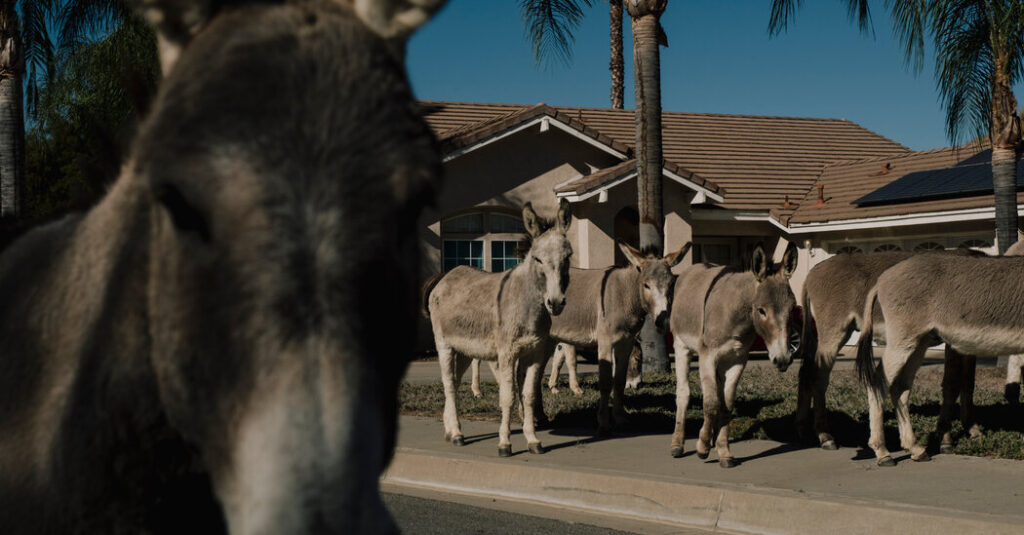
The donkey — the poor man’s horse and an international symbol of the lowly and the stubborn — may not find much respect in the popular imagination. But in Reche Canyon, the creature is everywhere. It may very well be one of the most donkey places in America.
There are yellow-and-black donkey-crossing signs that dot the only main road running through the canyon community, which straddles the boundary between San Bernardino and Riverside Counties. Pictures of the animals — the smoky coats, large protruding ears, cross-striped backs — hang inside homes. Burro statuettes guard front doors. Many of the donkeys even get names. Residents set out water troughs on their sprawling properties to quench the animals’ thirst.
And the donkeys have crashed at least one backyard wedding. Ross and Amanda Warner, the groom and the bride, didn’t mind. They now keep a burro-crossing sign on their four-and-a-half-acre property.
“If the donkeys were gone out of this canyon, this canyon just wouldn’t be the same,” Mr. Warner said.
No one knows exactly how big the donkey population is in the area, but one estimate put the number somewhere around 1,000.
One afternoon in May, traffic ground to a halt on a two-lane road in Reche Canyon as cars backed up by the dozen near a bend. A herd of burros that had been nowhere to be seen minutes earlier suddenly appeared by the road. Slowly but surely, the animals did exactly what the traffic signs along the road had warned they would do: They crossed. Motorists were patient. No one honked.
Reche Canyon is a largely semirural neighborhood 60 miles east of downtown Los Angeles in the region known as the Inland Empire.
Ranches are ringed by newer suburban neighborhoods. It’s where the city feel ends and the country feel begins, the kind of place where many people keep chickens, ride dirt bikes and shoot guns. Some residents own horses and go riding in the hills overlooking the canyon. Motorists fuel up at one of two pumps at a single gas station called the Hitchin Post.
The main drag was once a tranquil, dusty back road snaking through hilly terrain and farms. But as new homes have etched its hillsides and surrounding areas in recent decades, Reche Canyon has experienced an increase in traffic. Canyon life is changing, and becoming less rural and more urban. The donkeys, which have roamed these streets and properties for decades, are on the front lines of those changes. Cars are colliding with them, and troublemakers like the arrow shooter, or shooters, are picking on them, and many residents say they want to protect them.
Residents were first stirred to action late last year after San Bernardino County contracted with the Texas nonprofit group Peaceful Valley Donkey Rescue. Officials said the move was intended to reduce both the population of donkeys and the number of vehicle-donkey collisions. The county worked with the nonprofit to catch donkeys and relocate them to the organization’s sanctuary in Texas.
Many in Reche Canyon wanted to keep the burros closer to home and called for the county to instead work with a local group. County officials defended their decision, saying they had chosen the Texas group because of its resources. Residents circulated online petitions and crowded county board meetings. They succeeded in pressuring the county to cancel its contract with Peaceful Valley Donkey Rescue.
The Texas group relocated 256 burros before the contract was canceled. “If they had allowed us stay for a while, we would have got the numbers under control,” said the group’s executive director, Mark Meyers.
Mandy Miller, who has lived in Reche Canyon for 17 years, said the relocation episode had helped residents “bond in a way you wouldn’t expect.” They’re more donkey-aware now. They trade tips on how to live with the often-intrusive animals, she said. Shake a can of dry beans to shoo a herd away, for example (it mimics the threatening sound of a snake’s rattle). Still, it’s messy work having burros as neighbors.
“I have one neighbor, they’re very immaculate, and they don’t like the donkey poop in front of their driveway or close to their horse corrals,” Ms. Miller said. “So I’ll just come scoop it up and throw it in my plants and call it a day.”
There is no official account of how the wild burros, a nonnative species that originated in Africa, came to inhabit Reche Canyon. Locals tell the story of how the animals were introduced by prospectors during the California gold rush in the 1800s.
“There’s been this kind of mystery element and this thought that they have kind of always been there,” said Ian Wright, the curator of natural history at the Museum of Riverside.
There’s one rule to life in the canyon that some follow more closely than others: Do not feed the burros.
Motorists often pull near a herd with treats in hand. Because of that, many donkeys have learned to hang out near roadways, and that can have a devastating effect, said Lt. James Huffman with the Riverside County Department of Animal Services. Since January 2024, his office has responded to 72 calls for dead burros, most of them struck by vehicles.
“I know it’s fun,” Lt. Huffman said. “I know the kids like to feed them carrots and that kind of thing, but the ultimate outcome for the animals is tragic.”
A state law makes it illegal to feed nongame mammals such as wild burros.
Pamela Lamberto, who lives in a newer neighborhood in Reche Canyon, puts out water and feeds the burros carrots and apples when they show up to graze on her lawn. Doing so has led to a feud with a neighbor, and officials have warned her of a potential fine.
“When they’re walking up our canyon and coming to our home, I’m not going to not feed them,” Ms. Lamberto said. “Like, give me a fine. I’m going to feed them. They’re hungry.”
The donkeys tend to get into all sorts of trouble. Lieutenant Huffman’s animal-services office got a call for a burro that had fallen into a ditch at a construction site. Another time, a burro sneaked onto someone’s property and stuck its head in a horse-feed bucket. Lieutenant Huffman then spent the better part of a week tracking down the burro as it meandered around with a bucket on its head.
The latest threat to the donkeys is far more sinister. Officials are still trying to figure out who is behind the arrow attacks.
“If somebody was out in the back of those hills somewhere with something as quiet as a compound bow, it’s likely there may not be witnesses,” he said.
Wayward and injured burros find refuge nearby at the aptly named DonkeyLand.
DonkeyLand is the local sanctuary that many residents had wanted San Bernardino County to work with instead of the Texas group, and it now has the donkey castration and rescue contract. Roughly 500 rescued donkeys live on the sanctuary’s sprawling property in the hills near Reche Canyon. The donkeys are recovering from injuries from car collisions, attacks by other animals and, in some cases, animal cruelty.
“We’re here for them because nobody else was,” said Chad Cheatham, whose wife, Amber Le Vonne Cheatham, started DonkeyLand in 2011 after moving to the area.
The couple works with local animal-control officials to field and respond to calls reporting burros in distress. If necessary, the animals are taken to a nearby equine hospital, where they undergo treatment before being sent to recover at DonkeyLand.
One donkey that was shot with an arrow recently made a full recovery. She’s a jenny, which means a female donkey (male donkeys are called a jack). She befriended other recuperating donkeys and has shown normal donkey behavior, such as rolling around and taking dirt baths, as Mr. Cheatham calls them.
A donor helped cover the donkey’s medical expenses. The donor gave the burro a name. Now she’s known as Cupid.
Orlando Mayorquín is a Times reporter covering California. He is based in Los Angeles.
The post Welcome to Donkey Country, U.S.A. appeared first on New York Times.