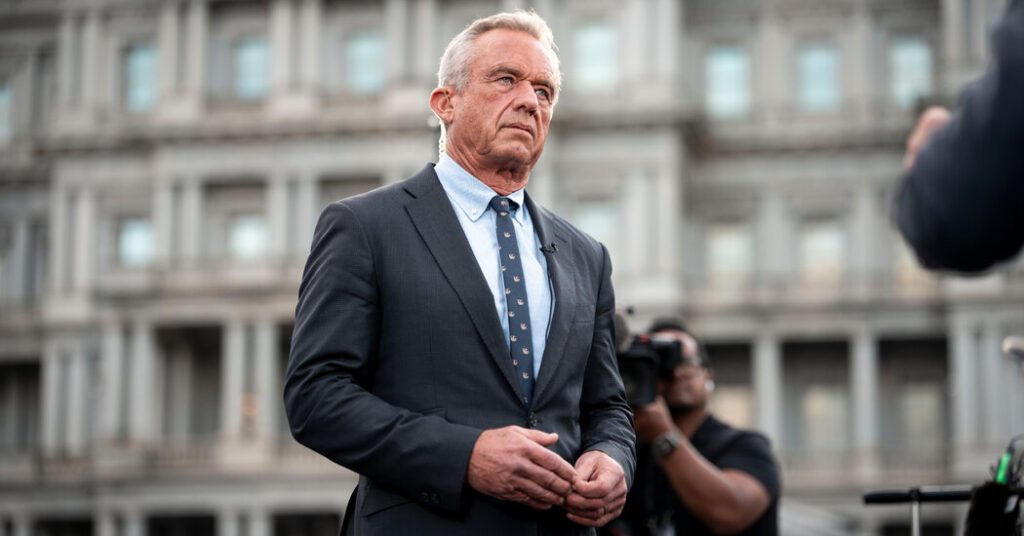
It has been six months since Health Secretary Robert F. Kennedy Jr. fired all 17 members of an influential panel of vaccine advisers as part of his mission to overhaul American vaccine policy. On Friday, his handpicked replacements delivered for him, voting to end a decades-old recommendation that all newborns be vaccinated against hepatitis B.
The implications are far-reaching: Hepatitis B can be passed from mother to child and leads to chronic liver disease in most infected children. The acting director of the Centers for Disease Control and Prevention, Jim O’Neill, must now decide whether to accept the panel’s recommendation that pregnant women who test negative for the virus should consult with their health care provider and “decide when or if their child will” be vaccinated against it.
But the vote, on the second day of a two-day meeting that descended into sniping and personal insults, was about more than a single disease. It was the first step toward a re-examination of other vaccines given to American children.
The committee, which has formed a working group to look at the entire childhood vaccine schedule, began that discussion on Friday with a presentation by Aaron Siri, a lawyer who is close to Mr. Kennedy and has pushed for the government to revoke its approval of the stand-alone polio vaccine.
As my colleague Apoorva Mandavilli reported, the meeting dealt a blow to the C.D.C.’s standing as a public health authority.
“Today is a defining moment for our country,” said Dr. Michael Osterholm, who directs the Center for Infectious Disease Research and Policy at the University of Minnesota. “We can no longer trust federal health authorities when it comes to vaccines.”
Many public health experts — including some on the advisory panel who voted against the recommendation and doctors from various medical societies who serve as liaisons to the group — say that delaying vaccination would put children at risk.
Having women consult with health providers sounds easy in theory. In practice, the experts said not all women get tested, and the best way to keep children healthy is to vaccinate them at birth, when they are in the hospital and have access to a doctor who can administer the shot.
Dr. Amy B. Middleman, a pediatrics professor at Case Western Reserve University who has worked with the panel for more than two decades as a liaison, told the committee that Friday’s vote was the first she could recall that “actually puts children in this country at higher risk rather than lower risk of disease and death.”
“Any policy that weakens the recommendation and allows children to potentially fall through the cracks of an imperfect medical system will harm children,” Dr. Middleman added.
Kennedy would counter that he is empowering parents by allowing them to make informed choices. A scion of the Democratic Party who broke with his family to serve President Trump, he took over the Department of Health and Human Services in February, having reassured skeptical senators that he would do nothing that “makes it difficult or discourages people from taking vaccines.”
But as my colleague Christina Jewett and I reported this week, the health secretary has methodically laid the groundwork for this moment, following a blueprint he laid out in books, speeches and podcast appearances during his 20-year crusade against vaccines. We examined how he has walled himself off from government scientists and installed old allies in government positions in pursuit of his vaccine agenda.
Some of those allies played key roles at the meeting of the vaccine panel. Mark Blaxill, a Harvard-educated businessman and advocate for parents of children with autism, presented data on the safety of the hepatitis B vaccine. He cited studies that included papers published by David Geier, an outspoken vaccine critic who was fined in Maryland in 2012 for practicing medicine without a license while working with his father to offer alternative therapies to autistic children.
Both men now work in Kennedy’s health department. Blaxill is at the C.D.C. and Geier is a “senior data analyst” in Kennedy’s office. In an interview, Kennedy said it should be no surprise that he has hired people whom he trusts, including parents like Blaxill, who believe their children have been injured by vaccines.
“I don’t want to perpetuate a system that everybody knows is broken,” Kennedy said, adding: “I need people in there who are highly motivated to challenge the inertia, challenge the orthodoxies, because the biggest threat to the system is inertia, because it will just continue this terrible sick-care system where everyone is sicker. You need to disrupt it.”
The stakes for American children are high. Vaccines have saved millions of lives; in 1999, the C.D.C. ranked vaccines at the top of its list of 10 great public health achievements of the 20th century, just above motor vehicle safety. Public health experts have long argued that, if vaccination rates dip low enough, infectious diseases will come roaring back.
Some of them already have. Two children and one adult in the United States died of measles this year in an outbreak that started in Texas, the first deaths from the disease on American soil in a decade. The virus is continuing to spread. In Chicago, cases of whooping cough, another potentially fatal and vaccine-preventable disease, are on the rise. In Kentucky, three unvaccinated infants have died of whooping cough within the past 12 months, according to state officials, who said the spike is the worst since 2012.
The recommendation that newborns be vaccinated against hepatitis B has been in effect since 1991. Since then, cases among infants and children have plummeted by 99 percent, according to an analysis by the Vaccine Integrity Project, a nonprofit founded by Osterholm at the University of Minnesota. The analysis, which included a review of the medical literature, found no benefit to delaying vaccination.
The vote to end the recommendation was 8 to 3. Dr. Cody Meissner, a professor of pediatrics at Dartmouth College and one of the three dissenting members, sounded despondent as he warned his colleagues that they were making a mistake.
“This disease,” he declared, “has become a victim of the vaccine. That is, we’re seeing disease rates go down because of the effectiveness of the vaccine. But that doesn’t mean that the virus has gone away.”
QUOTE OF THE DAY
“We want Europe to remain European.”
That declaration came from the Trump administration, in a document containing what my colleagues described as a “grim assessment of Europe’s future.”
Released as a part of an annual update to the United States’ national security strategy around the world, the document said Europe faced the “stark prospect of civilizational erasure,” adding that the U.S. should be “cultivating resistance” across Europe by supporting political parties that oppose migration and promote nationalism.
The document offered another sign of how Trump and his allies hope to shift not just America, but the world, to the right. And it carried some echoes of the Great Replacement Theory, the conspiracy theory embraced by some top Trump aides that claims that white people are deliberately being replaced by nonwhite immigrants.
NUMBER OF THE DAY
41 percent
That’s Trump’s approval rating as of Friday, according to The New York Times’s polling average, reflecting a small but notable downward shift in recent weeks as voters sour on his handling of the economy.
Much of the drop in support for Trump’s job performance has come among voters who describe themselves as political independents. The president has also lost support among men — particularly white, college-educated men.
ONE LAST THING
Trump wins a peace prize (no, not the Nobel)
President Trump was passed over in October for the Nobel Peace Prize, an award he had long coveted. Soon after, his friend Gianni Infantino, who leads soccer’s global governing body, FIFA, found a solution that would benefit them both.
Weeks before today’s draw for the 2026 World Cup — of which the United States is a co-host — Infantino hastily established the first-ever FIFA Peace Prize. Its recipient would be announced at the draw, to be held at Trump’s redesigned Kennedy Center in Washington.
And so today FIFA announced, to little surprise, that Trump had won the new prize. The president called it “one of the great honors of my life.”
My colleagues Tariq Panja and Luke Broadwater explain how FIFA’s creation of a peace prize is less about sports, and more about Infantino’s desire to ingratiate himself with Trump.
Taylor Robinson and Ama Sarpomaa contributed reporting.
Sheryl Gay Stolberg covers health policy for The Times from Washington. A former congressional and White House correspondent, she focuses on the intersection of health policy and politics.
The post Under Kennedy, U.S. Vaccine Policy Arrives at a ‘Defining Moment’ appeared first on New York Times.