ATLANTA — President Donald Trump on Friday ordered federal health officials to review the childhood immunization schedule and consider recommending fewer shots to align with other developed countries.
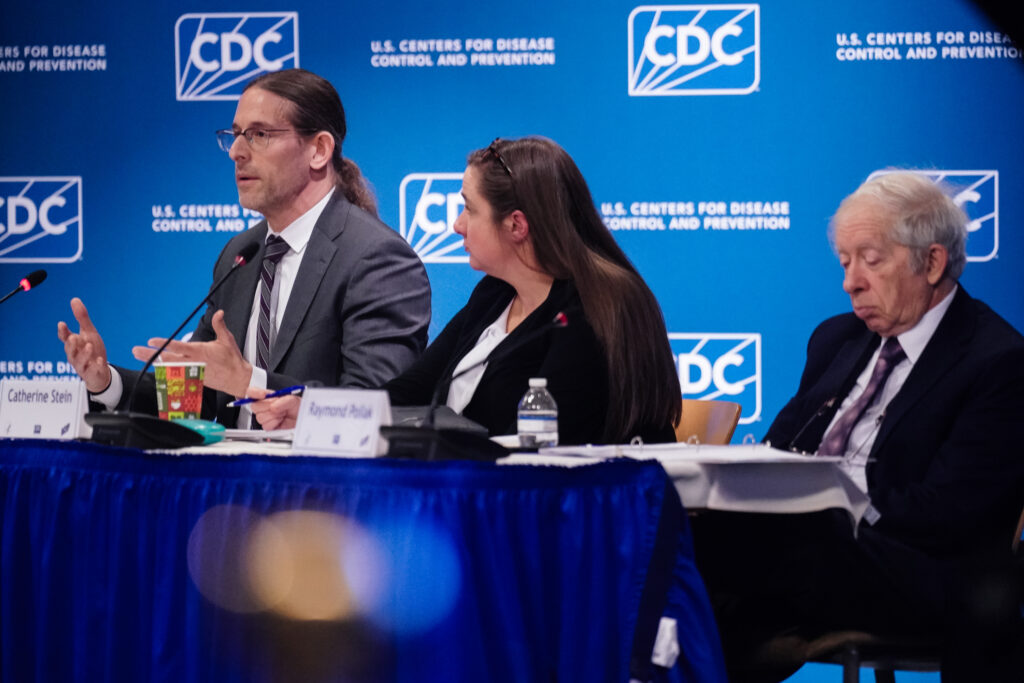
His directive came hours after an influential vaccine advisory panel voted to lift a long-standing recommendation that all newborns receive a vaccine for hepatitis B, marking the most significant change to the childhood immunization schedule under Health Secretary Robert F. Kennedy Jr. The advisers frequently invoked countries that have a more targeted recommendation and later heard a presentation from an FDA official touting the Danish vaccine schedule that calls for fewer shots than American children receive.
Critics of U.S. vaccine policy often note that European countries recommend fewer shots for children, but public health experts counter that those countries are smaller and have better health care systems to test for and treat disease. Medical associations have argued that the U.S. schedule has been thoroughly studied and have credited it for controlling once-rampant pathogens.
Trump’s memorandum described the U.S. as an “outlier” for recommending vaccinating children against 18 diseases and questioned the practice of giving children annual flu shots. It said changes to the schedule should preserve access to vaccines now available to Americans.
In a Friday evening Truth Social post, Trump said the U.S. recommends “far more” shots to children than necessary, echoing his past rhetoric that alarmed public health experts.
“In fact, it is ridiculous!,” he wrote. “Many parents and scientists have been questioning the efficacy of this ‘schedule,’ as have I!”
Asked for comment on Trump’s announcement, the American Academy of Pediatrics pointed to a statement this week from Jose Romero, a pediatrician on its infectious diseases committee.
“Children in the United States are at risk of different diseases than children in other countries,” Romero said. “We also have a completely different health system. The bottom line is vaccine recommendations in the United States are designed to help children resist serious illnesses so they can stay healthy, and our communities can stay healthy.”
Earlier Friday, the Advisory Committee on Immunization Practices approved the revisions to the hepatitis B vaccine guidance despite fierce objections from medical groups that said the recommendation had proved a successful public health strategy, nearly eradicating the dangerous virus among U.S. children.
The committee voted 8-3 to eliminate a recommendation, dating to 1991, for every child to receive a first dose of a hepatitis B vaccine shortly after birth. The panel said the newborn shot is no longer necessary for babies born to mothers who test negative for the virus. They suggested parents of those children delay the first dose for at least two months and consult with their doctors about whether or when to begin administering the three-dose series.
Supporters of the change said the universal recommendation regardless of risk was overly broad and undermined informed choice. Retsef Levi, an ACIP panelist who voted to change the language, said he believes the intention is to push parents to consider whether they want to give another vaccine to their child.
“It’s actually suggesting a fundamental change in their approach to this vaccine and maybe more broadly,” said Levi, a professor of operations management at MIT.
A slew of Democratic governors condemned the revision of the hepatitis B recommendation, and several of their state health departments reaffirmed the guidance for every newborn to get vaccinated, including in New York, Connecticut and Maryland.
The American Academy of Pediatrics continues to recommend routine hepatitis B vaccination for all newborns.
The recommendation from the group of outside government advisers goes to the acting director of the Centers for Disease Control and Prevention for final approval.
Medical experts have argued that it’s important to vaccinate all newborns for hepatitis B, even if their mothers test negative, because babies are at risk of infection if their mothers receive a false negative or become infected after testing. Although the virus primarily spreads among adults through bodily fluid, young infants can also contract the virus through contact with infected people in their household. Some of the dissenting panel members pushed back on the change — psychiatrist Joseph Hibbeln called the revised guidance on hepatitis B “unconscionable,” while pediatrician Cody Meissner said the move was rooted in “baseless skepticism.”
“We will see hepatitis B infections come back,” said Meissner, a professor of pediatrics at the Geisel School of Medicine at Dartmouth. “The vaccine is so effective, it does not make sense in my mind to change the immunization schedule.”
Under the revised recommendations, parents would still be able to vaccinate their newborns for hepatitis B if they want to, and insurance would still pay for it. Panelists who voted for the change said it would not undermine access to the vaccines because it calls for an “individual decision-making” approach that lets parents decide in consultation with doctors.
But Natasha Bagdasarian, chief medical executive for Michigan who was representing the Association of State and Territorial Health Officials, said that approach would cause confusion for doctors and create practical barriers for patients.
Many health care providers may interpret the decision as “the vaccine is controversial” and also consider that they may be “exposed to additional liability,” she said. “It muddies the waters, creates a false sense of scientific uncertainty and places unnecessary burden on clinicians and families.”
The vote came one day after the committee heard presentations on the issue Thursday but delayed a vote to review proposed language.
Kennedy has long criticized childhood vaccines, including for hepatitis B, and appointed fellow critics to the vaccine committee. On Thursday, prominent vaccine critics recently hired by the CDC questioned the safety and necessity of the vaccine series for infants, despite broad consensus among medical experts that the vaccine is safe and effective.
During the Friday discussion, Kirk Milhoan, a pediatric cardiologist who was recently named as the panel’s new chair, was overheard telling another panel member that he wanted to talk to “some of the higher-ups” about the panel’s work.
“You know, I feel like, you know, it’s, sort of like we feel like a little bit like puppets on a string as opposed to really being an independent advisory panel,” according to a transcript of the exchange captured by videoconferencing software and obtained by The Washington Post.
Asked about those remarks, Milhoan wrote in a text message, “There are pressures from many organizations: federal, industry, medical organizations that are trying to influence by ad hominem attacks, when we are trying to look at and ask for data.”
He said he was not referring to the Trump administration and has not faced any pressure from Kennedy.
The panel on Friday also voted 6-4 to recommend parents wanting their children to get second and third doses of the hepatitis B vaccine to consult with doctors about getting a blood test — paid for by insurance — to show if those doses are needed. One member abstained.
Proponents said they wanted to minimize the number of doses a baby might receive and empower parents because they said there is not enough evidence showing additional doses are effective.
CDC data has shown that infants achieve full protection after three doses, and dissenting panel members noted there was no evidence that the multiple shots are harmful to children.
The rollback of the hepatitis B shot recommendation could portend broader changes to come, as outlined by Trump.
On Friday, the panel also launched a sweeping reexamination of the nation’s childhood immunization schedule that included a presentation by a prominent lawyer for anti-vaccine causes.
In the past, the committee has often invited outside speakers with differing opinions. But Friday’s speakers have promoted skepticism about routine childhood shots.
Some health experts and representatives of medical organizations said the topics sow confusion while offering a government-sponsored forum to theories long rejected by mainstream science. They warn that revisiting the schedule could undermine hard-won trust in vaccines as the United States experiences regional outbreaks of preventable diseases such as measles and whooping cough.
Aaron Siri, a Kennedy ally and lawyer for the anti-vaccine movement, delivered a presentation for more than 90 minutes.
Siri said clinical trials for vaccines have not been properly performed, that safety surveillance after vaccines are licensed is lacking and that the efficacy of vaccines in reducing deaths and spread of disease has been overstated.
Siri and Kennedy-aligned activists argue that the cumulative number of shots places an undue burden on child immune systems. Scientists counter that the schedule is designed to protect infants and young children at moments when they are most vulnerable, and that the immune system can safely handle far more antigens than vaccines contain.
Siri petitioned the government in 2022 on behalf of the anti-vaccine group Informed Consent Action Network, which is run by Kennedy’s former communications director, to reconsider its approval of Sanofi’s stand-alone polio vaccine. Siri argued that the government had relied on inadequate data, a claim regulators rejected.
His scheduled appearance rankled Sen. Bill Cassidy (R-Louisiana), a physician who has treated patients with severe hepatitis B infections. Cassidy, chair of the Senate’s Health Committee, voted to confirm Kennedy despite concerns about his vaccine stance. In an X post Thursday, Cassidy said that Siri “makes his living suing vaccine manufacturers. He is presenting as if an expert on childhood vaccines. The ACIP is totally discredited.”
Cassidy on Friday also urged Jim O’Neill, the acting CDC director, to reject the proposed change to the hepatitis B vaccine. “Ending the recommendation for newborns makes it more likely the number of cases will begin to increase again,” Cassidy, a liver specialist who has treated patients with hepatitis B complications, wrote on X. “This makes America sicker.”
Panel member Evelyn Griffin, a gynecologist and critic of coronavirus vaccines, gave a brief presentation on aluminum adjuvants, ingredients added to vaccines to help the body produce an immune response strong enough to protect against disease. Aluminum salts, such as aluminum hydroxide or aluminum phosphate, are a key component in more than a dozen routinely recommended vaccines.
Aluminum has become a focal point for anti-vaccine groups that claim cumulative exposure may harm neurological development. Vaccine researchers note that aluminum is present naturally in breast milk, food and water at far higher levels than in vaccines and is rapidly cleared from the body.
Lauren Weber contributed to this report.
correctionA previous version of this article incorrectly said Sen. Bill Cassidy (R-Louisiana) is a pediatrician.
The post Trump orders review of childhood vaccine schedule, calls U.S. an ‘outlier’ appeared first on Washington Post.