The suspected drug traffickers, the lone survivors of a U.S. airstrike, were sprawled on a table-sized piece of floating wreckage in the Caribbean for more than 40 minutes. They were unarmed, incommunicado, and adrift as they repeatedly attempted to right what remained of their boat. At one point, the men raised their arms and seemed to signal to the U.S. aircraft above, a gesture some who watched a video of the incident interpreted as a sign of surrender. Then a second explosion finished the men off, leaving only a bloody stain on the surface of the sea. Footage of the two men’s desperate final moments made some viewers nauseous, leading one to nearly vomit. “It was worse than we had been led to believe,” one person told us.
The video was part of a briefing that Admiral Frank “Mitch” Bradley, the head of U.S. Special Operations Command, gave lawmakers on Thursday about the September 2 attack. Bradley told legislators that, after consulting military lawyers, he authorized the follow-on strike, judging that the men still posed a threat because of what they could have done: radioed for help or been picked up with what remained of their cargo of suspected cocaine. The video suggested they didn’t actually do any of that but Bradley defended his decisions in the first episode of the Trump administration’s newly-militarized counternarcotics campaign.
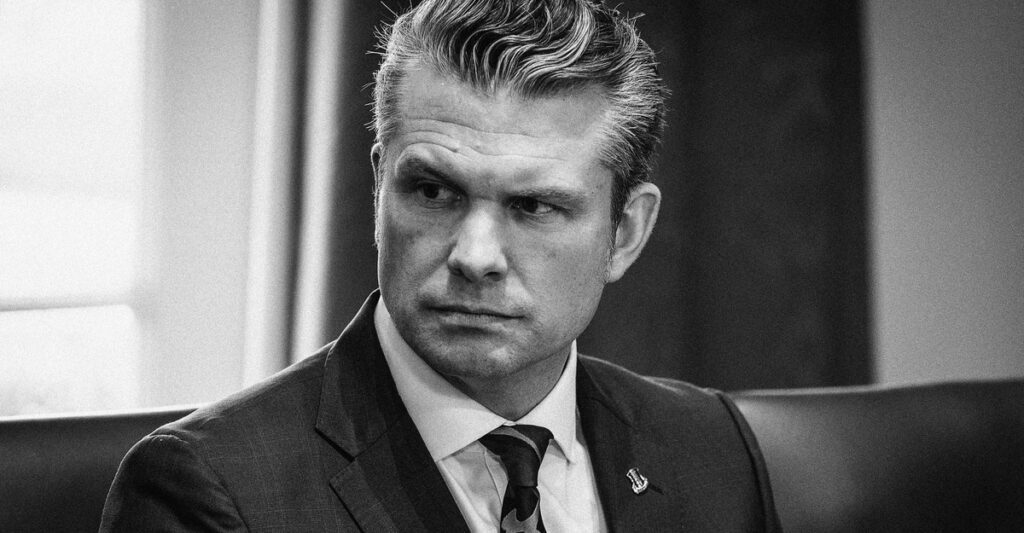
Republicans and Democrats who watched the grainy footage drew different conclusions about whether Bradley’s actions were justified. But many also sounded exasperated that once again they were dealing with controversy sparked by Bradley’s boss, Pete Hegseth. And, after 10 months of turbulence under Hegseth’s leadership, the Republican-led Congress is now showing signs of exercising its oversight powers.
Hegseth has denied reports that he issued a verbal “no quarter” order—that is, an order to kill, not capture—in the September 2 attack, an assertion backed by Bradley. Hegseth also defended Bradley’s decision to launch a second strike—while insisting he wasn’t a part of it. But the congressional scrutiny is likely to continue, deepening the former Fox News host’s reliance on the one person responsible for his political rise: President Donald Trump.
So far, Trump continues to profess support. But he, too, is starting to tire of the scandals surrounding Hegseth and does not push back when others suggest Hegseth is not up for the job, an outside adviser to the White House and a former senior administration official, told us. Trump has not been happy that a number of Republicans on Capitol Hill are using Hegseth’s record as a reason to stand up to the White House, a further sign of cracks in what had until recently been unwavering GOP fealty to Trump. Senator Thom Tillis of North Carolina publicly rejected Hegseth’s claim he had been “exonerated” in Signalgate, while Senate Majority Leader John Thune of South Dakota declined, when asked, to offer his endorsement of Hegseth’s performance.
As one senior administration official summed it up: “Rough week for Pete.”
Since taking office, Hegseth has had few defenders in internal White House deliberations, even as Trump has backed him publicly. But the past week has been rocky even by Hegsethian standards, a point that was made clear in our interviews with roughly two dozen people in recent days.
In 10 months on the job, Hegseth has proven himself one of the president’s most loyal aides. A pugilistic former National Guardsman turned TV star, Hegseth narrowly secured confirmation in January after a nomination process marred by allegations of heavy drinking and sexual assault, which he denied. He and Trump had grown close during Trump’s first term, when Hegseth defended military officers accused of war crimes. “He’ll really fight for me,” Trump told one outside adviser at the time.
Hegseth has generated widespread concern over his judgment and lack of restraint. His leadership has been defined by the summary firing of senior officers without cause, upheaval among his top advisers, giving his wife an outsized role in Pentagon affairs, juvenile social media habits, and his obsession with military fitness and appearance. At the Pentagon these days, there are increasingly two kinds of personnel—those fully on board with Hegseth and those afraid to say they are not. “It’s easier to stay out of the way than to be questioned about loyalty or willingness to do the job,” one defense official, who is in the latter camp, told us.
The maritime campaign, called Operation Southern Spear, is ostensibly aimed at curbing the flow of drugs from Venezuela to the U.S., though the rationale is viewed by many as a thin veneer for Trump’s professed desire for the ouster of President Nicolas Maduro. The boat strikes, now totaling 22 with a death toll of more than 80, are viewed by many military law experts as likely illegal. On Tuesday, the family of a Colombian man killed in a September 15 strike filed a complaint at the Inter-American Commission on Human Rights, alleging Hegseth violated international law. The Pentagon declined to provide a comment but pointed to the chief department spokesman’s denial that the Sept. 2 strike ran afoul of proper military tactics and his assertion that the maritime operations “have been a resounding success.”
Throughout this debate, Hegseth has used social media to taunt critics, posting videos of boats being incinerated and promising to kill traffickers en masse. This week, he posted on X a doctored version of the Franklin the Turtle children’s books, with a mock “Franklin Targets Narco Terrorists” illustration that shows Franklin hanging from a military helicopter, weapon in hand.
Also this week, the Pentagon’s inspector general released long-awaited findings of its investigation into Hegseth’s decision to post details of a pending strike on Houthi rebels in Yemen in a group chat on Signal, a commercial messaging app, that included the editor in chief of this magazine. (Mike Waltz, former national security advisor, had inadvertently added Jeffrey Goldberg to the group.) The inspector general concluded that Hegseth could have put U.S. personnel and the mission at risk by his actions, even though the mission was completed. The report also found that Hegseth, as the Pentagon’s senior official, had the authority to declassify the sensitive information as he transmitted it—in effect declassifying it in his own head—but noted that the attack details had been classified when they were relayed to him by U.S. Central Command. The report also faulted Hegseth for violating his own department’s policies by using Signal for Pentagon business.
As Hegseth was busy attempting to declare exoneration from a report that clearly suggested otherwise, he was sued by The New York Times over his October decision to bar reporters from working inside the Pentagon unless they agree to restrictions that could prevent reporters from publishing information not approved by the administration, conditions that journalists and First Amendment lawyers broadly agree represent an ostentatious attack on Americans’ basic constitutional protections.
It’s not as though Hegseth was widely adored until this week. He alienated many in Trump’s orbit all the way back in the presidential transition when they believed he was misleading about parts of his professional and personal history that later came to light in the media and in his contentious confirmation hearings. Susie Wiles, now the president’s chief of staff, groused to aides that she could never tell if Hegseth was telling the truth.
When Signalgate broke in March, Trump called a number of his close allies to take their temperature on whether he should dismiss Hegseth. Some suggested he be fired but Trump opted against it. He and his inner circle wanted to avoid the constant staff turnover of Trump’s first term. They have largely stuck to that “no scalps” policy so as not to give the Democrats a win—or the media a major story—by appearing to bow to pressure. (Waltz lost his post as national security adviser but was given a soft landing as ambassador to the United Nations). Hegseth never regained the trust of some in the West Wing.
[Read: Pentagon report: Hegseth risked endangering troops with Signal messages]
In the past week, Trump has been far more focused on immigration—a crackdown on migrants from Afghanistan after the shooting of two National Guard members and the dangers Trump claims Somalis pose in Minnesota—than the controversies around Hegseth, one of the outside advisers and a White House official told us. But some have begun to urge the president, whose poll numbers are slumping, to do a staff shakeup after hitting the one-year mark next month, which could include firing Hegseth. Others point to the need to protect the president from Hegseth.
“At the end of the day, people may forget who Pete Hegseth is,” Tillis told CNN. “People will not forget who Donald Trump is. And when they make decisions that are below the standards that I think President Trump wants, I’m going to hold them accountable because I care about his legacy.”
Many other Republicans believe the Pentagon is operating decently enough. After Admiral Bradley’s briefing, senior Republican lawmakers indicated they would continue their oversight around the strikes and Hegseth’s conduct. Some Republican members who attended the briefings appeared moved by the footage of the two survivors being killed, but have so far remained silent. Hegseth has had his defenders, too: GOP Senator Tom Cotton of Arkansas came out in favor of the military’s judgment after Bradley’s appearance, saying the admiral had made the right combat call.
Besides, Trump can’t afford to lose a secretary of defense and wade into another confirmation battle with Congress, the senior administration official told us. “The people around the president have always sensed that Hegseth isn’t really qualified for the job,” this person added. “But he’s redeemed himself in the eyes of the president because he is truly devoted to Trump. That goes a long way.” Karoline Leavitt, White House press secretary, released a statement of support for Hegseth over the Signalgate report’s findings.
“Taking Pete, with all his baggage, is just how it’s gonna be,” the official added.
Powerful GOP senators can’t agree on what to consider the Pentagon’s biggest problem. Senators Cotton and Dan Sullivan of Alaska have voiced unhappiness with the Pentagon’s policy unit and what they say is its failure to consult with Congress. Mitch McConnell of Kentucky is dissatisfied by what he sees as an inadequate military budget. Roger Wicker of Mississippi, the chairman of the Senate Armed Services Committee, has complained about potential troop reductions in Europe and surprised others on Capitol HIll when he teamed up with the committee’s top Democrat to demand the Bradley briefing.
“There isn’t a clear through line yet,” one Republican staff member told us. “We’re not yet in a scenario where a Republican senator is going to call the president and ask him to fire Hegseth.”
[Read: Pete Hegseth is the Pentagon’s holy warrior]
Still, “the pressure is building,” one Republican told us, because of the unpredictability of Hegseth’s leadership and the potential for policy or political victories to be overshadowed by Pentagon drama. Many Republicans have been reflecting on their initial reluctance to confirm Hegseth, though they set aside those concerns at the time after White House pressure. One Democratic lawmaker told us that a fissure in GOP solidarity had appeared midweek, although for now the White House seems to have tamped it down.
Hegseth and his closest allies meanwhile are projecting confidence and concentrating on his audience of one in the White House. “Hegseth is doing what he believes Trump wants—to be unapologetic, to push back and push forward,” one person close to Hegseth told us on Thursday. This person dismissed reports of softening Republican support on Capitol Hill and insisted Hegseth is secure in his job, adding, “people are scared of Pete.”
The post The Worst Part of Pete Hegseth’s Very Bad Week appeared first on The Atlantic.