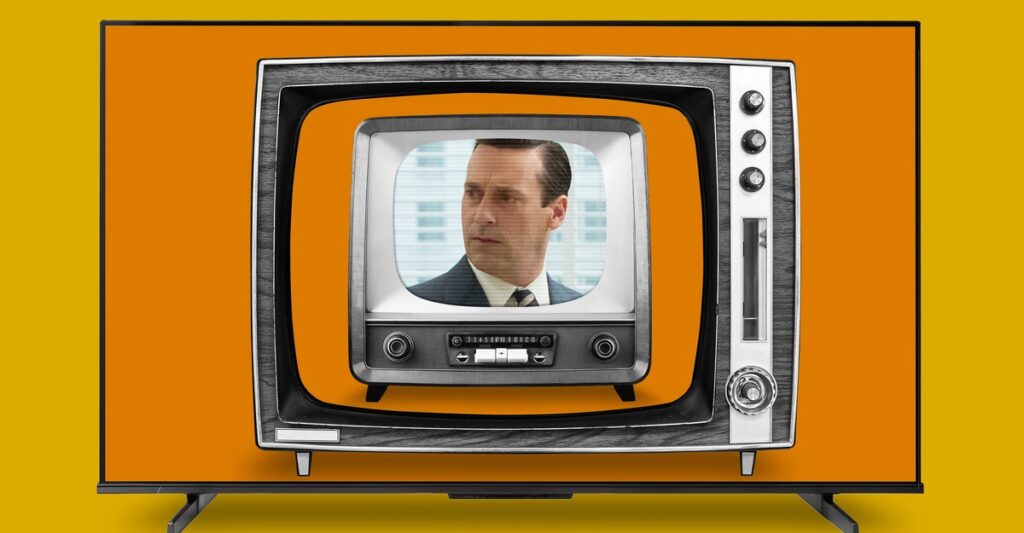
When Mad Men arrived on HBO Max earlier this week, after years languishing on the less-subscribed-to AMC+ service, the streamer’s parent company, Warner Bros., heralded it as a triumph. Finally, the much-acclaimed Emmy magnet would be available to watch in glorious 4K resolution; viewers would now have “the opportunity to enjoy the series in a fresh way,” as the WB executive Royce Battleman trumpeted. And the results certainly were fresh: For the first time ever, Mad Men fans could enjoy such sights as behind-the-scenes technicians operating Roger Sterling’s “vomit hose” as he unleashed a three-martini lunch on the carpets of Sterling Cooper.
The visually upgraded version presents Mad Men in the now-standard widescreen format, something all modern TVs, laptops, tablets, and phones are geared toward, as opposed to the boxy televisions of old. But the team behind the image conversion seemingly used footage without a bunch of the usual postproduction edits—hence the appearance of inessential elements like those dutiful barf wranglers and, in the background of a different shot, contemporary store signage. I was largely bemused to hear of the mistakes, which reportedly stemmed from incorrect files being delivered to HBO and will be corrected. But the incident did serve as a reminder that, in the case of finessing nostalgic TV’s shift into the current streaming era, newer is not always better.
Mad Men ran during a transitory era of TV. The series was one of the last entries in the medium’s “golden age,” which kicked off with HBO hits such as The Sopranos. These were the kinds of provocative water-cooler sensations that had cable subscribers tuning in weekly at an appointed hour (10 p.m. on Sunday, in Mad Men’s case)—an experience that has mostly vanished in the streaming era. It also helped make a name for its network, AMC, as a home of challenging dramas; Breaking Bad and The Walking Dead were also on the schedule. When Mad Men premiered, in 2007, Netflix had just launched its streaming service, an add-on to its disc-by-mail business; when the finale aired, in 2015, the show had grown its audience partly by gaining traction on that streaming service, where people would binge previous seasons to get ready for the new one.
[Read: Your TV is too good for you]
Bringing an older program onto a newer streaming service is rarely a seamless process. But the issue Mad Men’s HBO Max debut ran into is different from the growing pains many TV classics have experienced with their modern-day streaming upgrades. Take the notable examples of The Simpsons and Seinfeld: Each was filmed in a square-looking aspect ratio (4:3, for the audio-visual nerds out there), which was typical of all TV before the mid-2000s; the dimensions suited the televisions everyone had at home. When the image was stretched to fit today’s common flatscreens (designed for a 16:9 ratio, which more closely matches the scale of a movie-theater screen), the top and bottom of the frames were cut off. For The Simpsons and Seinfeld, that sometimes meant sacrificing visual jokes; the changed picture also had a weird surrealism.
Some streaming services have adjusted to this technological quirk. On Disney+, The Simpsons can be toggled into its original ratio. And some hits from the pre-widescreen era, such as The X-Files, were made by cinematically oriented people who anticipated the future that was coming for TV; they geared the visuals toward a bigger screen. But that was not Mad Men’s problem. The series had been mastered for the wider aspect ratio from the beginning; the problem here is an oddly lazy upload process. The HBO Max rollout’s shoddiness even means some episodes bear the wrong titles, alongside the proliferation of incomplete visual-effects work.
The release is an argument for owning physical media—go buy Mad Men on disc, and it’ll have none of these issues—but that’s becoming more and more of a niche market. People now desire the easy click of a button that any streamer provides; I love that I can cue up any of Bluey’s 150-plus episodes within seconds for my demanding daughter. Access to the deep archives of any big service, especially those filled with excellent dramas, is another reason to keep paying the ever-rising monthly bills. But as shows shuffle among Netflix, Hulu, HBO Max, and other platforms, viewers will be at the mercy of tweaks and potential problems like this one. Many of them will be perhaps unaware of how bowdlerized the product they’re watching has become. Mad Men was an instant classic in 2007, yes, but on the internet, not even TV history’s most celebrated episodes can be entirely set in stone.
The post The Mad Men Streaming Debacle Is a Strange Cautionary Tale appeared first on The Atlantic.