Chloé Zhao’s lyrical, elegiac new film Hamnet, based on the novel by Maggie O’Farrell, has been an Oscars frontrunner since its festival release earlier this year. But as it made its way to mainstream theaters over Thanksgiving week, a new narrative emerged with a central question: Is this film, built around the harrowing death of Shakespeare’s 11-year-old son and the writing of Hamlet, a moving meditation on grief and the power of art to help us process it? Or is it hokey and manipulative schlock?
There is something about the sheer force of emotion Hamnet evokes, in its theaters full of weeping audiences, that seems to make critics as suspicious as they are moved.
“‘Hamnet’ Feels Elemental,” went the headline of Justin Chang’s New Yorker review, “But Is It Just Highly Effective Grief Porn?” In the review itself, Chang confessed he watched the movie with eyes “blurred by tears, brought on with such diluvial force as to both quench my skepticism and reawaken it.”
In the New York Times, former Vox-er Alissa Wilkinson describes Hamnet as “ardent and searing and brimming with emotion.” The praise comes with a caveat: “That amount of heat can be tough to handle without veering into sentimentality. In a few places Zhao can’t, or won’t, keep it under control. …The parts of the film that feel beautifully full to overflowing are undercut, occasionally, by feelings of just a little too much, a shot or directorial choice that’s just a tad too precious.”
One surprising thing
Shakespeare borrowed the plot for Hamlet from other sources, as he did with most of his plays. But he made one big change. In the source material for Hamlet, the melancholy Dane has a great reason for pretending to be mad. He’s a child when the story begins, and he has to hide out in his murderous uncle’s court until he’s big and strong enough to take his enemy down. He pretends to be crazy for years as a long game, so his uncle will think he isn’t a threat and spare his life.
As the Shakespeare scholar Stephen Greenblatt lays out, Shakespeare simply trashed that straightforward plot. Shakespeare’s Hamlet has no good reason to pose as a madman. His motives are opaque, apparently as much to himself as they are to us. It’s that very mystery that makes Hamlet such a profoundly complex figure. By destroying the story, Shakespeare created an indelible character.
When I saw Hamnet, the audience was audibly sobbing at more than one scene. I was sobbing myself. I felt emotionally drained, as though I had been dragged through some profound catharsis. Yet I also found myself a little leery of such a physical, overwhelming response. I wasn’t sure whether what I was seeing was moving me in a complex, productive way, or whether it was just playing a clumsy tune on the horrible human fact that I have seen death, as we all eventually will.
More broadly, the question I had was: Can we trust grief when it is shown to us in such a bare, raw fashion? Does seeing mourning unadorned give us anything?
Ironically, this question is at the heart of Shakespeare’s Hamlet, a play obsessed with whether over-the-top expressions of grief are authentic or manipulative.
At stake for both Hamlet and for the Hamnet debate are fundamental questions about how we deal with the problem of death and why humans need art. How and why does art move us? When it shows us grief, what do we get out of it? What does it take for the art to be good?
To be or not to be?
Part of the enormous power of Hamnet, and part of what can also make it feel a little fake, is that it treats its characters more as archetypes than as individuals.
Zhao has spoken extensively about her interest in exploring a yin-yang balance in her films, and Hamnet is no exception. “The whole story is about existing in the tension between impossible polarities,” she told the Washington Post in November. “Life and death. To be or not to be. Grief keeps you in the past, but time is pulling you forward.” In her most recent films, Zhao has set herself the challenge, she says, of reviving “this feminine consciousness that I think has been destroyed in our civilization for tens of thousands of years, and that is very suppressed in myself because it doesn’t feel safe to bring out in the world.”
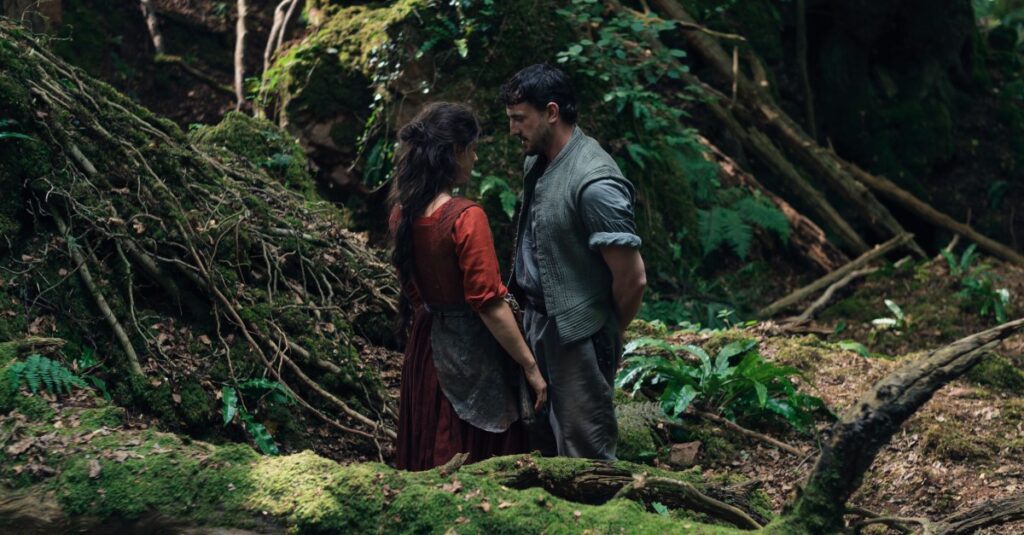
In Hamnet, the feminine consciousness is symbolized by Agnes Hathaway, Shakespeare’s wife. (We usually call her Anne today, but in Shakespeare’s day names weren’t standardized the way they are now — hence Hamnet and Hamlet, which an introductory text informs us were considered the same name in the 16th century.) Played with unnerving intensity by Jessie Buckley, Agnes is the daughter of a forest witch. We see her nestled among enormous mossy tree roots that drip vaginally with dew; we watch her tame a ferocious hawk and teach her children secret herb lore. When her children are in trouble — and as Hamnet goes on, Agnes’s children seem to be always in danger — she screams with a profound, elemental force, as though she is dragging the screams up out of the ground and through her body.
Agnes represents what is feminine, earthy, emotional, and nourishing. In contrast, Will (Shakespeare, but he is not named as such until late) is masculine, urban, intellectual, refined. As played by Paul Mescal, he keeps his emotions trapped behind his eyes, channeling them out into his poetry. Agnes sends him off to London so he can reach his potential as a poet, but she stays in small-town Stratford, where she can be connected to the forest. He is the city, art, and civilization; she is nature, wildness, and magic.
The symbolic associations here can make the emotional life of the characters feel profound, primal. When they first meet, and Will is so overcome he taps the iambic pentameter of love sonnets out against his beating heart, they are all young lovers beginning to court. When they grieve, they are all of us grieving. That’s why Agnes screams that way; that’s why the mourning poetry Will writes can still move us.
Yet characters who carry so much symbolic meaning sometimes have trouble feeling like their own real individual people. Everything that happens to them has to be painted with such a broad brush. The small intangible details seem to dissolve.
The part of the movie that makes everyone cry hardest comes when Hamnet dies in his mother’s arms, writhing in agony, a victim of the plague. His death is shown to us so nakedly that it feels something like cheating. Of course it makes you cry to see a child die in horrible pain. Of course it makes you cry to see his mother scream out her grief. Why wouldn’t it? Who wouldn’t cry? Where’s the art in that?
Then, too, there is something close to kitsch in the film’s final scene, which shows us Agnes finally seeing Hamlet, four years after the death of her son, and seeing how it allows both her and Will to grieve.
On the one hand: how monumental. What a testament to the power of art to help us work through the monstrous human problem of grief, and all the other emotions that feel too big to fit in our little bodies.
On the other hand: how vulgar, to treat a play as big and complicated as Hamlet as something utilitarian, a prop to emotional catharsis, an aesthetically pleasing antidepressant. Isn’t it bigger than that?
But after all, what’s bigger than grief?
The trappings and the suits of woe
The question of what grief should look like, and whether it’s wrong to represent it as too big, is one that Hamlet is profoundly invested in.
Early on in the play, Hamlet’s mother Gertrude tells him that he should stop mourning so intensely over his father’s death. Doesn’t he know, after all, that everyone’s father dies? Why is he acting as though his loss alone is so special?
Hamlet protests in response that he isn’t acting. Dressing in black and crying all the time are the kinds of things anyone would do if they were acting, he acknowledges, but he happens to be telling the truth. “But I have that within which passes show,” he says, “These but the trappings and the suits of woe.”
All the same, as the play goes on, Hamlet comes back again and again to the idea that there is a right and a wrong way to grieve, and that someone, maybe him, is doing it wrong. They are doing too much, or perhaps not enough.
Hamlet declares Gertrude to be wicked for not waiting more than a month to marry her dead husband’s brother. He hires actors to recite a mourning monologue, and then gets angry when they do too good a job: How is it possible that the actors should be able to cry over made-up grief, while Hamlet cannot even work himself up into committing a murder over his own grief? When he sees Ophelia’s brother Laertes climbing into her grave with her, Hamlet accuses Laertes of not caring as much as Hamlet does. He would eat a crocodile for Ophelia, and he doesn’t think that Laertes would do the same.
It’s not always entirely clear whether Hamlet is telling the truth about his grief to us in the audience, either. He tells us that he is entirely sane and sensible in his sorrow, and that when he starts to act mad, he’s faking it. But sometimes it seems as though Hamlet is not as sane as he tells us he is, as though his grief has become too big for his mind to hold.
We never get a straight answer from the play on any of this: whether Hamlet is really mad, why he takes so long to try to enact his revenge for his father’s murder, if he’s mourning the correct way. Hamlet isn’t the kind of play that answers the questions that it asks. In part, that’s because where Zhao’s characters are archetypes, Shakespeare’s are profoundly, horribly individual.
Hamlet is such a precisely rendered character portrait that it changed the way we think about human personality. It is the first great Western work of art to posit the self as something incoherent, inchoate, fragmented, and contradictory, all the psychological forces that the Greeks saw as externalized gods now rendered part of Hamlet’s stormy interior world. Hamlet is all of us grieving because he is so precisely himself, grieving in so many multiplicitous ways.
Part of the disconnect that critics are observing when they look at the difference between Hamlet and Hamnet is the difference between a work of art that finds the universal in the personal, and a work of art that aims to find the personal within the universal. It’s the difference between a scalpel and a sledgehammer.
The rest is silence
In Hamnet’s final sequence, Agnes travels out of Stratford to London and sees one of Will’s plays for the first time: Hamlet. When she walks into the theater, she is outraged, betrayed by the idea that Will has taken their son’s death and turned it into a display for so many people. Yet as the play goes on, she succumbs to it, at last dissolving into tears.
When I saw Hamnet, I found myself feeling oddly embarrassed by this sequence. I love Hamlet, yet everything about it felt so heightened, so mannered, next to the brutal simplicity of watching a middle-class child die of a very common illness. All those highfalutin royals, the duels, the poison. The tonal shift was so intense I found it difficult to surrender myself to the play, in the same way it seemed to be difficult for Agnes to allow herself to do so at first.
Eventually, like Agnes, I was able to give myself over to the play. But once I had, I found myself embarrassed by Agnes, too. Hamlet is so playful, so provocative. Agnes suddenly felt like a character from a clumsier, clunkier universe. I could not make them both exist fully in my mind at the same time.
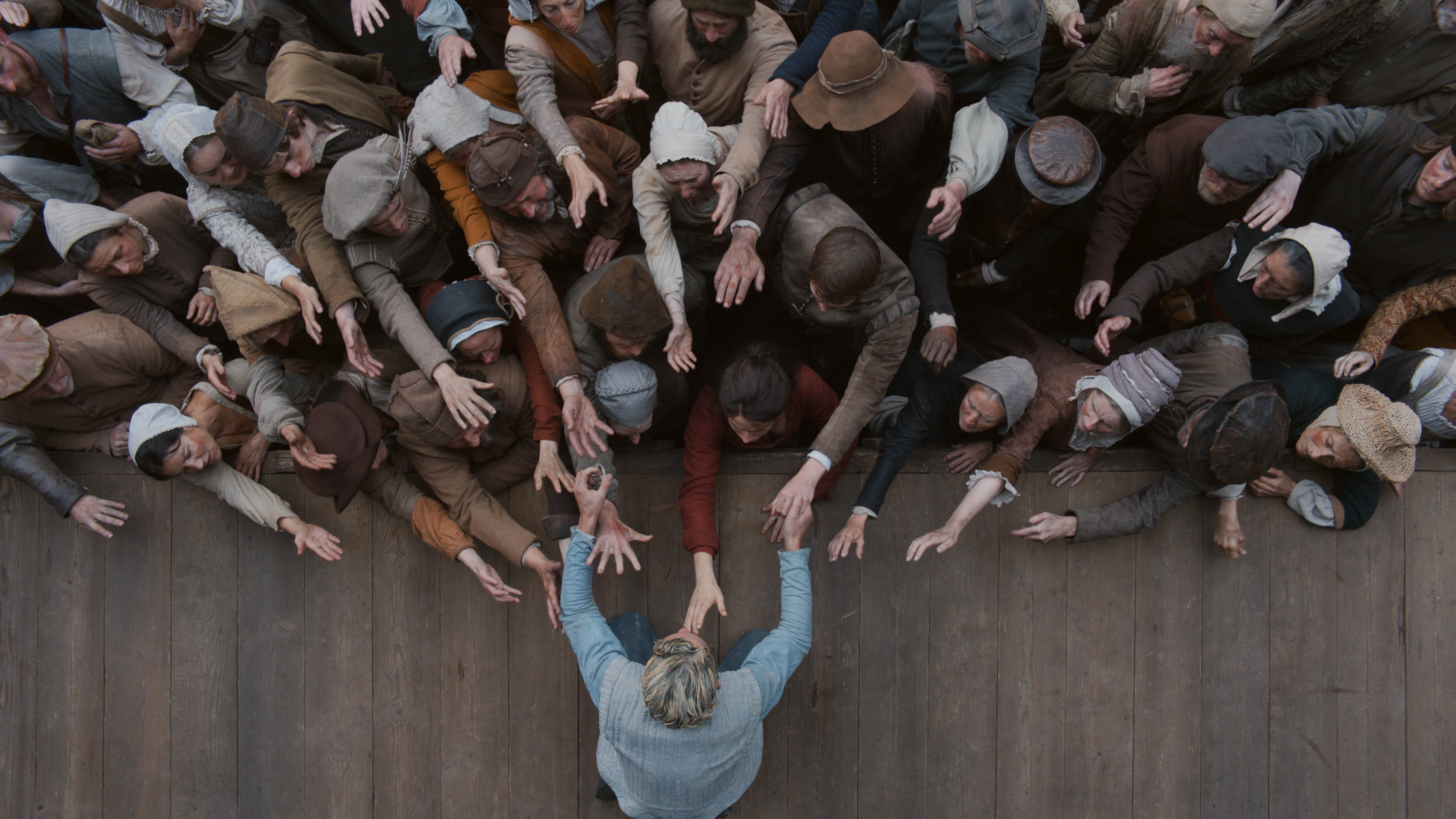
Noah Jupe as Hamnet’s Hamlet, meeting his first fans.
|
Courtesy of Focus Features
Zhao’s idea seems to be that the full redemption of Hamnet’s death comes only after Agnes fully gives in to the play, and then adds to it: She looks up at the actor playing Hamlet as he approaches his death, and she reaches out and takes his hand. And then the audience around her, all of them weeping, reach out to take his hand, too.
He gazes back at them, moved, redeemed. “The rest is silence,” he says.
The play, we see, has healed something in Agnes, something that was broken by the death of her son Hamnet, and it has healed some sort of grief in the rest of the play’s audience, too. But Agnes has in turn given something else to the play — something feminine and otherworldly that the classical masculine structure of the play could never achieve without her. Through her, the individual and the universal reach out and touch.
To the extent that the moment works, it does so because Hamnet and Hamlet are both such emotionally intense experiences: You can feel grief responding to aching grief, just as Zhao planned.
But both Hamnet and Hamlet are also so thoroughly themselves, and they exist in such separate aesthetic universes, that it can feel as though they each lose something when they come together.
That is one of Hamlet’s great insights: that we are suspicious of the grief of other people, that it can feel false and overstated when we compare it with our own terrible suffering. Art is a technology for bridging the gap between our experience of our own grief and of other people’s — one that helps break down that suspicion. It makes us feel Agnes’s anguish and Hamlet’s melancholy as though they are our own. Putting the two next to each other, though, creates a tonal clash that brings our natural suspicion back into play. It makes it hard to avoid wondering if there isn’t something wrong with the way either Hamlet or Hamnet shows us grief, if Hamlet isn’t too esoteric or Hamnet isn’t too crass and blunt.
Hamlet, with its immense artistry and its centuries-long legacy, is strong enough to withstand those moments of skepticism. But Hamnet is so new and so plain-spoken that it wavers under the weight of it. All of the film’s power and energy is brought to bear through the sheer force of its pain, so that it has very little left to offer if its audience ceases to believe in it.
I don’t know if Hamnet is great art. I am too close to it to tell. But despite its weaknesses, I don’t think that it is disqualified from that title by its emotional force.
The post The debate over Hamnet, explained appeared first on Vox.