Since he retook office, President Donald Trump has sought to discourage social media companies from taking down posts they deem hateful or misleading. Now his administration is using immigration policy to ratchet up that pressure.
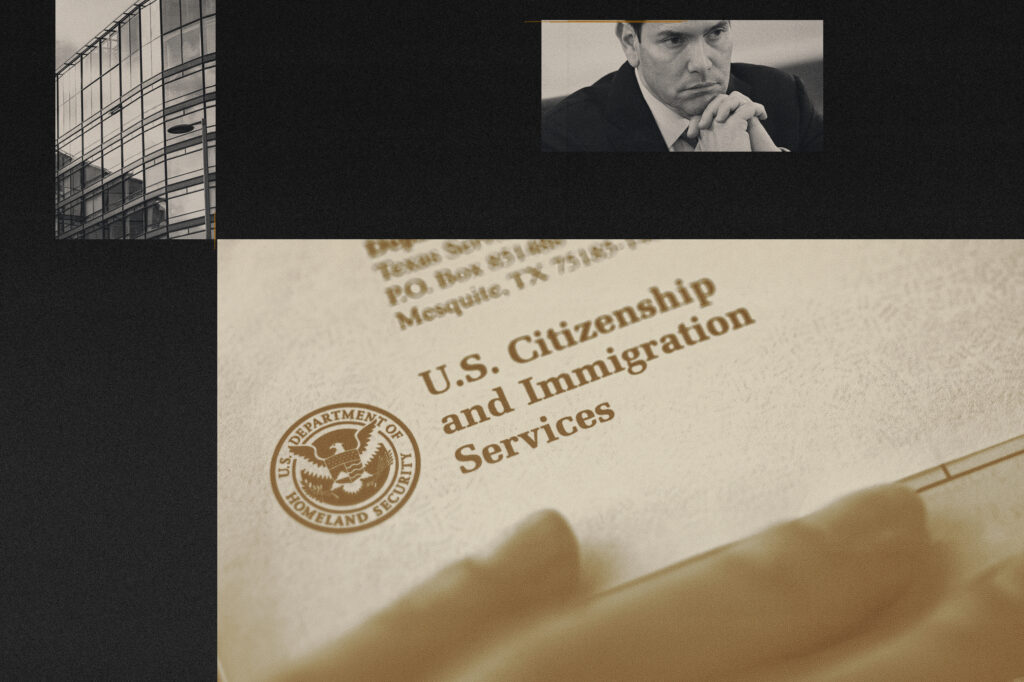
The State Department this week issued additional guidance that could deny visas to workers involved in online content moderation, which Republicans argue is a threat to Americans’ free speech. The move is part of an “enhanced vetting” process for H-1B visas widely used by Silicon Valley firms to bring skilled tech workers into the country.
Secretary of State Marco Rubio advised this week that U.S. diplomatic and consular posts “maintain extra vigilance” in reviewing H-1B visa applicants and screening for ineligibilities. Among the workers newly ineligible are “those responsible or complicit in the censorship of Americans,” according to messages seen by The Washington Post.
According to the messages, visa applicants could be denied on grounds of complying with global content moderation demands from a foreign entity, engaging in censorship that extends to activity in the U.S., or adopting global content moderation policies “inconsistent with the freedom of expression.” It advises officials to review resumes, LinkedIn profiles and publications for employment history related to combating misinformation, fact-checking, content moderation and trust and safety.
Trump has taken a dim view of online content moderation since his first term, when major social networks applied fact-checks and warning labels to his posts about the 2020 election. He was suspended from major platforms — Facebook, Instagram, YouTube and Twitter — following comments that the platforms deemed to be inciting violence in the days after the Jan. 6, 2021, attack on the U.S. Capitol before he was reinstated by 2023.
The new guidance comes as his administration ramps up its efforts to restrict immigration, including legal pathways like the H-1B visa. In September, the administration announced a steep $100,000 feefor applicants who are chosen for the high-skilled work visa.
The administration has already been screening some visa applicants’ social media accounts for what the government deems to be dangerous or hostile activity, and H-1B applicants will be required to make their social media accounts public on Dec. 15. Legal and policy experts said the more stringent vetting measures represent the administration’s latest attempt to redraw the boundaries of online speech.
“This seems to be another lever the Trump administration is using to pressure social media companies into doing content moderation the way the administration would prefer,” said Evelyn Douek, associate professor at Stanford Law School. “It is ironic and frustrating to see the administration try to control the public sphere in this way.”
The State Department said it doesn’t comment on leaked messages and reiterated that the administration doesn’t support immigrants coming to the U.S. to work to censor Americans. It also called Trump “the victim of this kind of abuse” after social media platforms locked his accounts following the Jan. 6 Capitol insurrection, and that he does not want other Americans to go through the same experience.
Big tech companies are the largest users of H-1B visas. About 65,000 visas are approved each year via a lottery system, with people coming from India having the highest number of approvals, followed by China and Canada, according to data from U.S. Citizenship and Immigration Services. Amazon had the highest number of H-1B visas approved among big tech companies in the fiscal year ending in 2024, followed by Google, Meta, Microsoft and Apple. (Amazon founder Jeff Bezos owns The Washington Post.)
Trump and Republicans have long claimed that online platforms run by Big Tech suppress conservative voices, though many researchers have disagreed. He was later reinstated on all platforms.
In January, at the beginning of his second term in office, he signed an executive order calling for an end to federal government censorship of Americans’ online speech. He has since criticized Britain and the European Union for their online speech and safety laws, which he says censor Americans.
In the past couple of years, content moderation rules have loosened across the board at social media companies as Republican leaders have grilled their executives and employees on the alleged censorship of conservative views. X, for example, shifted to limiting visibility of posts that violated policies versus removing them. And early this year, Meta, owner of Facebook, announced that it was dismantling its fact-checking program in the U.S. and that it had changed its rules around hate speech and abuse as it related to sexual orientation, gender identity and immigration status.
Meta, YouTube and X did not comment on the matter.
Some legal experts said it’s not entirely clear whether the extra vetting measures would target specific companies or content moderation more generally. The visa approval process is already often subjective, with officials choosing how to interpret and carry out the guidance, said an immigration lawyer who supports tech clients and declined to be named for fear of retribution.
Ted Chiappari, head of Duane Morris LLP’s immigration law group, said the State Department often asks for additional time, called administrative processing, that puts the visa in limbo when the eligibility of a candidate is unclear. Sometimes this can extend a process that’s typically one or two weeks to six weeks or longer. And if the visa is denied, there’s little recourse.
“There’s nothing you can do” once that happens, he said. “You’re stuck.”
The additional guidance could also lead to a drop in visa applications for professionals who work in content moderation or online safety, legal and policy experts said.
“The intention seems to be to chill platforms’ content moderation,” Douek said.
Dave Willner, an affiliate at Harvard University’s Berkman Klein Center and former head of content policy at Meta and head of trust and safety at OpenAI, said companies often don’t sponsor visas for content moderators because it’s pricey and complicated, and because the jobs aren’t as high-paid or prestigious. Instead, those roles are often filled by Americans in the U.S. or people working and living abroad, he said. Therefore, he doesn’t expect the new restrictions to have a big impact on social media companies’ content moderation.
“I think it will hurt some people,” he said, noting the vetting is cruel. “But I don’t think it will substantially change how these teams operate.”
It’s also unclear if the new guidance will also include those who work on building or maintaining content moderation systems, such as engineers, or even a wider range of workers at social media companies, said Scott Babwah Brennen, director of New York University’s Center on Technology Policy and policy research affiliate at NYU’s Center for Social Media and Politics.
“Would it affect [unrelated] engineers if the company is seen as participating in censorship? There may be an opening to give the administration the ability to deny visas for a company as a whole,” he said.
Several immigration attorneys are now advising H-1B clients to be mindful of their social media posts, adhere to all deadlines and inquiries, and only travel for essential trips during what they consider a period of volatility.
This seems to be “a justification for gumming up the works for H1-Bs,” Chiappari of Duane Morris said. “It’s putting more gravel in gears of the visa system to make it harder.”
Hannah Natanson and Will Oremus contributed to this report.
The post Tech workers face new H1-B scrutiny as Trump targets ‘censorship’ appeared first on Washington Post.