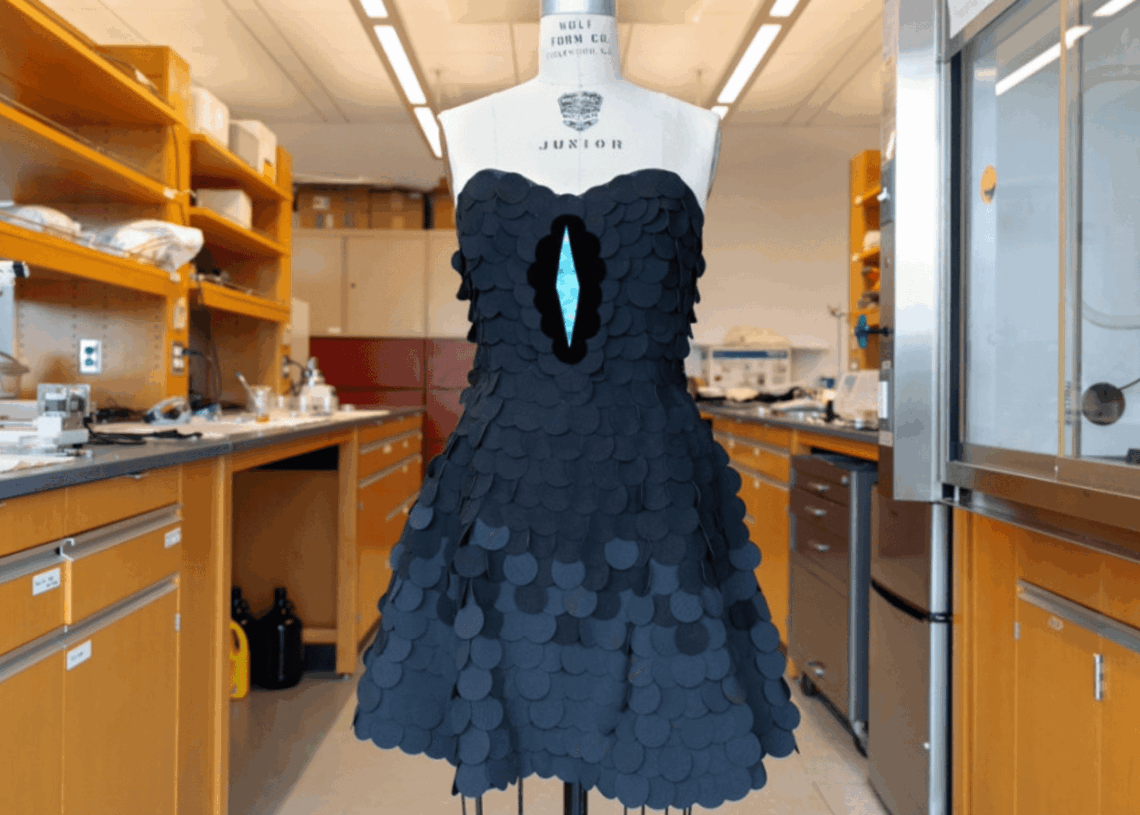
What happens when you’ve created an extraordinarily black fabric? That’s what scientists at Cornell had to figure out once they did exactly that. How do you practically apply something so niche?
The researchers who created a fabric so dark that it makes your favorite black tee look neon turned it into a classic black cocktail dress modeled after one of nature’s most beautiful pitch black creatures, the magnificent riflebird.
Riflebirds use their ultra-velvety plumage for courtship dances. Their feathers are so black that they swallow up light, giving the birds an eerie look of a flying black void, like a bird-shaped object was Photoshopped out of the picture, and only its gorgeous, shimmering green/blue chest was left behind.
You might know Cornell University for its ornithology work, having created the hugely popular Merlin and eBird of birding apps. Running with the birding theme, a Cornell team reverse-engineered the magnificent riflebird’s natural stealth tech and ended up with the darkest fabric ever recorded: just 0.13 percent reflectance, surely classifying it as an ultrablack, according to the findings published in Nature Communications.
For perspective, “ultrablack” is anything reflecting less than 0.5 percent of incoming light. Scientists have made darker materials before, but usually by cooking up tiny bundles of carbon nanotubes. Those are usually used for telescopes, though. Cornell’s approach actually produced something wearable, breathable, and stretchable. It’s the first ultrablack item you could reasonably throw in the laundry without worrying it’ll disintegrate or go so badly it looks like you’ve accidentally tumble-dried a crow.
The process starts with merino wool, dyed in polydopamine, a synthetic melanin. The fabric then gets blasted in a plasma chamber until tiny light-trapping spikes called nanofibrils sprout across the fibers. These mimic the riflebird’s barbules, the microscopic hooks that help feathers lock together while also devouring incoming light.
The result is a fabric that stays ultrablack even when viewed from wide angles, unlike other super-dark materials that only work head-on. Cornell decided to practically apply it in a context that the average person could understand, so they made a dress out of it that takes its inspiration from the magnificent rifle bird, radiant blue/green chest piece included.
Fashion isn’t going to be this ultrablack’s ultimate use case. The fabric could eventually boost the performance of cameras, telescopes, and solar panels, anywhere you want light to stop bouncing around. The team has already filed for provisional patent protection, meaning ultrablack could soon appear in other products.
The post Scientists Created the World’s Darkest Fabric—and Made a Dress Out of It appeared first on VICE.