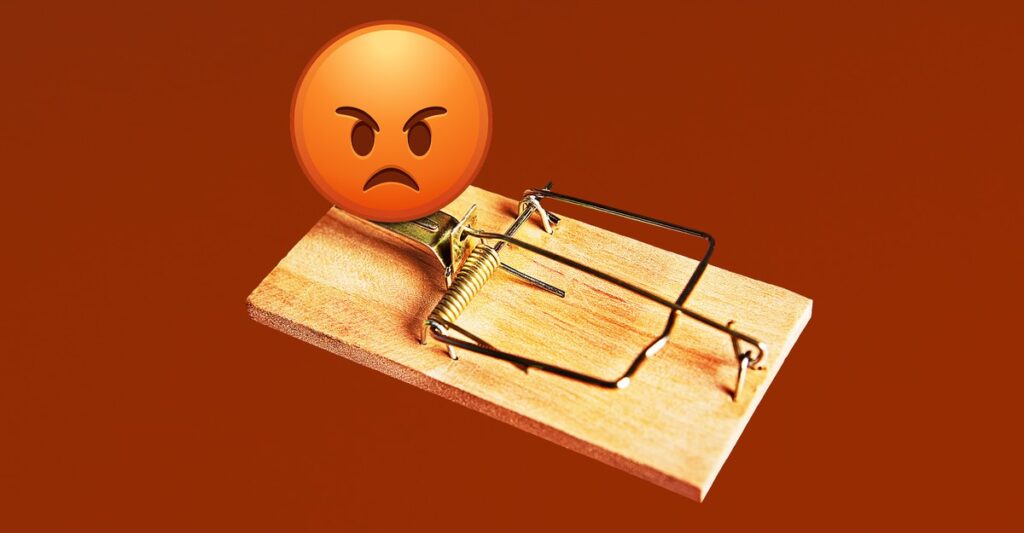
The lexicographers at the Oxford University Press seem to be punking us. In 2015, their “word” of the year was “ .” In 2023, rizz. In 2024, brain rot. And now the publishers of the Oxford English Dictionary have chosen rage bait. As I write this, the spell-check bot has underlined many of these words in red or blue squiggles, urging me to rectify my missteps. But no mistakes have been made here.
Rage bait—both the term and the phenomenon—is a product of the attention economy. The Oxford announcement defines it as “online content deliberately designed to elicit anger,” which is “typically posted in order to increase traffic to or engagement with a particular web page or social media account.” Its usage has increased threefold over the past year, the press notes. Oxford made its decision after more than 30,000 voters had their say. In endorsing this choice, Oxford may be chasing fame, or clicks, or—yes—rage, but it is also rightfully recognizing that language is malleable and that the latest innovations are online.
Language is the freest market that we have. Words that prevail do so on merit, no matter their origin. Rage bait is evocative and useful. Because the English language had previously failed to provide such an efficient term, we should be glad that the internet has come through.
[Kaitlyn Tiffany: The brilliant stupidity of internet speak]
When Oxford and other traditional authorities champion ideas and terms drawn from the internet, in many cases they’re accused of, at best, mindlessly following trends and, at worst, debasing English speakers’ cultural heritage. Decrying the elevation of rizz two years ago, Kayla Bartsch at National Review wrote, “Institutions such as Oxford—the primary steward of the English language for centuries—have a choice: elevate this new garble, or propel English speakers on toward worthier turns of phrase.” She then argued that “Shakespeare and Dickens have been tossed out and replaced with TikTokers and online trolls.” The same year the British publication The Tab lamented, “It’s like they see a word they’ve never heard of mentioned once on TikTok and automatically assume it’s how every single young person speaks.” Beneath these complaints is a much older debate between descriptivists, who seek to chronicle how people express themselves, and prescriptivists, who favor the enforcement of traditional language norms.
This year, however, the criticism from the latter camp has been muted. Perhaps the “new garble” has won. Perhaps Oxford’s decision to crown brain rot last year spilled the last of the ink on the matter. Some have quibbled that the phenomenon of rage bait is just too dire and insidious for the term to be elevated this way. As Zoe Williams moaned in The Guardian: “Good luck in the dictionary business, Oxford, if you collude to make rage bait all the rage.” Otherwise, the main complaint has been that rage bait is, in fact, two words. (In attempting to preempt such criticism, Oxford has insisted that their word of the year “can be a singular word or expression, which our lexicographers think of as a single unit of meaning.”)
All words fill some semantic gap. Either they succinctly describe a new phenomenon or they describe an existing one in a more fun and nuanced way. Rage bait manages both. In a mere two syllables, it captures a timeless attention-getting strategy predicated on human weakness, and it conveys the acceleration of our algorithmic estrangement from a worthier discourse of ideas. It exposes the baseness of some human impulses and the dysfunctional state of contemporary politics.
Without the concept of rage bait, we couldn’t adequately describe why the president of the United States might be broadcasting AI-generated videos of him dumping feces on Americans who protest his policies. Nor would we be able to explain why California Governor Gavin Newsom, a likely candidate for the 2028 presidential election, celebrated the Democrats’ electoral wins in November with a TikTok of him and fellow party members slamming Trump and other Republicans in a mock World Wrestling Entertainment smackdown. “Now that’s what we call a takedown,” Newsom posted.
Victory in online debates lies in cultivating an ironic detachment while triggering rivals into earnest, sloppy anger. This feat has become its own meme: an image of a lion shrieking at a blithely amused monkey. In 2025, the monkey is winning.
[Victoria Turk: The great language flattening]
This isn’t to say that elevating meme lingo always makes sense. Dictionary.com crowned 67 as its word of 2025. Pronounced “six seven,” the number has become a meme that Gen Alpha kids love repeating while making a juggling hand motion. Their inflection mimics the Philadelphia rapper Skrilla, whose song “Doot Doot (6 7)” kick-started the joke after it soundtracked viral TikTok hype videos of the NBA guard LaMelo Ball, who is 6 foot 7. But the term 67, which lacks a definition, probably won’t last; no kid uses it in a sentence. It’s simply a universally known in-joke that children use to bond, which makes it an odd choice for a word of the year.
The problem with hitching new words to memes is that memes die. Meme-popularized words from the 2010s, such as on fleek and yeet, are cringe now. Lexical survivors must fill a niche, so selfie, cancel, and ghosting promise to stick around. As long as we remain governed by algorithms that promote engagement over nuance, rage bait is likely to last as well.
The post Rage Bait Is a Brilliant Word of the Year appeared first on The Atlantic.