Donald Trump still doesn’t seem to have learned a thing about the Russian dictator he calls a friend. He’s tried all kinds of contradictory gambits in pursuit of peace in Ukraine: welcoming Vladimir Putin in Alaska, helping Kyiv blow up Russian oil refineries, offering Russia land it hasn’t been able to acquire militarily. None seems to have had much effect. The Kremlin is holding the line, and Trump can’t get through. On Thursday, Putin said that parts of the U.S. peace plan were unacceptable and that Russia would take Ukrainian land by force.
One reason may be that Trump and Putin are fundamentally incompatible personalities. Trump sees everything as a deal, and for Putin, any deal is a revelation of weakness. Trump is a creature of the Manhattan-real-estate world; Putin grew up amid the rubble of postwar Leningrad. Those Soviet courtyards formed him. In them, he internalized the rules of ponyatiya—an unwritten code, roughly translated as “the concepts,” or “the understandings,” that originated in Stalin’s Gulags and still governs much of life in Russia, regardless of who’s in power.
The ponyatiya of Putin’s youth generally meant never betraying your gang and always standing up for your friends. Putin still lives by these rules. He’s kept the same circle of friends since the 1980s—a good number of them are now billionaires—and no matter how badly they handle a situation, they are hardly ever punished. They’re in their 70s now, but they still play hockey together in what they call the “Night Hockey League,” or the NHL (they had custom jerseys made). Ponyatiya also meant never letting an insult go unanswered. Consider the defectors—not to mention the oligarchs, journalists, and dissidents who have displeased Putin—who have ended up dead.
Putin approaches foreign policy according to the same code. Hierarchy is absolute. The strong must be respected, and the weak must obey. The fact that Ukrainian President Volodymyr Zelensky—a man whose comedy performances Putin once enjoyed—is now leading a country that’s stopping Russia from reclaiming its imperial glory creates cognitive dissonance. A comedian is supposed to be feeble; a smaller nation without a nuclear arsenal is supposed to submit, and its people are supposed to stay silent.
By the same logic, Putin should regard an American president as equally powerful. Yet Trump has consistently presented himself as the weaker party.
For years, Trump was eager to prove that he had a great relationship with Putin. He courted the Russian leader with summits, diplomatic overtures, and long phone calls, even as the rest of the free world shunned him. Trump made no secret of his admiration, either. He called Putin a “genius” for moving troops to eastern Ukraine, praised him as tough, and at one point said that the Russian dictator was “outsmarting our country at every single step.” The media filled in the rest of the picture, suggesting that Trump was ready to concede America’s interests, principles, and allies for the sake of being accepted by an adversary. Putin may well have come to the same conclusion and, following the code of the streets, understood himself as dominant and the U.S. president as having relinquished his claim to Putin’s respect.
[Read: Why Trump is giving Putin everything he wants]
Sometimes, Putin lets his attitude toward Trump slip. At the 2018 U.S.-Russia summit, Trump publicly sided with Putin over his own intelligence agencies. The Kremlin propagandist Pavel Zarubin—known for his unfettered access to the Russian president—got hold of the summit’s guestbook. Trump wrote, “Great Honor,” while Putin simply added his signature and the date. “Please don’t be angry; I understand that we could have talked more. It’s just awkward to keep others waiting—they’ll get upset,” Putin said of his upcoming call with Trump to the audience at Russia’s Strategic Initiative Forum this summer. To a Western ear, that doesn’t sound like much, but for someone like Putin—or any Russian street kid, for that matter—“getting upset” is a feminine trait. To apply it to a man is not courtesy; it’s an insult.
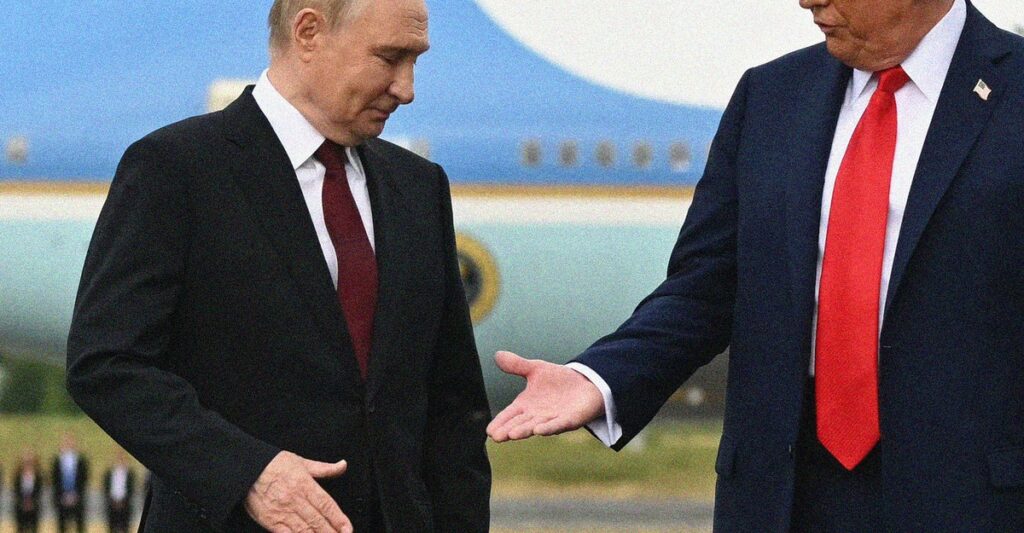
Trump has mostly approached the war in Ukraine as though it were a business transaction—a straightforward quid pro quo. The White House has repeatedly floated a list of proposals for Putin to end the war: recognition of Crimea as Russian, de jure control over parts of eastern Ukraine, and a package of economic incentives. The content of these offers matters less than the act of offering; in Putin’s world, initiating a deal is a sign of weakness. The moment Trump extends his hand, he marks himself as submissive and invites Putin to demand more. The better strategy would be to instead apply pressure and wait for Putin to make the first move. In dealing with Putin, in other words, Trump keeps thinking he’s entering a Manhattan boardroom, when in fact he’s walking into a Leningrad courtyard—and blinking first.
Putin has made mistakes in this relationship too, such as assuming that Trump is incapable of being tough on Russia. Before the latest peace proposal, the American president imposed sanctions on Russia’s top two oil companies, put a 50 percent tariff on India for purchasing Russian oil and weapons, and entered into talks with China about pressuring Moscow to end the war in Ukraine. In response, the Russian leader resorted to a show of force: He began appearing in military uniform, something he normally does only rarely, and issuing one nuclear threat after another.
Putin unveiled the Burevestnik, a nuclear-powered cruise missile, at the end of October, and started talking about testing the weapon. He then sent Kirill Dmitriev, his economic envoy, to Washington on a bizarre charm offensive. Predictably, Dmitriev told U.S. reporters that sanctions weren’t hurting Russia’s economy. He also presented a box of chocolates stamped with quotes from Putin to Representative Anna Paulina Luna, one of the few people on Capitol Hill advocating for ending the war essentially on Russia’s terms.
Trump reacted to Putin’s saber-rattling by saying that Russia should end the war in Ukraine instead of testing a nuclear-powered missile—and added that the United States has a nuclear submarine positioned off Russia’s coast. Treasury Secretary Scott Bessent dismissed Dmitriev on CBS News, calling him a “Russian propagandist.” After yet another of Putin’s threats, Trump announced that he would resume nuclear testing. That’s when Putin backed down: In an effort to ease tensions, his press secretary clarified that Russia would be testing nuclear engines, not warheads. It was the clearest example of the kind of approach that actually works on Putin.
[Read: Why does Steve Witkoff keep taking Russia’s side?]
Nevertheless, the 28-point peace plan Washington first presented late last month was a sweet deal for Putin and appeared to have been drafted with significant input from Moscow. It called for Ukraine to give up the Donbas, abandon its NATO ambitions, cap the size of its military, and hold elections within 100 days. It also offered amnesty to Russians accused of war crimes and invited Moscow back into the G8. But the U.S. was forced to seek European and Ukrainian input, and on December 2, the Kremlin predictably rejected the proposal, though negotiations haven’t yet come to a complete close.
If the talks end in failure, as seems probable, Trump may react with frustration and impose additional sanctions on Russia. Or, just as likely, he may show how little he’s learned by coming back with another deal. Nothing in the underlying dynamic—or the bloodshed—will change if Trump keeps assuming that Putin wants American investment, a G8 seat, and the Donbas more than he wants to destroy Ukraine.
One of the chocolates Dmitriev brought to the U.S. featured a quote from Putin that perfectly captured the Russian president’s worldview. It read, “If a fight is unavoidable, you have to hit first.” When Washington greets Putin with praise, it gets smiles, handshakes, and a reiteration of Moscow’s maximalist demands in return. Trump doesn’t have to become a friend to Ukraine, and he almost certainly never will. But he does need to learn how to deal with Putin. Only then will the Leningrad courtyard, with its unwritten rules, cease to be big enough for the both of them.
The post Putin Lives by a Code Trump Doesn’t Understand appeared first on The Atlantic.