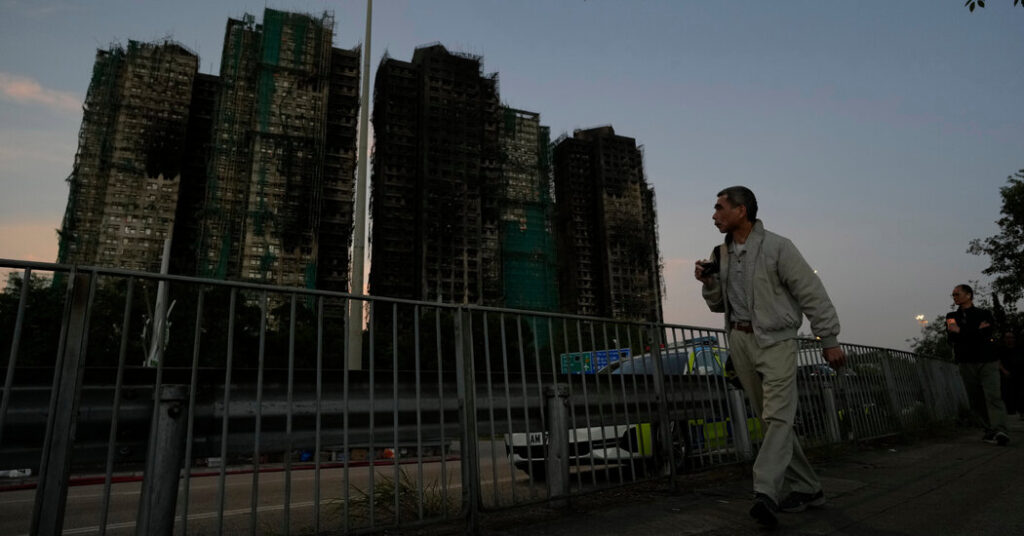
More than a week after a fire tore through a Hong Kong housing complex, killing at least 159 people, the city is confronting its biggest challenge yet. It must find homes for the thousands of residents who survived with little more than the clothes on their backs.
The government is already facing questions over its role in the worst tragedy to befall the city in seven decades. Now, survivors of the deadly fire are looking to the government to help them start over in one of the world’s most expensive and unequal places to live, where the average living space is smaller than a one-car garage.
The residential towers in Wang Fuk Court were home to more than 4,500 residents, many of them from working-class families who bought their subsidized homes through a government program and had lived there for decades before the raging fire took the lives of their loved ones and reduced their belongings to ash.
“It was horrible — all of our belongings are gone,” said Diana Yu, 71, who lived with her 43-year-old son in a two-bedroom apartment. She watched in tears as flames engulfed the sixth-floor unit where she had lived for four decades, her two cats trapped inside. Ms. Yu will stay in a small room in a former Covid-19 quarantine facility, but she said she did not know for how long.
More than 2,600 Wang Fuk residents have been placed in makeshift apartments in onetime quarantine facilities, youth hostels and housing projects scattered across the city. Others have turned to friends and family for temporary stays because they need to be closer to schools, doctors and workplaces.
John Lee, Hong Kong’s chief executive, has called on citizens to “transform their grief and care into a force for reconstruction” and allocated about $38 million for the families affected by the fire. The government has held daily news briefings to announce the rising death toll. It has regularly updated the public about an investigation into the malfeasance that led to the fire.
For the survivors, however, the most pressing concern is how to start their lives again.
“We are all waiting. The relief funds are good for short-term, but long-term arrangements have to be solved,” said Leung Ho, 42, a truck driver who lived in the complex with his wife, two children and 70-year-old father, who bought their apartment in 1983. Mr. Leung and his family are staying with friends near Wang Fuk Court so they can be close to his children’s school.
Over the past week, there has been a steady outpouring of support from the community. Volunteers have shown up to distribute food and clothing. More than $320 million in donations have poured in from the city’s 7.5 million residents. Posters taped to buildings that surround the site of the fire contain the names and contact numbers for dozens of nonprofit organizations that are also offering donations.
But there is a scarcity of housing. Officials have said that residents can stay in temporary housing at no cost for as long as they need, but some residents want clarity on their future.
The Hong Kong government is “committed to providing appropriate assistance to meet the housing needs of residents in the longer term,” said Michael Wong, the deputy finance secretary, in an emailed statement. The city would take into account factors like the condition of the buildings, the requirement for repairs and the preferences of the residents affected by the fire, he wrote, adding that the government would “not rule out any long-term possibilities at this stage.”
Hong Kong is a city plagued with some of the highest inequality in the world. Available space is limited, and wages have not risen at the same rate as housing prices. More than 215,000 people live in illegally subdivided apartments that are sometimes so small they are called coffin homes.
“In Hong Kong, we have a very large gap between the haves and the have-nots,” said Albert Lai, a civil engineer and founding chairman of the Professional Commons, an independent think tank focused on public policy.
The only immediate option available to help the residents of Wang Fuk Court is to tap public housing, Mr. Lai said. But nearly 200,000 people were already waiting for public housing before the fire, a backlog that typically takes about five years to address. Many displaced Wang Fuk residents are staying in some of the same facilities as citizens who are on the public housing wait list.
If the government decided to move residents from Wang Fuk into public housing, this could take up as much as 10 percent of its average yearly supply, Mr. Lai estimated.
Even as residents try to settle into a new transitory state, many had more questions than the growing army of government volunteers and social workers could answer.
One of those questions focused on the recent maintenance fees that residents had been forced to pay to help cover a $40 million renovation that had been underway at the housing complex before the fire.
It was this renovation, and a contractor’s decision to cut corners and save money, using substandard materials like flammable scaffolding netting and polystyrene foam, that caused the fire to spread so rapidly last week.
Mr. Ho, the truck driver, and Keith Cheung, 44, said their families had paid around $20,600 in renovation fees. “We’ve wasted so many years and so much money,” said Mr. Cheung, who lived with his wife and son on the 11th floor of the tower that was most badly burned.
Some residents said they wondered if those fees would be compensated, and whether their mortgages and other payments would count toward their next homes. Their questions have so far gone unanswered.
Some hope for one-off monetary relief to repurchase a private flat in the same neighborhood, other subsidized housing options or a long-term housing accommodation while their old homes are rebuilt. Many expressed hope that they could continue to live in the Wang Fuk Court area. Some housing experts have suggested that the government could enlist one of Hong Kong’s deep-pocketed property tycoons to repurpose a private real estate development for the displaced residents. Mr. Lai, who previously advised the Hong Kong government on housing and infrastructure as a member of the Commission on Strategic Development, suggested that a special government urban renewal scheme could be repurposed to build a new complex on the same site.
Residents described Wang Fuk Court as a tight-knit community where young children lived with their parents and grandparents. Some neighbors knew one another from church. Older residents, like Vinnie Chung, 68, had moved in when the housing complex was first built, in 1983. Ms. Chung said another couple in her building had lost their son in the fire. She recalled watching him grow up.
“Now that life turned out like this, who wouldn’t be heartbroken?” Ms. Chung said.
Some residents, like Mr. Ho, even wanted to go back to live in their old homes, though he knew it was too burned.
“The fire was too huge,” he acknowledged. “I know that there is no going back.”
Alexandra Stevenson is the Shanghai bureau chief for The Times, reporting on China’s economy and society.
The post ‘No Going Back,’ Survivors of Deadly Hong Kong Fire Are in Limbo appeared first on New York Times.