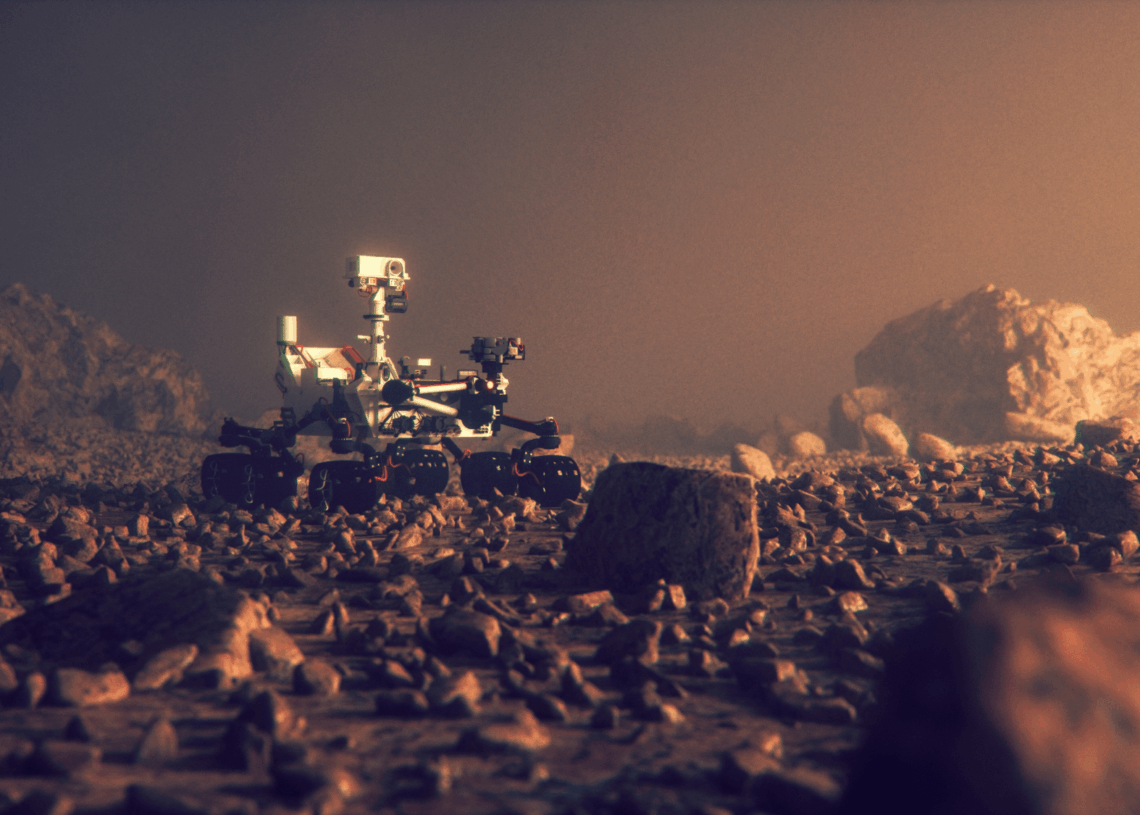
The red planet has a new, fun little surprise for us. While trundling through an ancient channel last year, NASA’s Curiosity rover literally ran over a rock on Mars and cracked it open, only to find bright yellow crystals glinting inside.
Tests showed the glittery material was pure elemental sulfur—also known as brimstone—which had never been seen on Mars before.
Sulfur isn’t rare on the red planet. Curiosity has spent years crawling across regions packed with sulfate minerals, the salts that form when sulfur mixes with other elements in water and then dries out. Elemental sulfur, though, is different. It forms under a tight set of conditions that geologists didn’t expect to find in this part of Gale Crater.
NASA described it as the first confirmed “native sulfur” on Mars, identified when Curiosity’s wheel accidentally crushed the rock.
The discovery got stranger when the team looked around. The find came from Gediz Vallis Channel, a scar carved by ancient debris flows running down the flanks of Mount Sharp. Photos showed the area dotted with similar pale rocks, suggesting sulfur might be scattered across the landscape.
“Finding a field of stones made of pure sulfur is like finding an oasis in the desert,” said Curiosity project scientist Ashwin Vasavada. “It shouldn’t be there, so now we have to explain it.”
That explanation matters for more than curiosity’s sake (no pun intended). Sulfur is essential for life as we know it. On Earth, organisms use it to build amino acids and proteins. No one’s saying those crystals are proof of life, but they add another clue to the list of what Mars once had: water, complex chemistry, and now an element linked to biological systems.
The discovery also shows how much Martian science depends on luck—and heavy machinery. If Curiosity had taken a slightly different path, that yellow flash might still be sealed inside the rock. Instead, a random wheel roll handed scientists a new piece of the puzzle that is Mars’ geological past.
Curiosity has already moved along the edge of Mars’ Gediz Vallis, capturing final images of the sulfur field before heading toward its next target on Mount Sharp. Back on Earth, researchers are running models to figure out how a cold, dry planet ended up storing pockets of brimstone near its surface.
However it happened, one thing’s clear: Mars isn’t done surprising us yet.
The post NASA’s Curiosity Rover Found Something Strange Hidden on Mars appeared first on VICE.