In 2018, Senator Cory Booker, the Democrat from New Jersey, introduced a bill that would create something called a “baby bond” for every child born in the United States. It was an ambitious idea to use federal money to help individual children build a nest egg, a type of wealth out of reach for many. It never got out of committee.
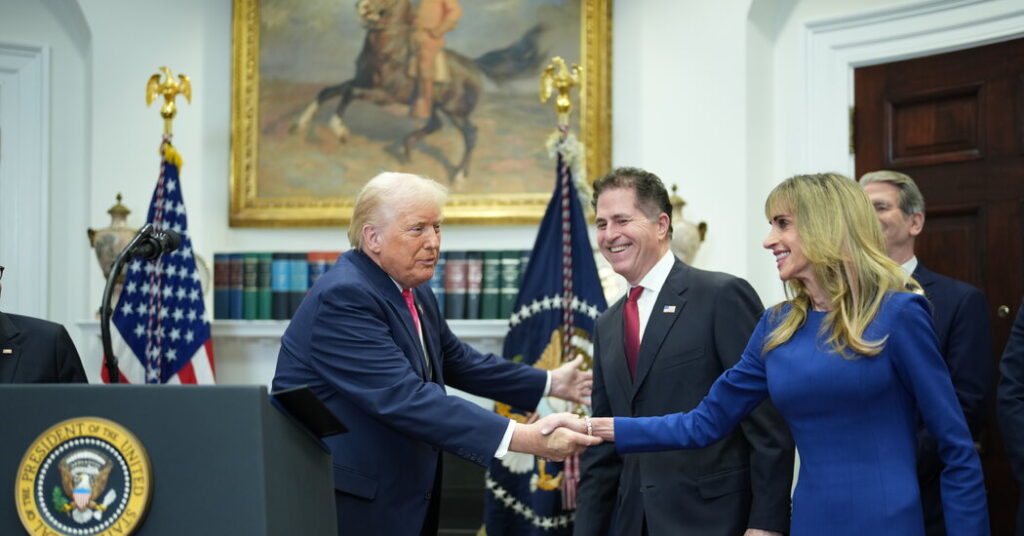
This week, Michael and Susan Dell announced a $6.25 billion donation that will seed savings accounts for 25 million children with $250 each. The vehicle for the gift is called a Trump account, not a baby bond, and it was created in a Republican-supported tax law. While the children born during the four years of President Trump’s second term will get federal seed money of $1,000 each, the accounts are meant to be filled largely by family or philanthropy.
Mr. Trump called the savings accounts a “stake in American prosperity.” In an interview on Friday, Mr. Booker called them “a step in the right direction.”
If government is not ready to deliver on the program’s potential, private help is a start, he said. “If we are giving wealthy people huge pathways for tax avoidance,” he added, “we should be trying to do things to encourage philanthropy.”
Giving to children so they will come into wealth is a notion that people on the left and the right can find merit in. It is also an example of a kind of philanthropy that has come into vogue in recent years: philanthropy that bypasses the bureaucratic, top-down structures of foundations that have been a major conduit of funds for decades.
The nonprofit GiveDirectly has handed out over $1 billion to more than two million individuals over the past 16 years. During the coronavirus pandemic, a renewed emphasis on mutual aid drew people to platforms like GoFundMe, where, for instance, you can give to a patient to pay for chemotherapy treatments rather than to the American Cancer Society. According to Giving USA, gifts to individuals increased to nearly $24 billion in 2024, from under $2 billion in 2004, though that figure was down slightly from the year before.
The size of the Dells’ donation, which could become the biggest ever to go straight to recipients, brings even more attention to this model of direct and unencumbered giving. The gift to the Trump accounts is roughly the size of the entire endowment of the storied Rockefeller Foundation.
“It’s not a coincidence that a whole bunch of people with very different philanthropic profiles are gravitating toward a particular approach to philanthropy, which does not involve constructing a traditional philanthropic bureaucracy,” said Benjamin Soskis, senior research associate at the Urban Institute’s Center for Nonprofits and Philanthropy.
Those large bureaucratic institutions have been a facet of American life since the Rockefeller Foundation was created in 1913. The Ford Foundation supplanted it as the largest and most powerful philanthropy in the United States during the 1950s.
More recently, the Gates Foundation and Bloomberg Philanthropies became the standard bearers for what was known as philanthrocapitalism. This new generation of entrepreneurs wanted to apply the lessons of their business careers to helping the needy and the sick. To them, that meant evaluating the efficacy of their donations with the same type of rigorous metrics they used to evaluate business investments. They hired large staffs to vet nonprofit recipients and track their donations.
While these foundations were generous, grant recipients complained privately that reporting requirements were onerous, requiring reams of paperwork, not to mention so strict that they couldn’t change course when warranted.
But the emphasis on achieving the most impact for the fewest dollars was now built into the structure of giving. In the early 2010s, a new group of donors, called effective altruists, upped the ante. They sought out the cheapest interventions that could save the most lives, such as mosquito bed nets to prevent malaria. That often led to giving in the world’s poorer countries, where they could prevent hundreds or even thousands of deaths for the cost of sending one American child to a private university.
While it may have been criticized for high overhead, defenders of the old foundation model point out that even the largest foundations lack the resources of government to make an impact, and are at their best playing the role of incubators for new ideas.
Between 1997 and 2015, the Ford Foundation spent $662 million studying the racial wealth gap — and how different forms of savings for children could help close it. “I think you can go so far as to say baby bonds in its current iteration and form might not have occurred without the generous contributions of the Ford Foundation,” said Darrick Hamilton, a professor at the New School for Social Research, whose work with William Darity Jr., an economist at Duke University and Howard University, helped lead to the baby bonds concept.
Dr. Darity said the idea to provide children with some kind of publicly financed trust account first arose in 2009 and 2010, a period marked by the fallout of the financial crisis and the Great Recession.
There was also a growing awareness that generational wealth gave rich people a leg up on everything from college tuition to homeownership to investments in the stock market. Even a high-achieving poor student, saddled with tens of thousands of dollars in student loans, would have a difficult time catching up.
“We focused on newborns because no one could blame them for the wealth position of their families,” Dr. Darity said in an email.
Dr. Darity and Dr. Hamilton both worked with Mr. Booker on what would become his baby bonds bill. The bill proposed an initial $1,000 for every child and annual payments of as much as $2,000 for families living below the poverty line. The program was meant to be entirely government funded.
In 2021, the tech investor Brad Gerstner began pursuing the idea of investment accounts for children in a way that would help disadvantaged children while highlighting the virtues of the stock market to a generation of disillusioned young people. He set up a nonprofit, Invest America, to push for the idea and enlisted his friends the Dells, who had made a fortune in the computer industry and given away $3 billion in the past 26 years through their family foundation.
They spoke to the Biden administration as well as legislators on Capitol Hill, including Mr. Booker. But the proposal really gained momentum after Mr. Dell pitched the idea to President Trump.
When Senator Ted Cruz, Republican of Texas, proposed a version of child savings accounts in May, they were called Invest America accounts. As in Mr. Booker’s proposal, the government would pay the $1,000 for newborns, though only those born between Jan. 1, 2025, and Dec. 31, 2028. The rest would have to come from family contributions or benefactors like philanthropists and corporations. House Republicans changed the name of the program to MAGA accounts before the Senate settled on Trump accounts.
Some on the right hope that these individual investment accounts could eventually supplant entitlement programs. Treasury Secretary Scott Bessent has called the Trump accounts “a back door for privatizing Social Security,” though he later clarified that the accounts were “an additive benefit for future generations, which will supplement the sanctity of Social Security’s guaranteed payments.”
On Monday, the day before the Dells’ announcement, Mr. Cruz and Mr. Booker sent a letter to the chief executives of 1,000 large companies asking them to contribute to the new accounts.
Dr. Hamilton, who preferred to see a federally funded program, said Trump accounts as constituted would not close the wealth gap between rich and poor and could even make it worse. But he has hope that some future, more left-leaning Congress will take the structure that has been created and improve on it.
“Donald Trump, who controls the Republican Party, has now endorsed the idea,” Mr. Booker said. “So if the next president comes along and says, ‘I want to deal with the friction issues, and I want to expand the seed money,’ or what have you, it’s not even going to be debatable anymore.”
Sophia June contributed reporting.
Nicholas Kulish is an enterprise correspondent for The Times writing about philanthropy, wealth and nonprofits. Before that, he served as the Berlin bureau chief and an East Africa correspondent based in Nairobi, Kenya. He joined The Times as a member of the editorial board in 2005.
The post Giving Money Directly to Children Is an Idea the Right and Left Could Love appeared first on New York Times.