Long before the Guggenheim Museum Bilbao and Walt Disney Concert Hall made him a global celebrity, L.A. served as Frank Gehry’s laboratory — where he could test materials, shift building types and blur the lines between art and architecture. These projects reveal a designer learning to bend norms and shape spatial narratives, in the process shifting the cultural landscape of the city. (He died Friday at 96 at his home in Santa Monica.)
From modest homes to major cultural institutions, Gehry’s L.A. buildings capture an architect inventing a language that would eventually transform places around the world.
Walt Disney Concert Hall, Los Angeles, 2003
Dreamed up by Walt Disney’s widow, Lillian, in 1987, the project wouldn’t be completed until 2003. But it was worth the wait. Now the cultural and visual anchor of downtown Los Angeles, Disney’s riot of titanium sails reflect rippling waves of music, Gehry’s love of sailing, fish scales and other nautical themes, and the frenetic city around it. Inside, the boat-like, wood-clad hall has an intimate, vineyard-style seating arrangement, with its superb acoustics shaped by Yasuhisa Toyota. Don’t forget the 6,134-pipe organ, which resembles a box of exploding French Fries. Lillian Disney, a connoisseur of flowers, would die before the hall was finished, but its hidden rear garden is centered around the “Rose for Lilly” fountain, composed of thousands of broken blue-and-white Delft china pieces.
Gehry Residence, Santa Monica, 1978
Gehry’s own Santa Monica home remains one of the most influential houses of the 20th century — a modest Dutch Colonial reimagined through an envelope of chain-link fencing, gray corrugated metal, exposed wood framing and sharply tilted glass planes. It challenged the idea of domestic respectability, treating the house as an open-ended experiment rather than a finished object. The home became a keystone of Gehry’s work, and a symbol of rebellion against architectural polish and formality.
Loyola Law School, Westlake, 1978-2002
Built over two decades beginning in 1978, Loyola is a playful, village-like compilation of structures clustered around a central plaza; both an internal world distinct from the car-dominated cityscape around it and a reinterpretation of stuffy academic buildings and quadrangles. Its stucco, concrete, metal and glass structures showcase Gehry’s evolving language of shifting scales, fractured forms, unpretentious materials and sculptural components. Filled with surprising patios, alleys and landings, it’s one of his forays into postmodernism: brightly colored buildings contain, among other features, gabled brick rooflines, extra-bulky columns, long cantilevers and cylindrical steel elevators.
Chiat/Day Building, Venice, 1991
Nicknamed the “Binoculars Building” and once the headquarters for advertising agency Chiat/Day, this building faces Main Street in Venice. It was, according to legend, a last-ditch effort. Struggling to please his clients, Gehry reached across his desk for a model of a theater and library created by his friends, the sculptors Claes Oldenburg and Coosje van Bruggen, in the shape of a pair of binoculars. The three collaborated on the matte black, three-story binoculars, clad in black rubberized paint. While mostly decorative, they serve as a pedestrian entryway and contain conical conference rooms. Behind them, Gehry designed bulky offices — one clad in dark, rough masonry, the other in irregular white stucco — but they’ve since been overshadowed by the quirky entry sculpture.
Norton Residence, Venice, 1984
This house dives headfirst into the counterculture of Venice. Its irregular volumes, pastel colors, elevated decks, jagged rooflines and collage of materials — stucco, corrugated metal, broken tile — echo the local mashup of artist studios, surf shacks and light-industrial sheds. Inside, spaces unfold with shifting geometries that privilege visual surprise over domestic convention. In front, an elevated writers’ room, perched on a narrow base, resembles a lifeguard stand, its large windows allowing the original owner (who was a writer) to survey the neighborhood while working.
Temporary Contemporary (Now Geffen Contemporary at MOCA), Downtown, 1983
By converting a police vehicle warehouse into the Temporary Contemporary in 1983, Gehry helped popularize the reuse of industrial buildings in the museum world. Instead of overwriting the building’s industrial character, he retained exposed trusses, concrete floors and vast, column-free volumes, ideal for contemporary art. Strategic interventions — mechanicals, skylights, entrances and ramps — were surprisingly understated, considering Gehry’s track record. The result was both monumental and flexible, capable of supporting installations that MOCA itself couldn’t.
Air and Space Gallery, Exposition Park, 1984
This project in Exposition Park allowed Gehry for the first time to translate his sensibilities into a larger public building. Completed in 1984, the hangar-like space blended industrial materials — metal cladding, stucco, exposed structure and utilitarian forms — with folded, sculptural masses and cheeky artistic moments. Most notably, a Lockheed F-104 Starfighter jet is suspended from the facade in takeoff, angled upwards from the south wall. It distilled his concept for the museum of “frozen explosion,” rupturing the idea that architecture and artifact should be distinct.
Gemini G.E.L. Studios, West Hollywood, 1976 onward
Gehry’s work for Gemini G.E.L. — one of the most important printmaking workshops in the country — is reflective of his deep engagement with L.A.’s art community. Completed between 1976 and later phases, the project transformed industrial sheds into light-filled studios where artists like Jasper Johns and Robert Rauschenberg produced major works. Gehry introduced clerestory windows, skylights, large exposed trusses, raw concrete floors and metal cladding, elevating the utilitarian spaces without erasing their industrial character.
Edgemar Center, Santa Monica, 1988
This project transforms a 1920s industrial complex (the Edgemar Dairy and Ice Company buildings) in Santa Monica into a cultural and retail hub. Gehry respected the industrial bones while adding sculptural flourishes — punctured facades, angled walls, stepping rooflines, and strange material contrasts, such as lime green tiles next to raw steel columns. “I interviewed 16 designers, and the best were all already influenced by Frank,” said Edgemar’s founder, Abby Sher. “So I thought why not get the real one?” All is organized rather classically, with human-scaled plazas and passages punctuated by quirky campaniles. It’s a good example of how public space emerges not only from buildings but from the gaps between them. The Santa Monica Museum of Art eventually left the center, but the shopping plaza is still thriving.
Hopper Compound, Venice, 1983
Designed for artist and actor Dennis Hopper, the house is part residence, part creative compound — an ensemble of buildings arranged around a private courtyard. Gehry contributed studios and additional structures that reflect the neighborhood’s industrial roots: corrugated metal siding, simple boxlike volumes and subtle geometric twists. The project, which blurs boundaries between living and making, captured both Hopper’s renegade spirit and Gehry’s evolving architectural language.
Schnabel House, Brentwood, 1989
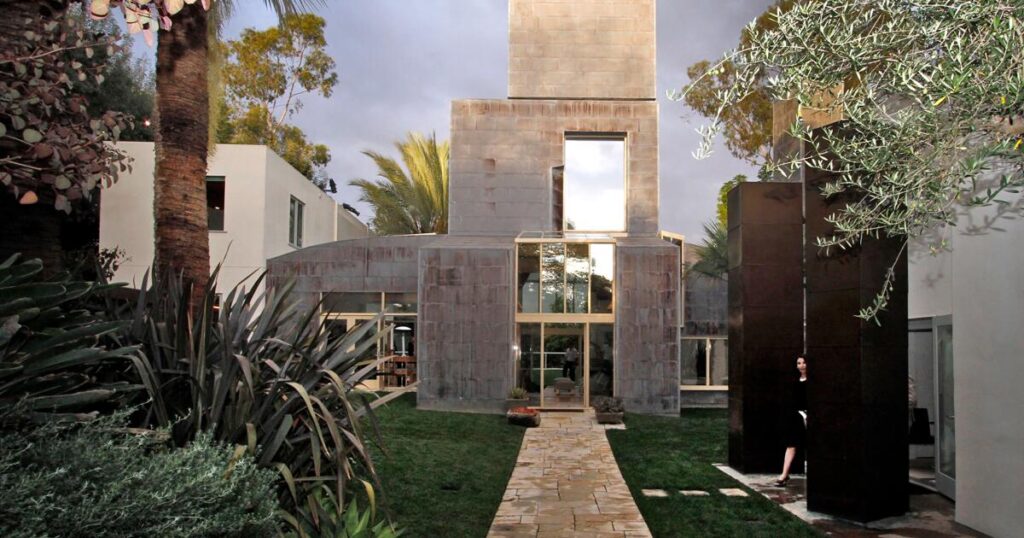
Completed for Rockwell and Marna Schnabel, the home represents a moment when Gehry translated his experimental vocabulary into a more refined domestic language, producing a residence that’s equally serene and expressive. It consists of shifting, interlocking pavilions organized around courtyards, gardens and a large rear reflecting pool. Gehry combines stucco, tile, metal and glass into a composition that feels sculptural and elegant, punctuated by the interiors’ dramatic heights and angled volumes, which open onto the landscape. Neighbors were at first suspicious, said Marna Schnabel, but soon they embraced the home. “It’s amazing how people react to something that’s not ‘normal,’” she said.
The post 11 fascinating Frank Gehry buildings in Los Angeles appeared first on Los Angeles Times.