On Thursday, the Brooklyn Family Court judge asked the woman the question for the seventh time:
Where was Jacob?
Jacob Pritchett, an 11-year-old so small that his neighbors in Brooklyn thought he was no older than 7, had not been seen for months. The police and a child welfare caseworker, prompted by a call to 911, had gone to his Brownsville apartment on Oct. 1 to find him. But the woman who answered the door, Jacqueline Pritchett, told them she had never had a child.
The apartment was spotless and had the pungent scent of cleaning products, and the police could see toys in the bathroom and in the closet, according to court transcripts. But Ms. Pritchett, 50, continued repeating her claim even after Judge Dawn Marie Orsatti issued a civil warrant on Oct. 10, charging her with contempt for not revealing where her boy was, and sent her to Rikers Island.
Ms. Pritchett has been brought back to court repeatedly, and on Thursday, Judge Orsatti tried again.
“If you tell the court the whereabouts of Jacob, I will release you from incarceration,” Judge Orsatti said.
Ms. Pritchett, dressed in brown sweatpants and sweatshirt, sat next to her lawyer and looked back silently. Her lawyer, Daniela Mancini, leaned over and said her client was invoking her Fifth Amendment right against self-incrimination.
Judge Orsatti sent Ms. Prichett back to Rikers.
The case has flummoxed detectives who scoured three months of surveillance footage taken from the building, looking for any sign of the boy. They traveled 330 miles to upstate New York to search a landfill where the garbage from the Brooklyn building was taken. They have interviewed neighbors and relatives, but no one has been able to help them figure out where Jacob, whom the police and neighbors have described as nonverbal, could be.
The answer appears to lie with Ms. Pritchett, but she has resisted giving one despite the efforts of the court, the police and the city’s Administration for Children’s Services.
Brooklyn Defender Services, the public defenders representing Ms. Pritchett, declined to comment about the boy’s disappearance or whether his mother knew anything about it. It has filed court papers arguing that she should be released immediately from Rikers Island, calling her detention a “constitutional violation.”
”The Family Court in this case is doing precisely what the constitutional guarantee against compelled self-incrimination forbids: It is exerting the court’s coercive power to force Ms. Pritchett to give testimony that could expose her to criminal prosecution,” wrote Brian A. Holbrook, a lawyer for Brooklyn Defenders, in a Dec. 2 petition.
It is unclear whether Jacob went to school. The police once made a check on him in 2017 after a 911 call, according to court transcripts. The Police Department said it is continuing to investigate the case.
The 911 call this fall came from a worried neighbor, according to a law enforcement official with knowledge of the case who was not authorized to discuss it.
Police officers went to the apartment in a three-story red brick building on Howard Avenue on Oct. 1. for a wellness check.
Ms. Pritchett told officers that she lived alone and “became loud and boisterous during the interview,” according to an internal police document.
During a hearing on Oct. 10, an A.C.S. caseworker, Gabriel Martindale, said that when he and the police arrived, he went inside and saw two mattresses. The apartment was dark and the electricity had been shut off.
The smell of cleaning products, he said, was “very strong.”
When Mr. Martindale asked whether the toys belonged to Jacob, Ms. Pritchett said they were hers. He then presented her with Jacob’s birth certificate and asked whether that was her son.
“She said she’s never had a child, that she has never had a period, that she’s never been with a man,” Mr. Martindale said. She then said “that she is Jesus Christ.”
Ms. Pritchett was taken to Brookdale University Hospital nearby for psychiatric evaluation. Neighbors said they had seen the police checking the building’s dumpsters. A police dog that later searched the apartment “got a hit” from the refrigerator inside the kitchen, the internal document stated.
On Oct. 9, the police went to Perinton, N.Y., near Rochester. Wearing white coveralls, they fanned out across the High Acres Landfill. The official said investigators went there after they learned the garbage collected at the Brooklyn apartment was sent there.
Neighbors said in interviews in October that they had not seen the boy in months, but had noticed that Ms. Pritchett, who had grown thinner, had lesions on her skin and sometimes talked to herself.
Shamik Burchet, who lives in the building and often saw Ms. Prichett and Jacob, said the child “seemed really neglected.”
When the boy was younger, Mr. Burchet said, his mother sometimes left him sitting in a stroller alone in the building’s lobby.
“Sometimes I’d have to sit with him,” he said. “Eventually she’d come back around.”
Evelyn Rolon, who lives nearby and works as a bartender, said the mother and son moved into the building about seven years ago.
“I would hate to think that a mom would hurt her own child,” said Ms. Rolon, 49, who often saw Ms. Pritchett and her son. “I’m hoping she gave him to somebody because she got overwhelmed.”
Sometimes, Ms. Pritchett would meet neighbors at block parties. The boy was usually not with her, but at a cookout in early September, Ms. Rolon said she gave the woman two burgers — one for her and one for Jacob.
“He would be making sounds. He wasn’t formulating words,” Ms. Rolon said.
Ms. Pritchett was often seen out alone. Other times, they could hear her screaming at Jacob in the apartment.
“We’d tell her, ‘Stop yelling at the baby like that.’ You know how someone yells at a grown person? That’s how she used to yell at the baby,” Ms. Rolon said. “You could tell she was overwhelmed.”
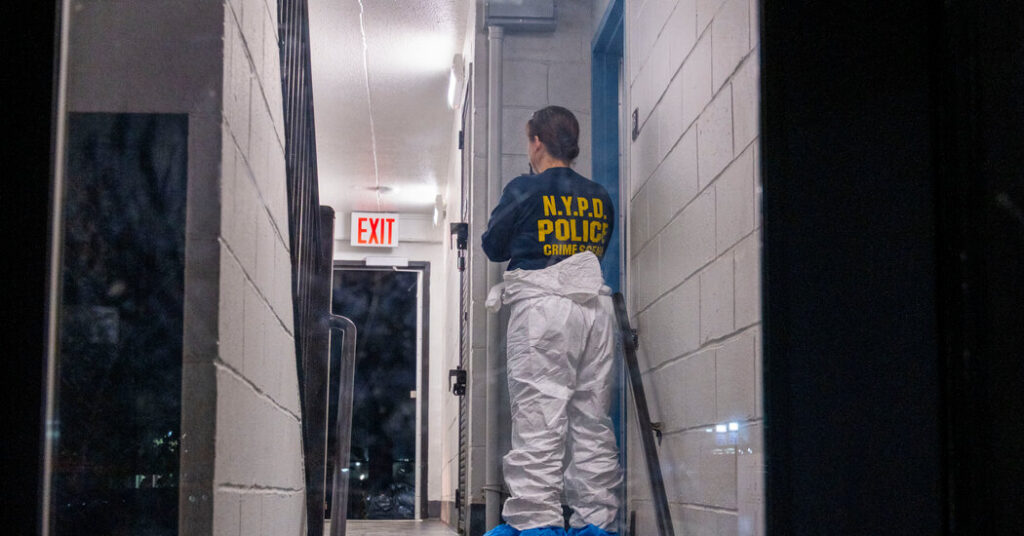
In October, when officers from the crime scene unit were searching the apartment, they sealed the door with a neon green warning sign that forbade anyone from coming inside without police authorization. Affixed just below that sign were several pink and yellow stickers with happy faces.
Chelsia Rose Marcius and Maia Coleman contributed reporting from New York City. David Andreatta contributed reporting from Perinton, N.Y. Susan C. Beachy contributed research.
Maria Cramer is a Times reporter covering the New York Police Department and crime in the city and surrounding areas.
The post Where Is Jacob? His Mother Won’t Say, and the Police Cannot Find Him. appeared first on New York Times.