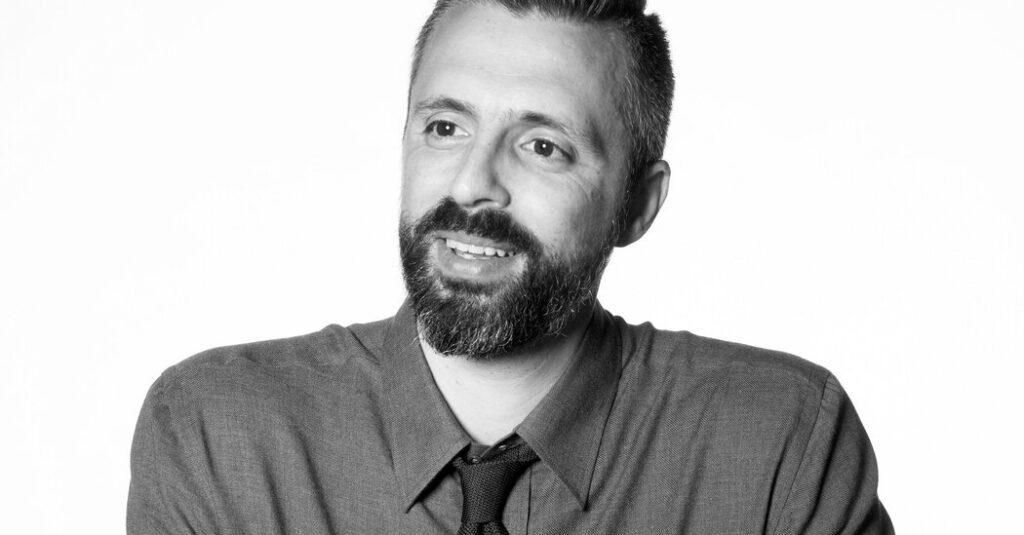
This is an edited transcript of an episode of “The Ezra Klein Show.” You can listen to the conversation by following or subscribing to the show on the NYTimes app, Apple, Spotify, Amazon Music, YouTube, iHeartRadio or wherever you get your podcasts.
Note: This conversation was recorded on Tuesday, Dec. 2, and does not reflect more recent developments in Congress’s review of the Sept. 2 boat attack.
Ezra Klein: Hello, and welcome to our end-of-the-year “Ask Me Anything” for subscribers — a storied tradition here at “The Ezra Klein Show.”
You’ve sent in a bunch of questions. Our executive producer and team have collated them and selected several based on some judgment and algorithm — I don’t actually know. [Chuckles.]
If I sound a little weird, I’m hosting from home with a cold. But I’m excited to be here, talking through your thoughts in conversation with our wonderful executive producer, Claire Gordon.
Claire, welcome back to the show.
Claire Gordon: Thank you, great to be here.
We’re doing this as a little bit of an experiment, structure-wise, because a lot of the listeners’ questions neatly tied into some of our bigger episodes through the year, and especially your column reads. And so I thought we would approach this not as a kind of “This Is Your Life, Ezra Klein” but as a “This Is Your Year, Ezra Klein” —
Klein: “This Is My Podcast, Ezra Klein.”
[Klein and Gordon chuckle.]
Gordon: “This Is Your Podcast” — let’s go through it from the top.
Klein: OK.
Gordon: So starting with: It’s February 2025, cold outside. Trump was inaugurated just a couple of weeks ago. And we publish your piece “Don’t Believe Him.”
Archival clip of Ezra Klein: In Trump’s first term, people said: Don’t normalize him. In the second, though, the task, I think, is a little bit clearer: Don’t believe him.
So 10 months later, should people still not believe him?
Klein: You know, I still believe what I said in that piece. But in retrospect, I wonder if I would have headlined it differently.
I think that many people took it to say that Trump and his powers are a figment of the imagination and to just ignore them or refuse to accept them, and let the institutions of the government do their work, and it will all go away. And that wasn’t the argument of the piece.
The argument of the piece was that power is contested.
I would say that the response early on from civil society was abysmal. They went beyond believing him — they went toward bending the knee to him, transacting with him, bribing him. I think that in terms of moments that are going to look really bad in history, the attentional oligarchs assembled at the inauguration; Tim Cook presenting Trump with a gift of gold functionally in the Oval Office; Paul Weiss, the law firm, just completely rolling over — a lot of moments like that are going to look bad.
But slowly, the law firms began to stop just accepting whatever the Trump administration wanted them to do. The universities began to fight back. So I think we’re in a better place in many ways than we were a couple of months into the administration.
I think the most disappointing dimension of this has been the Supreme Court. I would say that the various lawyers arrayed into the opposition here have done a remarkable job challenging what the Trump administration has sought to do seven ways from Sunday. And as we’ve discussed in episodes with Kate Shaw and others, the Supreme Court has gifted Trump powers that many people thought — prior to this, on a straightforward reading of the law — he just doesn’t have.
Now, it didn’t give him all of the powers. But I thought he would get maybe 20 or 25 percent of what he was asserting, and it looks to be more like he’s got, say, 50 to 75 percent of it. So there has been a lot of fighting.
But you can’t deny that executive power was, primarily by the Supreme Court, expanded over the past year in response to Trump asserting that it was much larger than anybody had heretofore believed.
Gordon: But you think we’re in a better place now, civil society-wise, in terms of people, you know, growing a pair?
Klein: Yes. [Chuckles.]
My read of it is that there is less fear of Trump and more sense that his political capital is waning. I think the 2025 elections were very significant here — a recognition that this is not just going to be the full story of this regime. Republicans, I think, are getting restive and nervous. You’re beginning to see retirements.
I think that a lot of American businesses, particularly very large corporations, are enthusiastically transacting with the Trump administration, trying to get the best deal they can out of an administration that governs through deal making. You see this with pardons, which have been just a bizarre and corrupt dimension of all this.
Those who want to pay to play are doing that. But my sense is there is a much more widespread belief than there was six months ago — because it is true now in a way it wasn’t then — that there’s a time limit on how unrestrained this administration is going to be able to be.
That time limit is according to the natural rhythm of politics. It’s pretty typical that in the first year of a new administration, they’re really setting the agenda. They have a lot of power. And then in the second year, as you begin to get closer to the midterms, a sense of vulnerability begins to take hold, and you see new things happening.
I’ve been somewhat cheered to see even Republicans in Congress saying that they want to investigate whether or not Pete Hegseth committed a war crime in apparently, allegedly, ordering a second boat strike. The fact that Republicans were beginning to talk about that seems notable to me.
Gordon: So that ties very neatly to my second question — and the second column read of the year. A few weeks after “Don’t Believe Him,” we publish another column read of yours about the first institution that seemed to be abdicating its power, this Republican Congress.
Archival clip of Ezra Klein: The most powerful branch of government, the branch with the power to check the others, is supine. It is not that it can’t act to protect its power, it’s that it will not act to protect its power. This is a nonplayer Congress. Behind it is a collapse of the structure of government the founders envisioned and the nationalization of the two parties.
And a big part of that piece was kind of a callback to your first book, “Why We’re Polarized.”
This tees up a question from Mark S., who’s a college professor who assigns “Why We’re Polarized” to his students. As a final paper, he gives his students a prompt that he was interested in hearing your response to, too: “Politics has changed in many ways since ‘Why We’re Polarized’ was published in 2020. Should I continue to assign ‘Why We’re Polarized’ in future semesters, or has its relevance to today’s political environment declined?”
Klein: It’s funny — my personal experience of that book is that it has roared back into focus for me in the last four to five months. “Why We’re Polarized” is about the way that the highly regionalized, ideologically diverse political parties of the 20th century — where you had very liberal and very conservative Democrats, very liberal and very conservative Republicans — how those parties collapsed or transformed into much more ideologically narrow and coherent groups by the end of the 20th century and coming into the 21st century.
And so basically you went from having a Democratic Party where you could at the same time have a Hubert Humphrey, who was very, very liberal, and a Strom Thurmond, who was very, very conservative — and a Republican Party that genuinely had liberal figures in it, people we would today recognize as more liberal than many Democrats. How that all falls apart is a story for the book, and I do think it’s worth reading.
The question of whether we can recapture any of it has become more and more on my mind. When I was writing that book, I was treating the sorting of the parties into these much more coherent units as an inevitability of media, of technology, of politics. And now I think we’ve gone so far in that direction and the parties have become so narrow that the party that wants to win any kind of enduring majority is going to have to find a way to become broader than this moment has thus far allowed.
To me, the question that “Why We’re Polarized” now poses is: Can we depolarize even just a little bit? And when I say “depolarize,” I don’t mean stop arguing with one another or stop disagreeing with one another. I mean creating more space for disagreement and diversity — ideological, regional, etc. — inside the parties.
So when I keep saying on the show: Can you imagine that in 2010, Democrats had Senate seats in South Dakota, North Dakota, West Virginia, Ohio, Nebraska, Missouri, Arkansas and Louisiana? — that’s the question on my mind. Because in a political system governed by place in the way ours is, there is no enduring answer to Trumpism and MAGA in a Democratic Party that is only competitive in, let’s call it, 26-ish states. So I think “Why We’re Polarized” is pretty relevant.
I will say, the thing that “Why We’re Polarized” did not talk about enough — in the new versions, there’s an afterword talking about it — is educational polarization as a decisive form of polarization. The Democratic Party was sorting into the higher-educated coalition, the Republican Party moving into a less-educated structure — that being a master key for the way polarization is functioning, particularly in the Trump era. This is the part where the book is the weakest. But the other stories it’s telling, I think, are pretty relevant.
Gordon: Well, it sounds like you may have already answered this, but part of Mark S.’s question was also that some of the argument of that book was that our polarization was so potent and dangerous because it was becoming less about policy disagreement and really about these layered group identities. You had race and geography and religion and all these things coalescing around the two parties.
But given recent election results, there has been some racial depolarization. Does that challenge the thesis at all?
Klein: It challenges it in the sense that the thesis is incomplete in the forms of polarization it’s looking at. The thing you see happening in the past couple of elections is functionally that educational polarization is beginning to overwhelm racial polarization, and ideological polarization is beginning to overwhelm racial polarization.
Again, “beginning to” — because we might be seeing a snapback among Hispanic voters that would change how that looks quite a bit. The Democratic voter margin among Black voters remains huge, even if it went down significantly from 2012 to 2024. But racial polarization is still there. And yes, educational polarization and its link to ideological polarization began to eat away at it.
Now that doesn’t mean that we don’t have polarization of stacked identities. But it does mean that the polarization and the particular way the identities are stacking looks a little bit different than it did at the end of the Obama era, which is when I began writing that book.
Gordon: All right, it’s March now. Your book with Derek Thompson, “Abundance,” came out. For folks who haven’t read the book, we handily adapted a part of it into audio and video.
Archival clip of Ezra Klein: The answer to a politics of scarcity is a politics of abundance, a politics that asks what it is that people really need and then organizes government and markets to make sure there is enough of it.
Question from Gabe J.: “Is ‘Abundance’ centrist? I’ve read the book, and it seems manifestly left wing” — and he goes on to list the ways it seems so. “I feel like the debate over ‘Abundance’ has been absolutely abstracted from the actual principles of the book.” Thoughts?
Klein: I mean, my view is that “Abundance” is best understood as a fairly left-wing project. Meaning “Abundance” is saying that there are certain things that liberals, and I think in this case also leftists, want government to deliver: Housing, and a lot more of it, particularly a lot more affordable housing; clean energy; and capable state capacity: the ability to build things like public infrastructure — high-speed rail, roads — rapidly.
So some of the backlash and the tendency to see it as a more centrist project surprised me. I think over time, I’ve come to understand it as having a couple of dimensions, which I’m not going to tell you there’s no kernel of truth to them. I don’t think they describe the project — but let me try to be fair to it.
One is that I have found there’s a kind of pushback from a populist left that has a much cleaner delineation of good guys and villains in politics. And they feel that “Abundance” doesn’t name corporations and billionaires as its enemies. That’s the most simple way to put it. If you listen to the episode I did with Zephyr Teachout, who comes from this tradition and is one of the critics, you’ll hear her say that pretty directly. And they would like to say that American politics should be about breaking the power of corporations, breaking the power of billionaires and if you can do that, you can achieve your goals.
I understood that as a separate project. There are certainly places where I would like to break the power of corporations, break the power of billionaires, tax them more, regulate them more. But then also, if we’re going to decarbonize the economy and build all this clean energy infrastructure, corporations are going to do a lot of it. If we’re going to build all this housing, and if we’re going to move to something like modular housing, corporations are going to do a lot of that.
I understand corporations as simply one more social and economic force among many. You can orient their energy and their power and their money for good with wise regulation and incentives and structures. Or they can be doing things that harm the public good.
And I would tax billionaires a lot more. But again, I understand them also as complicated and lined up on different sides of different issues.
I think what a lot of the people on the left would say is that they have a different theory of power than I do. That’s probably true, so far as it goes. I just think their theory of power is incomplete and doesn’t illuminate well a bunch of the issues I was looking at in that book. As I say ad nauseam, the reason Texas builds so much more housing than California is that Texas solved oligarchy — and California didn’t. So I think it has been absorbed into factional battles that don’t quite reflect the theory of the book.
At the same time, “Abundance” has been fairly well embraced by actual left-leaning politicians. Zohran Mamdani has talked about it.
Archival clip of Zohran Mamdani: Small businesses employ nearly half of all New Yorkers in the private sector. They keep the city running. But the last four years have been hard.
He just released videos on Small Business Saturday talking about cutting regulations and making things move faster.
Archival clip of Zohran Mamdani: That’s why, as mayor, I’ll appoint a mom-and-pop czar with a clear goal of making it easier to run a small business. The mom-and-pop czar will coordinate with agencies to speed up turnaround times, cut red tape and let New Yorkers start businesses sooner. Because you shouldn’t have to fill out 24 forms and go through seven agencies to start a barbershop.
Bernie Sanders was asked about “Abundance” by my colleague David Leonhardt, and he gave this, I thought, very funny answer, where he talked about how hard it was to get just two community health centers built in Vermont.
Archival clip of Bernie Sanders: You cannot believe the level of bureaucracy to build a bloody health center. It’s still not built. All right? So I don’t need to be lectured on the nature of bureaucracy. It is horrendous, and that is real. But that is not an ideology. That is common sense.
I don’t think you can accomplish left-wing goals without something like the policy program or the reform program we’re pointing toward in “Abundance.” But I think that there are a lot of people on the left who feel that I represent a form of politics where, in order for their form of politics to triumph, mine needs to be knocked off the pedestal or knocked out of contention.
Again, that’s not my view of it. I think these things are going to be more positive-sum than that zero-sum competition for influence and power and attention implies. But I think that has certainly generated a fair amount of the anger at the book.
To the question: Is ‘Abundance’ a left-wing project? — I certainly understood it as one.
Gordon: I would just add also, to be fair to the critics: As you admit in the book, a lot of these issues are difficult for liberals. They push in many cases against parts of the liberal coalition. A lot of these issues are going to involve things that unions don’t like or that environmental conservationists don’t like. And at the same time, folks see tech billionaires and Republicans say nice things about the book or speak at a conference called Abundance, and it generates a reaction.
Klein: Yes. I think I have two thoughts on that.
I think that people in these arguments are very selective about when they see odd-bedfellows coalitions as good and when they see them as bad. It was a common talking point that one reason Lina Khan is great is that JD Vance liked her. That was something the populist left thought was evidence of how well they were doing and how their arguments were winning converts in strange places. And by the way, I agreed with that argument.
But what I don’t accept is a view of politics where you can say: It’s great when JD Vance likes my people — but the idea that anybody unusual would find something valuable in “Abundance,” that any tech billionaire who wants to see California governance be more effective would read “Abundance” and think: Yes, I have run into this. I do think it’s too hard to build — and that would be seen as a negative for the project as opposed to a positive — that’s a part I probably don’t buy and that I think reflects a fundamental inconsistency in the way they are looking at politics.
I see the broadness of the coalitions that “Abundance” can build on some issues as evidence of its viability as a political project. I am not trying to create ideas that only people “on my side” like.
What’s strange to me about the reception “Abundance” got is that the people who it criticized most were, in fact, the most open to it. In a way, you would expect Gavin Newsom or Kathy Hochul — or name your sitting mayor or governor or members of the Biden administration, like Jake Sullivan or Brian Deese — to be incredibly defensive on that thesis, because the governance in the cross hairs was specifically their governance. Instead, they have mostly said: Yes, that’s what it looked like to me. I lived this book.
I don’t actually see it as obvious that parts of the liberal-to-left coalition that were not in power and were not responsible for many of these mistakes should see it as so much more difficult to swallow.
In truth, I don’t think they will. I think that if Zohran Mamdani decides he really wants to get things done using the New York City government — and by the way, a bunch of the people he has picked on his transition team have been very, very promising from an “Abundance” perspective, and I think Zohran has enough trust from them — that if he is rebuilding process in a way that is making it easier to achieve his goals and build affordable housing and all the other things he might want to do, that they’re going to cheer him.
So I think there’s a lot of effective and symbolic and factional fighting happening here that sometimes obscures how much more mixed the reality is: the reality of who is being critiqued in that book and what that book is trying to achieve — and the reality of who is responding to it and being willing to bring some of its ideas into play.
Gordon: Yes, things being flattened and simplified feels like the story of our time.
Klein: Particularly online. The online fights are much more flattened and simplified than actual governance, or for that matter, actual politics.
Gordon: I was debating whether or not to ask this question because it’s such a whiplash, but I actually think that’s kind of the point. The next column read was in April: “The Emergency Is Here.”
Archival clip of Ezra Klein: The emergency is here. The crisis is now. It’s not six months away. It’s not another Supreme Court ruling from happening. It is happening now.
So this has been part of the whole challenge of this year: So much of the theme of the show has been “Democrats in the wilderness,” “Democrats rebuilding,” while also turning and covering the Trump administration and trying to figure out what timeline we’re on and where we are on that timeline.
I’m curious in general about how you feel about how those things have balanced through the year for you on the show.
We also had a question from Jess C., in terms of threshold moments. She lives in Melbourne, Australia, and she’s just watching aghast from afar:
As Trump’s policies tend closer and closer to autocracy and fascism, I wonder whether you and your family or community have a threshold that would trigger you emigrating. Have you had these conversations among yourselves? And if not, what would make you start to consider it?
Klein: I certainly know of conversations like those. They’ve happened around me. I’ll be honest that I have not had them.
I’m American. I don’t plan to leave. And I’m not saying things cannot get so bad, but they’re not there yet, at least for me. It doesn’t mean they’re not there yet for other people, but I don’t think we are in any respect beyond stopping this from falling into various nightmare scenarios.
And I think maybe that gets to the way you set up the question. There’s been a feeling I have heard from others that there is some tension in the show between things like “The Emergency Is Here” and the pretty relentless examination of where Democratic Party politics went wrong. To me, those things are wholly one project, wholly one way of looking at the moment. Because if you really believe the emergency is here — and I do — then you have to get very disciplined and cold-eyed about what it would mean for the coalition that wants to end the emergency to wield power more safely and more in line with liberal values. And I mean that here in the more classical sense — to win.
There are strategies you will use, reckonings you will confront, compromises you will make when things are really bad that you won’t make when the stakes are lower. People don’t do chemotherapy because they enjoy it. They do it because cancer will kill them.
Trying to be very rigorous about where the Democratic Party has gone wrong, why it has shrunk, why so many people have come to see value and possibility in Trumpism, is to me a reaction to recognizing this is now really an emergency.
There’s a certain margin of: If the other side of the electoral coin is Mitt Romney, well, maybe there are painful things you don’t want to do, because if Mitt Romney wins, it’s not that bad. If it’s Donald Trump or JD Vance, then the question of: How are you competitive in Ohio, in Missouri, in Alaska, in Kansas, in Louisiana? — becomes paramount, because you need to start building a wall.
I’ve said this on the show in many different forms, but I really, really, really reject any kind of political nihilism right now. And I really reject the idea that all the answers will be the ones we want.
Gordon: Yes, something you said earlier this year has stayed with me, about how if you’re comfortable in this Democratic Party, then there’s a good chance that the Democratic Party will become a little uncomfortable for you if it’s going to change enough to be a Democratic Party that can win. I’ve been thinking about what are the personal principles and policies I care deeply about that I’m willing to — trying to crack that open for myself.
Klein: This goes back to “Why We’re Polarized.” I do think people have lost the instinct or the felt reality that parties are not meant to be just one thing. America has two political parties, functionally, that are supposed to represent some 343 million people.
To do that, you cannot have two very narrow coalitions. They have to be very diverse. Obviously, the most comfortable party is the imaginary one where you disagree with nothing and nobody, but you wield massive levels of majority power.
But it’s very uncomfortable, I think, to be in this period where the Democratic Party is more purified and Donald Trump, JD Vance and Stephen Miller are running the country.
In a nice line, Gavin Newsom said he thinks the Democratic Party should be from Manchin to Mamdani. I would find it more comfortable to be in a Democratic Party that could have Mamdani winning in New York City and that also could be winning elections of more conservative Democrats in West Virginia — and thus wielding power in more places and getting more things done and negotiating these questions within itself.
I don’t think people would, in practice, find that less comfortable. I think, in theory, they find it less comfortable. But I think what’s really uncomfortable is losing when the stakes are this high.
Gordon: We’re in early September now, and we release another column, calling on Democrats to strongly consider shutting down the government.
Democrats did shut down the government. They did it over health care. And you were somewhat critical of that as a choice and of Democrats in general this year, I’d say, who haven’t always played all the cards they maybe could have played.
This was a question from Tra H.:
Democrats this year have opted instead to strategically engage on key issues where they demonstrate strength, like health care during the shutdown. Despite criticism, this approach appears to be yielding notable results, reclaiming the affordability argument, achieving a strong election showing and a right-wing movement increasingly defined by internal divisions and extremism.
Is it possible that Democratic leadership’s restraint has been a key factor in these successes and that maintaining the strategy remains the most effective path forward?
Klein: The problem I always saw with the health care shutdown was that it was going to end in an incredibly unsatisfying way.
And I think it did that, because the truth is that if you couldn’t get them to negotiate with the right on premium subsidies, there wasn’t going to be enough energy in the long run on destroying the workings of the federal government to stop the Trump administration from doing something that they did legally and fairly normally.
Gordon: Just to pause here, because the question is moving beyond just the shutdown specifically and how it went: What is your broader report card on the Democratic Party and how they’ve played their chips this year?
Klein: I think it’s mixed. I don’t think they’ve been incredible. I don’t think they’ve been catastrophic.
But the thing that is really happening, that I think you see in New Jersey and Virginia, in New York City, in the Georgia utility elections, in the redistricting ballot initiative in California, is that the anti-Trump coalition is incredibly motivated.
I don’t think they’re primarily motivated at the moment from Democratic messaging. I think they are motivated by a mix of: one, the reality of what Trumpism has meant — from the tariffs to the deportations to the craziness and the cruelty of it all; and two, a lot of those same policies are depressing Trump’s own supporters, particularly the more fly-by-night ones who were disappointed in the Biden-Harris administration but were never MAGA ideologues who were trying to create an ethnonationalist country that prized heritage Americans above all else. They just wanted cheaper groceries, and they didn’t get them, so they’re staying home. And it has always been the case that many of Trump’s own supporters stay home when he’s not on the ballot.
So I don’t want to take anything away from Democrats. Trump has managed with tariffs and other policies to put himself strongly on the wrong side of affordability.
So I do think the Democratic Party has been very consistent and disciplined in making these arguments. But the person who is really harming Donald Trump the most day-to-day is Donald Trump — or possibly Stephen Miller and Russ Vought.
Gordon: But does this feel like a strategic path for Democrats going forward? Just to try to turn everything around and back to affordability or health care?
It was amazing, for many reasons, watching the Mamdani and Trump presser in the Oval Office, where every question thrown at Mamdani just put “affordability” in the answer.
Archival clip of Zohran Mamdani:
Reporter: Mr. Mamdani, does New York City love President Trump?
Mamdani: New York City loves a future that is affordable, and I can tell you that there were more New Yorkers who voted for President Trump in the most recent presidential election because of that focus on cost of living. And I’m looking forward to working together to deliver on that affordability agenda.
Is that what the Democratic Party writ large really should be doing?
Klein: I think so. Certainly, in the midterms, where it’s much harder to break through with a message.
Now, the question you get into is that I don’t think right now the Democratic Party understands what affordability would mean as a governing agenda.
If you take power and you don’t deliver, people are going to be mad at you again, and they’re going to boomerang back to the other side. So you’re going to need to figure out how to govern in a way that reconnects people to the fruits of effective government, where they can feel that you are doing something for them.
I think what we’re going to see in Virginia and New Jersey and New York City are early tests of that — where you have politicians who are elected in this moment, on this kind of agenda, trying to show they can deliver. And Democrats can take some lessons from that.
Then — and this is something you’ll probably hear us explore more in 2026 — I think there’s going to have to be more than affordability on the governing agenda, too. I think there are big questions of human experience and national experience right now, to say nothing of foreign policy, that affordability misses.
You need to know where the puck is at the moment and also be trying to see and shape where it’s going.
Great politicians, great political leaders, don’t just respond to the moment. They also shape the next moment. They have a vision of what it should be about. And that will become a more fundamental question, as well.
Gordon: Well, speaking of what Democrats should stand for, last month we published our last column read of the year — unless you get some brilliant idea in the next couple of weeks.
Klein: You would never allow me to do that at this point. [Laughs.]
Gordon: [Laughs.] People need a vacation.
“This is How Democrats Win,” calling for Democrats to become a bigger tent. We already talked about it a bit, but a lot of listeners wrote in wondering how the big tent should really work.
Daniel L. wrote:
Opening up a brand to include everything and everyone can very quickly leave that brand meaning nothing to anyone. So what’s a Democrat?
Klein: I think a Democrat is somebody who believes that the fundamental nature of the economy is unfair, and that the working class and the middle class need both a better deal than they’re getting and more resources than they’re getting.
I think a Democrat is somebody who believes you can solve big problems through a government able to act strongly and capably and agilely. And, I would add, from the abundance perspective, a Democrat is someone who makes governments actually work that way, as opposed to governments that don’t work that way.
And I think a Democrat is somebody who believes that this country is forever trying to realize the ideals of the Declaration of Independence, that we are far from equality right now, and you need to — in the incremental, difficult, transformational way we’ve always done it — keep moving forward on that.
And then, this to me is more about liberalism, although that’s involved in the Democratic Party, as well: I think there is something in there that we are going to have to hash out about what it means to live in a polity this big, diverse and disagreeable, and that there are modes of engaging with one another, modes of being in political community with one another, that need to be rediscovered.
I don’t think being a Democrat is going to mean you have to engage in politics in one way. But I think that it is not accidental that if you look at the Democrats who have won nationally in the last couple of decades — you look at Bill Clinton and you look at Barack Obama and you look, to some degree, at Joe Biden — you are dealing with figures who are fundamentally pluralistic in remarkable ways.
All of them, and particularly Clinton and Obama, had this almost eerie capacity to contain the contradictions and pluralism of this country within themselves.
Archival clip of Bill Clinton: We will build an American community again. The choice we offer is not conservative or liberal. In many ways, it’s not even Republican or Democratic. It’s different, it’s new, and it will work. [Applause.]
Archival clip of Barack Obama: There is not a liberal America and a conservative America. There is the United States of America. [Applause.] There is not a Black America and a white America and Latino America and Asian America. There’s the United States of America.
I think this capacity to exist in a state of grace amid disagreement, in a state of fellowship amid profound division, is a very important political project. It has an aspiration and an ambition and a mission unto itself.
I think there is a policy level to politics, I think there’s a political level to politics, and I think there is a spiritual and a communal level to politics. And Democrats are going to need to have answers on all of them.
I think too often they just want to have the policy answers: They believe they’re right, and they’re going to tell you why they’re right, and if you don’t agree and you’ve turned on them, well, so much the worse for you.
This question of: How do you do politics in places where people have come to not like you — or feel, more to the point, that you don’t like them? What is your relationship to people you disagree with?
I’ve been very critical over this year of the turn to what I think of as “deplorables” politics. I think that was a very, very dangerous turn in Democratic politics, and it needs to be something that the next iteration of the Democratic Party really purges from its system. Because creating a sense of community, even over big disagreement, with tens of millions of this country’s inhabitants and residents, is going to be a very important part of being an effective political party — but also just making this a politically livable place again.
Gordon: We got a number of questions about what the Democratic Party would offer young men. You’ve acknowledged on the show that young men seem, by various measures, to be struggling. What’s the policy offer or even just the messaging offer to young men?
Klein: If you listen to what I’ve been saying, you can hear me kind of hinting at some thinking I’ve been doing, and I’m not there yet on this. You’re hearing sketches of what I think.
There’s obvious policy answers. There is making housing affordable. That is a clear policy for young people just across the board — men, women, everybody.
There’s labor market policy, there’s A.I. policy, and, particularly, what A.I. is going to mean for young workers. There is this set of policies that I think we know are out there and many people have come to acknowledge already. And I don’t think that is going to end up being quite enough.
Gordon: Particularly once A.I. wipes out a significant percentage of entry-level jobs?
Klein: We’ll see. But yes, maybe.
I think there is something about the way in which liberalism — it’s sometimes hard for me to know exactly the coalitional unit I want to talk about here — but it has lost a sense of what at another time you would have called civic formation or just being a good person or being a good man or being a good citizen and having genuine views about the nature of the good, the nature of virtue, the nature of the kind of world that we want to inhabit that is not simply set up according to the dictates of the market.
People have all kinds of definitions of neoliberalism, and I think a lot of them don’t hold up. But one that has influenced me a lot is from Wendy Brown, who is a political theorist and professor emerita at U.C. Berkeley. She talks about neoliberalism as the logic of market exchange becoming a public logic: It is as if we become the market and look at everything the way the market would.
And among other things, I think that creates this desire to solve everything in terms of market answers: Bring down the price of this, bring up the wages of that. That’s all important. It’s all worth doing.
But I think it has robbed us of a language for what it means to live well. What does it mean to be decent? What does it mean to succeed? And it has also robbed us then of a policy standing to enforce some boundaries on what we allow in society — flooding society with online gambling; with porn; with algorithmic social media and now A.I., which I think in the darker corners is going to prove to be much worse than we even currently have any idea; and with commercialized cannabis, which I very much supported. Now I think commercialization is probably a bad idea that has been very bad for a segment of society. Even though I don’t want it to be illegal.
I think these are really hard because the refrain “Who are you to tell adults what they should and shouldn’t be doing?” is very powerful. And at the same time, the abdication of having views about what is good and bad in society, what we mean by human flourishing, is a real mistake.
I think if you look at where a lot of the energy on the new right is, it is in arguing over these kinds of questions.
Gordon: Yes, I was going to say, as you were talking, that I could hear Christians on the right saying: Yeah, where have you been?
Klein: I find that there is much more discourse about this in Christian, and, particularly, Catholic circles than almost anywhere else. I think that’s in part because it has maintained, within those religious and ethical frameworks, much more of a structure of talking about virtue and the good and flourishing — which does not need to be stretched over a market scaffold.
When I had Jonathan Haidt on the show earlier in the year, I remember saying to him that my critique of his book “The Anxious Generation,” which I really liked on a lot of levels, was that it was very thin on these questions of flourishing. It just ended up in these big arguments about how well you could identify the effects of social media, starting when you were young on literacy — or on income or depression rates when you were older. Everything had to be visible on a chart.
And everybody who has followed my career knows I love a good chart, but I think that is robbing us of some unquantifiable dimension of human experience and the ability to have opinions about it and debate them publicly, even if we don’t know what the answers to them are.
I’m not saying this is a full answer for young men, nor do I think it is just about young men. But I think there is an adriftness in our society that reflects a weakening of structures of formation and flourishing for young people. And I think that a successful party will at least be able to speak to that in a way Democrats now can’t.
There’s just been this big case where the F.T.C. lost its effort to sue Meta for antitrust violations for purchasing Instagram. If you look at the lawsuit and the judge’s decision, one of the things the judge says is that the way that the F.T.C. tried to define the market in which Facebook was a monopolist didn’t hold together.
Meta said: How can you say we’re not competing with TikTok? Of course, Instagram is competing with TikTok.
And on some level, I find that persuasive. Of course, Instagram is competing with TikTok. Instagram looks more like TikTok every single day.
But I think it also speaks to some thinness in the remedy we were trying to think about there, some way we were trying to fit that into the framework of antitrust and competition. Because the fact that TikTok emerged and created more competition for Meta, for Instagram, for Facebook — to me that didn’t make society better off.
It created more innovation in terms of how to addict people to algorithmically suggested vertical video. But I think that was bad, and my remedy for it isn’t that Meta should be given a monopoly, of course. But we need some way of describing what we do think should happen here.
I think we keep trying to address it in a logic that does not fit it, that is not just about market failures or cost or competition. It has to somehow move into an idea that is a little bit more spiritual. That’s a tough charge and a tricky thing for politics to have in it.
The problem of young men, the problem of young people, the problem of society, is bigger than politics. But politics is going to have to be able to speak to it.
Gordon: The guiding light for the Democratic Party for the future is to be able to stand up and say that being a gooner is bad.
Klein: [Laughs.] I think one reason that the Harper’s article on gooners — look it up, if you are so inclined — struck such an incredible chord is that in finding such an extreme manifestation of the adriftness and lack of moral structure in our society and seeing people who have fallen into a space where they’re not doing anything illegal, but they’re living in a way that I think many of us would consider to be living poorly — even as that language is very judgmental — it felt like it was an extreme manifestation of a truth we all know.
There is something about living in your masturbation cave, endlessly scrolling and receding from contact with the outside world, that is unnervingly similar to living in your TikTok or Instagram cave and receding from contact.
It’s not the same in that gooning is an intense manifestation of it, but it would not have struck a chord if it didn’t feel like a spectrum condition.
Gordon: One last wrap-up question, Ezra.
This is from R.S. Q.:
I have the sense that the show has been under more heat than ever this year, both because of particular episodes that strongly divided opinions that Ezra has chosen to confront directly, and that Ezra’s public profile has grown a lot.
How do you know when to keep pushing on a topic? How do you decide when it’s better to cool things down and release something like the Brian Eno episode? How do you plan without knowing how this heat is going to increase or not? And lastly, do you feel that this pressure has had consequences on you, personally, and how do you cope with that?
Klein: I think that’s all accurate. [Laughs.] As Claire knows, it’s a thing on my mind a lot.
I have a lot of different thoughts about this. I also want to be thoughtful about how much of them I put out publicly, because I think one of the things that most scares me is allowing it to get too much in my head.
There is some way in which I simultaneously have to hear criticism and hear the signals of anger or frustration or disagreement, and be able to respond to that openly — which does not always mean responding in the moment. Sometimes it means scheduling episodes that won’t come out for months, where I am engaging in a different way with ideas that feel distant or more in conflict. Sometimes it does mean responding in the moment, like having Ta-Nehisi Coates on.
But I need to somehow do that without getting so in the meta-narrative about me — which has exploded to new levels this year for all kinds of different reasons — that I’m seeing myself in the third person and that the show or my work becomes an exercise in brand management as opposed to an authentic exploration and engagement with the world.
So the danger to me or to the show, in my view, isn’t the heat — although the heat can be tricky — so much as it is the pressure to be programming from a space of defensiveness as opposed to an honest space. And I don’t know — I’m not going to tell you I have it all figured out.
Something you’ll probably see on the show over the coming year is that there is some engagement I want to do with people who have proven to be more opposed to me than I would have thought, or who see in me something that I don’t recognize in myself.
I can’t tell you how often I see pieces about me or about “Abundance” that will often be like: This is all an effort to dodge a wealth tax.
But I support a wealth tax. I have always supported wealth taxes. You can go all the way back, and I have been a consistent supporter of wealth taxes my entire career.
So some of it might mean I need to re-emphasize parts of myself and my ideology or my views that have just been quieter as I’ve been doing the “Abundance” work. Because, to me, that was a different topic.
I want to engage with the reaction the show creates openly and charitably — and recognize that I can learn from it. But not fearfully. Because at the same time, I do see some of these dynamics as ways of imposing social discipline within a group. That if you question things, you get this terrible backlash, particularly online: See, that’s a lesson to you. Don’t question that.
I don’t think that’s healthy. I think that these dynamics were stronger online in the, say, 2018 to 2023 period. I think it took the left coalition in a lot of bad directions.
So one reason I don’t do much social media and try to maintain some distance is to maintain some independence in my own thoughts — so I know what I actually think of things, not just what I think everybody else would think of my thinking about things.
Then, yes, personally, the amount of parasociality in my life has dramatically increased, even just on the street, in a way that, again, creates this tendency to see yourself in the third person, to be looking at yourself from outside yourself, from how other people view you. It can be strangely alienating from yourself.
But there’s nothing more irksome than hearing people complain about conditions that they have actively sought. [Laughs.] I chose to make this a video podcast recognizing that would make me a more recognizable figure. So I’ll leave that one at that.
Gordon: That brings us to the rapid-fire round. You have three seconds to think of your answer, but ideally, just shout it right out.
Klein: Oh, God. Because you know what I like is to be unprepared and off the cuff. [Laughs.]
Gordon: How many packs of Splenda do you eat in a day?
Klein: Four to six.
Gordon: If you could time travel, would you travel to the past or the future?
Klein: Ooh, I would have thought the future, but the feeling that really came up in me was maybe the past.
Gordon: The Roman Empire?
Klein: [Chuckles.] No, not the Roman Empire. I’m really fascinated by the American ’60s and ’70s, and there’s a lot I would like to see, a lot of people I would have liked to talk to.
Gordon: What is a piece of culture you love that would surprise people?
Klein: My favorite book growing up, which I still have a lot of love for and keep in my house, was Anne McCaffrey’s “The Dragonriders of Pern” trilogy. Maybe that won’t surprise people that I was very into a fantasy novel.
Gordon: [Laughs.] Never read it, but I feel not surprised —
Klein: About having a fantasy novel about having dragons as friends?
I don’t know, Claire. You know me. What’s a piece of culture I’m into that you think would surprise people?
Gordon: I mean, we were joking on the team that you would bust out some great reality-TV show, but you’re not that surprising a person.
Klein: I’m worried I’m just not that surprising of a person. [Chuckles.] I think my love of esoteric electronic music is now well-enough known that that’s not surprising, either.
Gordon: We all know it, Ezra. It’s part of the brand now.
Klein: I actually read a lot more theology than people probably realize I do, including not just a lot of Buddhist stuff, but a lot of Christian and Jewish theology, too.
When I was in college, I almost became a religious studies major and some part of me still wishes I could spend my time thinking about that.
Gordon: Huh! I didn’t know that.
The Democratic Party is putting up billboards all over America with a new slogan on it, five words or less. What should it be?
Klein: I don’t think I have a slogan off the top of my head for the entire Democratic Party. I will say, once Ben Wikler, the former chair of the Wisconsin Democratic Party, said to me that Democrats are the people who make government work for you. And I loved that as a description of it.
I didn’t quite think it was true about the Democratic Party as it exists — but I think it should be true of the Democratic Party. And if it was, then they could use that slogan: The party that makes government work for you.
Gordon: I was trying to make it five words: Government that works for you. I’ll take it.
Klein: Oh, don’t be such a stickler.
Gordon: The year 2025 in one word?
Klein: Rough.
Gordon: And I think that’s a wrap.
Klein: Thank you so much, Claire. And as this is our end-of-the-year AMA, I just want to say that standing outside of this show, it is impossible to know how much work this team does to make it happen — people whose voices are not regularly in the microphone or whose faces are not regularly on YouTube.
The producers, the video editors, the audio engineers, the fact-checkers, the logistics of production — it really is so much more complicated of a project than it was when I started it, and people on it work so hard to give it the production value and the integrity that it hopefully has, yet still move anywhere near the speed of the news.
It’s such a big team effort, and so many people put in long nights and early mornings and then drop everything to move in a different direction because something happened.
I just want to say thank you.
This was a rough year. It was a hard year to do this show in the way we did it. And it only happened because the people behind it are amazing and excellent and worked like hell to make it happen — all of us, a lot of times, and at a lot of times when we might have preferred not to be working.
So I hope it’s been a good show, a useful show for the audience this year, even when it’s been maybe challenging or frustrating. But the effort that goes into this behind the scenes is really tremendous. And I’m so grateful to the people who do it.
Gordon: Well, I’ll second that for the rest of the team. It’s the best in the business.
Klein: They really are. Thank you, Claire.
Gordon: Thanks, Ezra.
You can listen to this conversation by following “The Ezra Klein Show” on the NYTimes app, Apple, Spotify, Amazon Music, YouTube, iHeartRadio or wherever you get your podcasts. View a list of book recommendations from our guests here.
This episode of “The Ezra Klein Show” was produced by Claire Gordon, Kristin Lin and Marie Cascione. Fact-checking by Michelle Harris. Our senior engineer is Jeff Geld, with additional mixing by Isaac Jones. Our executive producer is Claire Gordon. The show’s production team also includes Annie Galvin, Rollin Hu, Emma Kehlbeck, Jack McCordick, Marina King and Jan Kobal. Original music by Carole Sabouraud and Pat McCusker. Audience strategy by Kristina Samulewski and Shannon Busta. The director of New York Times Opinion Audio is Annie-Rose Strasser. Transcript editing by Andrea Gutierrez, Sarah Murphy and Marlaine Glicksman.
The Times is committed to publishing a diversity of letters to the editor. We’d like to hear what you think about this or any of our articles. Here are some tips. And here’s our email: [email protected].
Follow the New York Times Opinion section on Facebook, Instagram, TikTok, Bluesky, WhatsApp and Threads.
The post What I Learned in 2025 appeared first on New York Times.