That’s all he got? Eight months?
On Thursday, Prada Group announced that Dario Vitale, the previously unknown designer who had dared to take the reins of Versace after Donatella, was leaving the fashion house after a single collection. The news detonated across the fashion-celebrity nexus, leaving behind a trail of shredded denim, chain mail and confusion.
His tenure was one of the shortest of the creative director era — and certainly the only one to be cut short after a debut that was one of the most buzzed about, debated and potentially influential of the recent runway season. Not only had it knocked the socks off jaded fashion critics like this one, but it resonated through social media and with that holy grail of heritage brands: Gen Z.
Indeed, less than three weeks before the announcement of Mr. Vitale’s departure, Olivia Dean, the 26-year-old British singer-songwriter nominated for a Grammy Award as best new artist, had worn four — four! — looks from his new collection as the musical guest on “Saturday Night Live.”
“It’s crazy,” Nicky Campbell, a fashion commentator who posts under the Instagram account Nickycbell and is known for his pithy and unvarnished red carpet recaps, said when he heard Mr. Vitale was leaving. “This was the first time I really understood the brand. It felt progressive and desperately needed.”
Hanan Besovic, who uses the Instagram account ideservecouture, posted, “I’m not happy, because I wanted to see more.”
Even Luca Solca, a luxury analyst at Bernstein who represents a very different perspective, was surprised. “It’s a pity,” he said, adding: Mr. Vitale’s “first step was good. I don’t understand why this happens.”
That the news of Mr. Vitale’s departure came only two days after Prada Group announced the completion of its nearly $1.4 billion acquisition of Versace from Capri Holdings was clearly not a coincidence. Mr. Vitale, after all, was hired by Capri management after Donatella Versace had decided to cede her design duties and become Versace’s chief brand ambassador. He was not Prada’s choice.
“We would like to sincerely thank Dario for his outstanding contribution to the development of the brand’s creative strategy during this transition period, and we wish him all the very best in his future endeavors,” went the Prada statement. It had no attribution, though Lorenzo Bertelli, Prada’s director of marketing and sustainability and the son of Miuccia Prada and Patrizio Bertelli, is now also the executive chairman of Versace.
Still, given that before joining Versace, Mr. Vitale had spent 15 years working under Mrs. Prada at Miu Miu, most recently as its design director, and given that during that time he had been critical to transforming it into the explosive success story of the Instagram generation, it seemed a particularly anodyne goodbye. Some had seen his presence at Versace as a potential attraction for Prada — he was a known talent, at least to them — but that was clearly not the case.
“He left the Prada Group, and then suddenly, he was part of the Prada Group again,” said Marigay McKee, a founder of the venture capital firm Fernbrook Capital and a former president of Saks Fifth Avenue. “That could be an awkward situation.”
Even before Mr. Vitale’s first collection was rolled out, there were rumors that he was not long for the job. First, it was said that Mr. Vitale would not have an official show, and Versace was not listed on the Milan Fashion Week calendar. Then Mr. Vitale had a surprise show, but neither Mrs. Prada nor Ms. Versace attended. The press team said that they didn’t want to “steal the limelight” from Mr. Vitale, but the conscious distancing was glaring — and it seemed like a backhanded message.
Then came the rapturous response to the show and its celebrity supporters. Aside from Ms. Dean, they include Addison Rae, who is also nominated for a Grammy as best new artist, Lorde and Aimee Lou Wood, the gaptoothed actress from “Sex Education” and “The White Lotus,” who appeared in Mr. Vitale’s first Versace eyewear campaign. Rumor had it that Mr. Vitale may have bought himself some more time. Even if Mr. Vitale’s clothes had not yet made it into stores and their literal impact was impossible to measure, their stylistic impact was another story.
“The show went very wide on social, because people were having such a strong reaction to it,” Mr. Campbell said. “It was like a seismic shift. You couldn’t avoid it.”
What Mr. Vitale did in his very short time at Versace was offer a new way to see the brand, which under Ms. Versace had seemed increasingly frozen in amber, locked into a rinse-and-repeat cycle of old goddess gown references and medusa head prints. You can understand it: She had taken over as creative director, a job she unexpectedly assumed after the murder of her brother Gianni, and had dedicated herself to keeping the company, and his vision, alive. It was a task she managed in the face of great pain and skepticism with resounding success, as the sale price indicated.
But the house needed someone else to take it forward. The fact that Ms. Versace accepted a recent Council of Fashion Designers of America award for positive change, with Amber Valletta wearing yet another version of the famous green palm-print gown that Jennifer Lopez wore in 2000, illustrates the point.
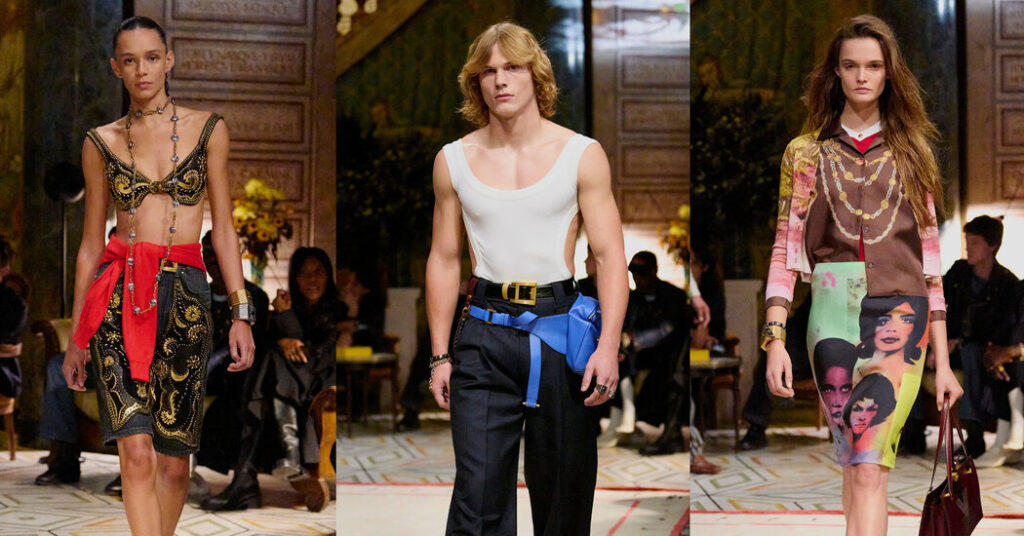
By contrast, Mr. Vitale, 42, took inspiration from Gianni Versace’s years in South Beach, Fla., and brought an accessibly hedonistic edge to his work, with crotch-hugging pants, studded leathers, a “Miami Vice” color palette and beaded skirts that flashed a bit of bottom as they swished past. Though the show shocked some of the old Versace customers, Mr. Vitale seemed a part of a new generation of designers that emerged last season, including Jonathan Anderson at Dior, Matthieu Blazy at Chanel and Michael Rider at Celine, who were less beholden to the past of the storied brands they had inherited and more focused on reshaping them for the future.
“It brought a new set of eyeballs to Versace,” said Robert Burke, the founder of a luxury consultancy. Abruptly abandoning Mr. Vitale’s vision, he said, means that “now even the educated fashion consumer is confused.”
The optics of dumping a designer so quickly, before it is possible to assess his success at retail, sends a particularly disheartening and jumbled message to designers and to consumers. There’s a reason Mr. Anderson said he had told Dior he needed at least “five collections” before his ideas would be fully realized. History is littered with the stories of wildly successful designers who took a few years to get it right, including Pierpaolo Piccioli and Maria Grazia Chiuri at Valentino.
“Many designers already feel a lack of job security,” said Karen Harvey, a longtime fashion headhunter, referring to the more than 20 designers who were fired and hired over the last year. “This will not help.” For retailers, she said, “this will impact sales, as the continuity of vision will likely not be there for future collections, so they will certainly have pause” before investing in the brand.
According to the Prada announcement, a new creative director will be named “in due course.” In the meantime, the creative team will be led by Emmanuel Gintzburger, the chief executive officer.
“It’s such a missed opportunity,” Mr. Campbell said. Whether it also becomes one of fashion’s cautionary tales is the question.
Vanessa Friedman has been the fashion director and chief fashion critic for The Times since 2014.
The post Versace’s Shocking Announcement appeared first on New York Times.