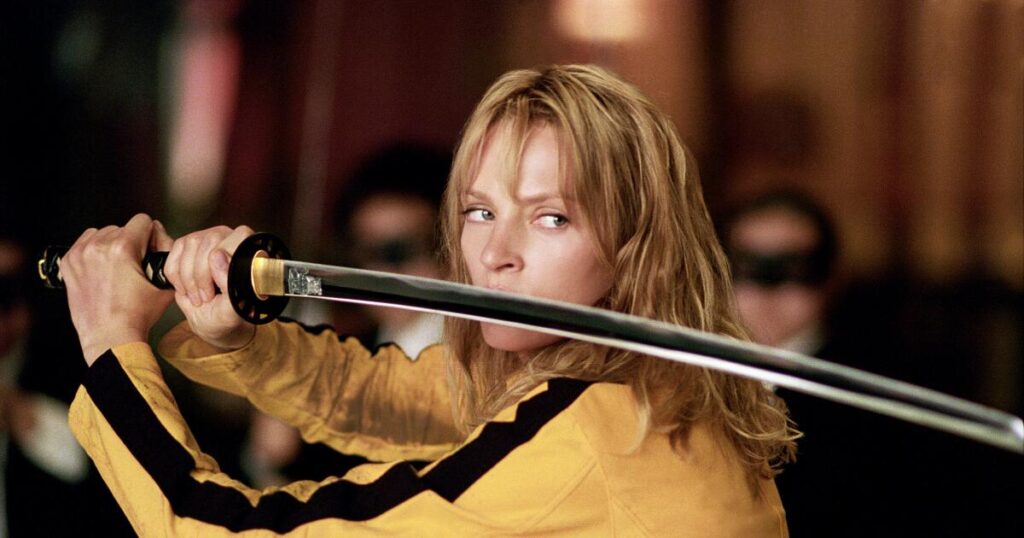
Credits at the end of “Kill Bill: The Whole Bloody Affair” attribute the creation of the Bride assassin to “Q & U” — stark-white capital letters that stand in for Quentin Tarantino and Uma Thurman. The coy initials look a little like something a romantic kid might carve into a tree. Fittingly, the four-and-a-half hours leading up to them feel like a sheaf of love letters. It’s an ode from a director to his star, to the chop-socky classics that inspired it and to every film nut willingly spending their day in a theater.
Big words. But the saga of the Bride, a.k.a. Beatrix Kiddo, a.k.a. Black Mamba, and her vengeance upon her lover Bill (David Carradine), the boss of her former Deadly Viper Assassination Squad, for mowing her down in a wedding chapel, makes for an awful big movie. Especially as it is now, rejiggered into the epic that Tarantino had in mind before Miramax made him cleave “Kill Bill” into two movies as cleanly as a Hanzō sword hacking off a head. The separate “Kill Bills” were released in 2003 and 2004 before “The Whole Bloody Affair” premiered at Cannes in 2006 and has been screened in rare one-offs ever since. Yes, it’s taken this long to get a wide release.
This cut sutures the two halves together while sustaining its unusual momentum. It’s a film so flush with ambition that it rarely crescendos; it can afford to chop sequences, songs, even genres, down to a string of snippets. The exhausting, invigorating totality of the thing sets its own tone. We’re pulled along less by suspense, but by the heaviness of the Bride’s quest, summed up best when Bill’s brother Budd (Michael Madsen), a target on her hit list, stoically says, “That woman deserves her revenge. We deserve to die. But then again, so does she. So I guess we’ll just see, won’t we?”
Fused into an arc, you’re doubly aware that “Kill Bill” is a domestic drama. The Bride’s first combatant, Vivica A. Fox’s Vernita Green, a hit woman-turned-Pasadena housewife, suggests dueling at 2:30 a.m. in all-black costumes on a Little League field. Her last opponent, Bill himself, pitches a private beach sword fight at sunrise “like a couple real-life honest-to-goodness samurais.” Both foes imagine a self-consciously cinematic scene, something audiences themselves assumed Tarantino would then deliver with gusto exactly as they described — isn’t that the hipster pastiche he’s after? He doesn’t. Both die right where they are at home.
In between those kitchen and backyard deaths, we speed from Texas to Tokyo to China to Mexico, with plenty of other people dying along the way. But the story circles back to insist that home is where the violence starts, literally and emotionally. Bill slays a church of innocents to get back at his ex. The Bride offs 10 times as many victims to get back at him.
“There are consequences to breaking the heart of a murdering bastard,” Bill says, unrepentant to his last breath. It’s the sign of the Bride’s wisdom that she rarely toys with her prey. Once weapons are drawn, she kills as fast as she can.
The changes in “Whole Bloody Affair” aren’t so dramatic that casual admirers will notice. Tarantino peels away the cliffhanger at the end of “Vol. 1” and expands an animated sequence that he didn’t have time to finish. One black-and-white bloodbath is now in color, with the Bride spinning around a dance floor slicing off limbs like a food processor. (Gotta love the sprinkle-hiss sound effect of those gore geysers.)
Few will mourn that the hokey Klingon proverb in the opening crawl has been swapped out for a sincere salute to Kinji Fukasaku, the director of “Battle Royale.” There’s also a post-credits “Fortnite”-style cartoon of an earlier excised character, Gogo Yubari’s sister Yuki, who Tarantino was right to delete the first time.
What has changed is the culture. A decade after “Kill Bill,” Hollywood started posturing like it had suddenly invented the feminist action movie. “Wonder Woman” and “Atomic Blonde” and “Captain Marvel” with its tagline, “Everything begins with a her(o),” were more sodden with self-congratulations than blood and guts. Tarantino by this point was considered what the kids call “suss” — not canceled, but dinged by the reveal of Thurman’s car crash on the set, as well as his open admiration of feet, an in-joke between him and viewers until some of them decided he didn’t know when he was being funny.
But “Kill Bill” did empowerment better. It’s an intensely female movie with miscarriage grief, sexual assault and an assassination attempt that’s aborted when one character reveals she just took a positive pregnancy test. The Bride has a maternal streak, spanking one teenage thug with a sword while scolding, “This is what you get for f—ing around with yakuzas!” But on the battlefield, she and the rest of the Deadly Viper Assassination Squad are warriors first, women inconsequentially. That’s respect. (And 2007’s underappreciated “Death Proof,” which builds on the camaraderie between the Bride and her doomed bridesmaids, holds up just as well. If that grindhouse film had been made by anyone with less pressure and baggage, I suspect it’d be officially deemed a mini-masterpiece.)
Here, the great Gordon Liu of the 1978 Shaw Brothers’ landmark “The 36th Chamber of Shaolin” plays an allegedly thousand-year-old martial arts instructor who is as sexist as one might guess from his age. But as twisted as it sounds — and this may have contributed to Tarantino’s ill-fated insistence that Thurman do her own stunt driving — there’s valor in how he treats the Bride as harshly as he would any student, sneering that her Tiger Crane kung fu technique is “really quite pathetic” and scuttling her bowl of rice to the ground when her knuckles are too bruised to use chopsticks.
The valor comes when she picks her chopsticks up. You get why Kobe Bryant nicknamed his alter ego the “Black Mamba” after her. What’s more ironic: Bryant, who in 2003 was at his personal nadir after a rape accusation, drawing strength from a rape victim? Or “The Whole Bloody Affair” opening with an executive producer credit for Harvey Weinstein? Legally, I assume there’s no way around the latter and, as queasy as it is to stomach, the frankness of it fits the tone. The film recognizes sexual violence as a grim fact, never frothing it up with violins or using a character’s lecherousness as an excuse to leer. It’s horrible and it’s sickening and it’s just there.
The orderly Buck (Michael Bowen) who sells the comatose Bride’s body during her hospitalization is a snickering imbecile. All of the goons in this movie are. Even the Bride’s groom-to-be, Tommy (Chris Nelson), a Guy Fieri-looking himbo, comes off as a sweet dope who doesn’t know his girlfriend at all. But true villains like Bill are complex.
As a suspicious young cineaste, I used to see the 34-year age gap between Bill and the Bride as just another dumb Hollywood fantasy where older guys land whatever babe they want. I must have wanted the film to come out and tell me that it knows their romantic pairing feels wrong and maybe even explain why, like most movies would.
In a word or two, the film hints that she’s an orphan and he has daddy issues. Maybe that bonds them. But we don’t know how they met or when, or how innocent the Bride might have been — or not — before she teamed up with a professional killer. We don’t even know if he brought her into the squad as a new replacement for Darryl Hannah’s eye patch-wearing Elle Driver, although there’s a venom in Hannah’s dynamic turn that makes me suspect that he did.
After marathoning “The Whole Bloody Affair,” it’s startling to realize how little we really know about the Bride and Bill’s relationship, the beating heart behind all of this agony, and it’s stranger still to realize that the mystery doesn’t need to be solved. You see the complexity of their toxic bond whenever the camera closes-up on Thurman’s face. The emotions are all in there — sorrow, love, rage, pain, hope — and in some shots, like an aerial view of the Bride curled on the floor of a bathroom, I’m not even sure which one I’m seeing. Maybe all of them at once?
Thurman benefits the most from spending an entire afternoon in the thrall of her performance. The scene that most wowed me came after two hours of carnage and an intermission when the story leaps back to the minutes before the wedding chapel massacre, the last moments when the Bride thinks she might have secured herself a happy, nuclear family. She’s so trusting that it hurts.
Bill walks in, but he doesn’t immediately go on the attack. He lets his ex try to win his forgiveness — maybe even his approval. “You promised you’d be nice,” the Bride teases when he makes fun of her groom’s bleached hair. She’s a little afraid of Bill, but not enough. She still thinks kindness might get the best of him. She’s going to need swords and knives and fists and every ounce of resolve she’s got.
The post Uma Thurman rules every brutal minute of the 4½-hour ‘Kill Bill: The Whole Bloody Affair’ appeared first on Los Angeles Times.