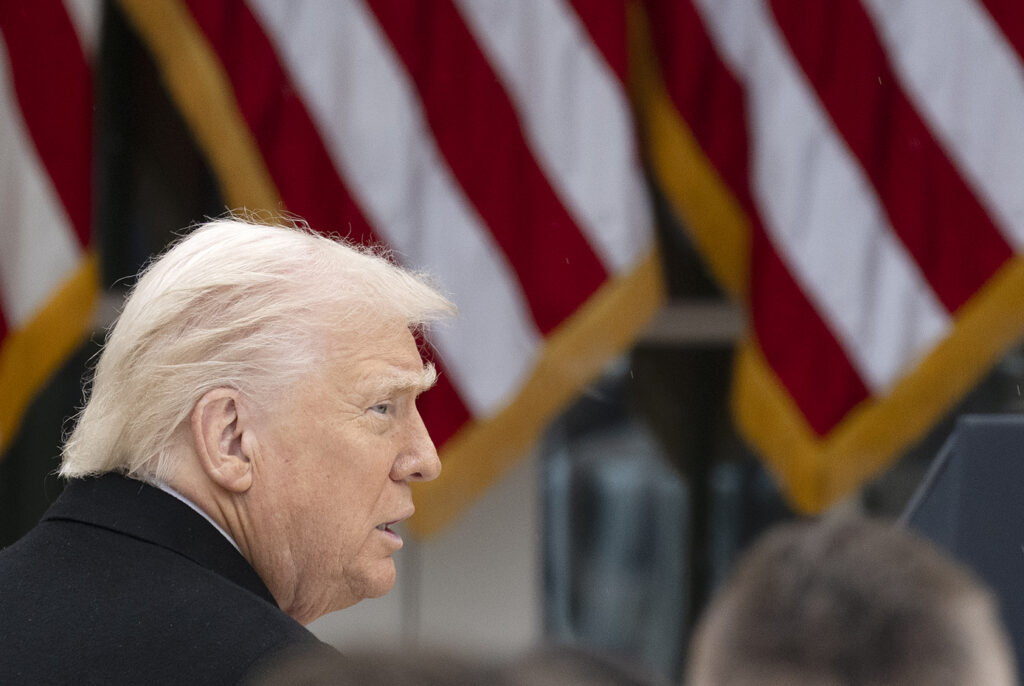
The Trump administration unveiled a new National Security Strategy late Thursday that called for the reorientation of the United States’ global military presence to the Western Hemisphere as a means of boosting security and combating drug trafficking, while issuing a scathing criticism of European partners and being light on details about Russia.
The document— a congressionally mandated mission statement that sets out an administration’s overarching priorities for global engagement, economic bargaining and military might — was posted on the White House website late Thursday, and focuses in part on a strategy it described as the “‘Trump Corollary’ to the Monroe Doctrine” — a reference to the 19th-century policy position expressed by President James Monroe, which declared the Western Hemisphere a U.S. sphere of influence.
“The days of the United States propping up the entire world order like Atlas are over,” the strategy said, adding that the administration would prioritize restoring “American preeminence in the Western Hemisphere” to “protect our homeland,” working with partners “control migration, stop drug flows, and strengthen stability and security on land and sea.”
The strategy is highly critical of European governments. “The Trump Administration finds itself at odds with European officials who hold unrealistic expectations” for the war in Ukraine, the document said, describing them as belonging to “unstable minority governments.” The U.S. sees it as a “core interest” to “negotiate an expeditious cessation of hostilities in Ukraine” and “establish strategic stability with Russia,” the document added.
The strategy said that Europe risked “civilizational erasure” and that certain NATO countries would become “majority non-European” soon, and expressed support for right-wing, populist parties that have a surge in support in recent years. “The growing influence of patriotic European parties indeed gives cause for great optimism,” it said.
The last National Security Strategy, released under President Joe Biden in 2022, was dedicated largely to the U.S.’s posture toward Russia and China. It condemned “Russia’s brutal and unprovoked war” on Ukraine and described “constraining Russia” as a priority.
The latest strategy, however, gives few specifics about Russia other than noting that “many Europeans regard Russia as an existential threat” and asserting that the U.S. should prioritize “managing European relations with Russia … both to reestablish conditions of strategic stability across the Eurasian landmass, and to mitigate the risk of conflict between Russia and European states.”
The 2025 National Security Strategy supports an end to any potential expansion of NATO, something Russia has long sought. Ukraine has pressed for NATO membership, believing that being part of the military alliancewould protect it against attacks by Russia.
The document also appears to accuse European governments of promoting continued conflict with Russia and claims they do so without the support of their populations. Russian rhetoric in recent months has continually sought to place the blame for its ongoing war against Ukraine on the European nations, calling them warmongers. “A large European majority wants peace, yet that desire is not translated into policy, in large measure because of those governments’ subversion of democratic processes,” it stated.
The U.S. no longer needs to prioritize the Middle East in its foreign policy, the strategy said, describing the area’s energy reserves as the “historic reason” for America’s focus there. “Energy supplies have diversified greatly, with the United States once again a net energy exporter,” it said.
It added that the U.S. must stop “hectoring” its partners in the region, specifically referencing the “Gulf monarchies” such as Saudi Arabia and the United Arab Emirates that have been criticized by past U.S. administrations over human rights concerns. Instead, the strategy emphasized the region was becoming “a place of partnership, friendship, and investment.”
Trump’s strategy advocates curbing Chinese power around the world and maintaining the status quo on Taiwan, but also calls for “maintaining a genuinely mutually advantageous economic relationship” with Beijing as part of U.S. growth.
China wants to see Taiwan, a self-governing, democratic island under the full control of its government, which has raised fears of a potential future invasion. Under Trump administration, the U.S. maintains “our longstanding declaratory policy on Taiwan, meaning that the United States does not support any unilateral change to the status quo in the Taiwan Strait,” the document said.
The post Trump’s security strategy criticizes Europe, seeks ‘stability’ with Russia appeared first on Washington Post.