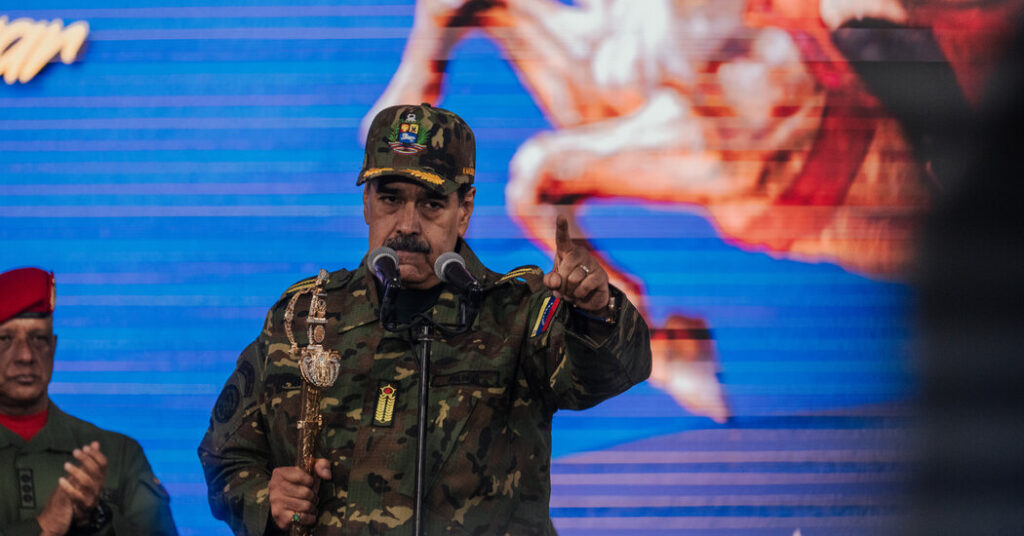
President Trump has been increasing pressure on Venezuela’s leader, Nicolás Maduro, labeling him the head of a terrorist organization, amassing warships in the Caribbean, claiming to close the Venezuelan airspace and suggesting imminent strikes on the country.
The Trump administration publicly asserts that its campaign is aimed at preventing Venezuela’s government from sending drugs and criminals to the United States. Former and current officials, however, have said in private that the White House’s ultimate goal is the departure of Mr. Maduro, who has held on to power despite losing a presidential election last year.
“It’s not a pressure campaign, it’s much beyond that,” Mr. Trump told reporters on Wednesday, referring to Venezuela. He added, “You can’t cheat on elections like they did, and be stupid.”
When a reporter asked him last month if Mr. Maduro’s days as president were numbered, Mr. Trump answered, “I would say yeah.”
The New York Times has reported that the Pentagon has drawn plans for potential military actions in Venezuela, including for Special Operations forces to try to kill or capture Mr. Maduro.
People close to Venezuela’s government have said the stress of resisting Mr. Trump’s pressure has tired Mr. Maduro physically and emotionally, and he has tightened personal security in response to Washington’s threats. His officials suggested to Washington this year that Mr. Maduro might consider leaving office in 2027. The Trump administration, however, has pushed for a quicker resignation.
Should Mr. Maduro end up losing power, his replacement would be largely determined by the manner of his departure. A voluntary resignation, an internal coup or an external military action would each produce a different set of contenders.
The Moderate: Delcy Rodríguez, Vice President
Mr. Maduro’s economic leader, Delcy Rodríguez, would be the first in line to replace Mr. Maduro if he were to step down or become incapacitated, according to the Venezuelan Constitution. As an interim president, Ms. Rodríguez would be required to hold new elections, though the timing would depend on when Mr. Maduro stepped down.
A relative moderate, Ms. Rodríguez is the architect of a market-friendly overhaul that has stabilized the Venezuelan economy after a prolonged collapse. Her privatization of state assets and conservative fiscal policy have left Mr. Maduro better prepared to resist this round of economic pressure from Mr. Trump.
Partly educated in France, Ms. Rodríguez has cultivated ties with Venezuela’s economic elites and with foreign investors and diplomats, presenting herself as a cosmopolitan technocrat in a militaristic and male-dominated government.
Her claim to the presidency, however, would be weakened by Mr. Maduro’s election theft. The opposition argues that Mr. Maduro and all of his executive appointees are usurpers.
The Hard-Liner: Diosdado Cabello, Interior Minister
Mr. Maduro’s main internal rival, Diosdado Cabello, is the face of the country’s repression apparatus, according to rights groups, as well as the voice of a hard-line faction focused on preserving the current government at any cost.
A retired lieutenant close to Mr. Maduro’s predecessor, Hugo Chávez, Mr. Cabello has so far been one of the biggest Venezuelan political winners of Mr. Trump’s pressure campaign.
The invasion threat has weakened Mr. Cabello’s more moderate internal rivals, who supported an economic and diplomatic thaw with the United States. Washington’s warmongering has also provided a useful foil for Mr. Cabello’s caustic political style. He has used his frequent public rallies and television show to bash opponents,and rally the ruling-party faithful against the foreign threat.
As the interior minister, Mr. Cabello tightened his grip on Venezuelan security forces over the past year, installing allies in key posts and overseeing systematic arrests of opposition sympathizers.
His harsh tactics, however, also mean that Mr. Cabello is the senior official with most to lose from a political transition. Like Mr. Maduro, he faces drug trafficking charges in the United States, and he has a $25 million bounty on his head.
The United Nations has called the repression by security forces loyal to Mr. Cabello and his allies crimes against humanity. This means that he would be the primary target of any formal or vigilante justice campaigns that could follow Mr. Maduro’s departure.
Mr. Cabello’s influence inside Venezuela’s security forces has complicated Mr. Maduro’s chances of leaving power without provoking a military coup, political analysts say.
The Nobel Laureate: María Corina Machado, Opposition Leader
A longtime conservative politician, María Corina Machado led a grassroots election campaign that managed to win, and then prove, a landslide victory in last year’s presidential vote, which is widely recognized as legitimate around the world.
That effort earned her this year’s Nobel Peace Prize.
A wave of repression that followed the vote forced her to go into hiding inside Venezuela. She has continued denouncing Mr. Maduro’s power grab and human rights abuses in video addresses.
Ms. Machado has long ruled out any compromise or talks with Venezuela’s government and has been an unequivocal supporter of Mr. Trump’s pressure strategy against Mr. Maduro.
Her courage and unwavering political agenda have made her the most popular politician in the country, according to polls. That same rejection of compromise, however, has made her an anathema to Venezuela’s governing elites, complicating her path to a negotiated transition.
The Elected: Edmundo González, Retired Diplomat
Edmundo González was a little-known retired civil servant until last year, when he became the opposition’s unlikely presidential candidate. He replaced Ms. Machado, who had overwhelmingly won the primary but was barred from participating in the election by the Maduro government.
Unable to take office after the vote, he fled Venezuela for Spain, ceding the opposition spotlight to Ms. Machado. In occasional statements from exile, he has struck a more conciliatory tone than his political mentor.
“It would be against my principles and against my lifelong record to advocate any violence, let alone a coup d’état,” he wrote in The Economist magazine last year.
Mr. González’s electoral win gives him the strongest legal claim to the presidency, experts say. His weak political connections, however, would make it difficult for him to hold on to power in the volatile period likely to follow any transition, they add.
The Operator: Jorge Rodríguez, Congressional Speaker
Jorge Rodríguez is the older brother of Delcy Rodríguez and is Mr. Maduro’s chief political strategist. He has represented Mr. Maduro in talks with the United States for years, including in negotiations with the Trump administration this year.
His claim to power would stem from his official job as the speaker of Venezuela’s Congress. The ruling party won a majority in a parliamentary vote in May after running largely unopposed.
As the head of an elected body, Mr. Rodríguez could have political legitimacy in a transition, some constitutional experts say. Others disagree, arguing that he should have no role because the parliamentary elections were neither free nor fair.
A skilled political operator, Mr. Rodríguez lacks popular support, polls show. His standing inside the government has also been weakened by his decision to go ahead with last year’s presidential election, even as the polls showed Mr. Maduro heading for a decisive loss.
The General: Vladimir Padrino López, Defense Minister
Venezuela’s highest-ranking officer, Gen. Vladimir Padrino López, has been entrusted by Mr. Maduro for years with preserving the loyalty of the disparate factions of the country’s armed forces.
He occasionally made pro-democracy references in previous years, and media reports implicated him in a failed coup attempt against Mr. Maduro in 2019. This has led political commentators and journalists to speculate for years about his ultimate loyalties.
In public, Gen. Padrino López has staunchly defended Mr. Maduro, and units under his command have suppressed anti-government protests over the years.
Gen. Padrino López has no formal path to the country’s top office. The vital position of the military in Venezuelan politics, however, means that he could play an important role in any transition, according to analysts and people close to the government.
Sheyla Urdaneta contributed reporting.
Anatoly Kurmanaev covers Russia and its transformation following the invasion of Ukraine.
The post Trump Wants Venezuela’s Leader to Go. Here’s Who Could Replace Him. appeared first on New York Times.