The Supreme Court is in the process of deciding the fate of President Trump’s tariffs, but even if the administration loses, it might not matter, said Treasury Secretary Scott Bessent.
At issue is the Trump administration’s use of the International Emergency Economic Powers Act (IEEPA) to justify some of its tariffs, including its baseline 10% duty on almost all nations. IEEPA, passed by Congress in 1977, gives the President “broad authority” on economic issues like tariffs after declaring a “national emergency,” for which the White House has pointed to elevated fentanyl imports from abroad.
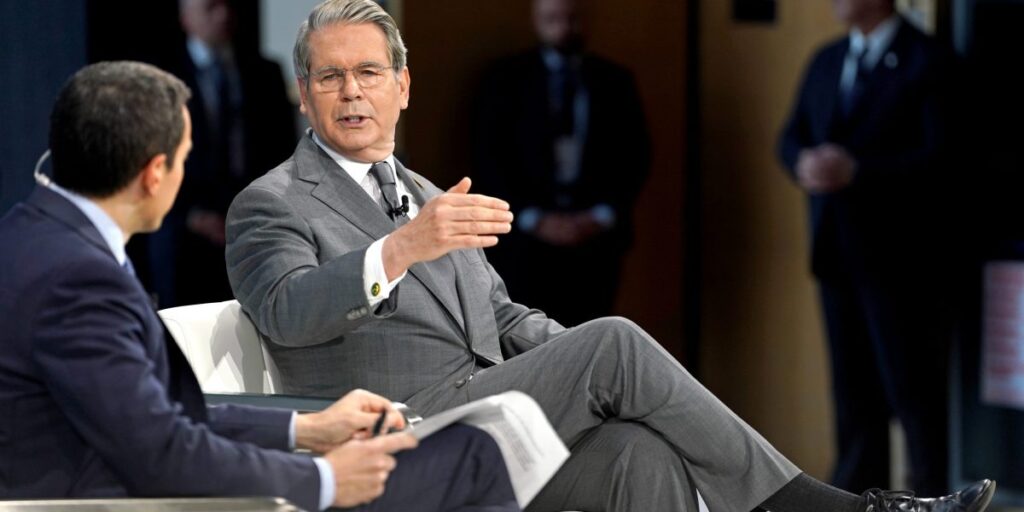
Although not guaranteed, it’s possible the Supreme Court will decide the fentanyl crisis can’t be used as an emergency to justify broad tariffs on U.S. trading partners, which would make many of the administration’s tariffs invalid. In that case, the White House will just pivot to another justification to make tariffs permanent, said Bessent during the New York Times DealBook Summit this week.
“We can re-create the exact tariff structure with 301s, with 232s, with the, I think they’re called, 122s,” he said, referring to several sections of various trade acts that could serve as alternatives to the administration’s current justification for its tariffs.
When interviewer and DealBook editor Andrew Ross Sorkin questioned whether these measures could exist permanently, Bessent replied, “Permanently.” He later clarified that tariffs under Section 122 of the Trade Act of 1974 would not be permanent.
In sum, the Constitution gives Congress purview over tariffs, but over the years it has given the executive branch more leeway to levy them through the trade acts mentioned by Bessent.
Each of the sections Trump’s team may consider comes with its own set of pros and cons. Section 122 would be the quickest method to restore tariffs in the case of a Supreme Court loss because it doesn’t require investigation of a trading partner’s practices. Using this justification would let the government levy tariffs of up to 15%, with certain limits, but only for 150 days before congressional action is required.
The other two sections, as Bessent pointed out, have no time limit or limit on the tariff rate that can be levied, although they have other caveats. To justify tariffs under Section 301 of the Trade Act of 1974, the administration would need to conduct an investigation into practices by its trading partners it sees as “unjustifiable” or “unreasonable.” Trump did this successfully during his first administration to justify tariffs on China in 2017.
Alternatively, the administration could turn to Section 232 of the Trade Expansion Act of 1962 and try to justify tariffs as an issue of national security. The White House is already using this justification to underpin its tariffs on steel, aluminum, and autos, and those are not being scrutinized by the Supreme Court.
Finally, experts have previously told Fortune, Trump could also ask Congress to pass a bill giving the president explicit authority to levy tariffs. Although it would require some caveats in terms of scope, and possibly duration of the tariffs, it would likely receive bipartisan support, international trade law expert and University of Kansas Law School professor Raj Bhala told Fortune.
Despite the options in the administration’s back pocket, Bessent said he was optimistic about the White House’s chances at the Supreme Court.
He also said a loss in court would be “a loss for the American people,” and pointed to the fact that China agreed to tighten control over exports of precursor chemicals used to make fentanyl earlier this year—a decision which he attributes to pressure created by the administration’s tariffs.
“I have been very consistent on this, that tariffs are a shrinking ice cube. The ultimate goal is to rebalance trade and to bring back domestic production,” Bessent said.
The post Treasury Secretary Bessent insists Trump’s tariff agenda is ‘permanent,’ saying the White House can re-create it even with a Supreme Court loss appeared first on Fortune.