Only two decades ago, all nine Supreme Court justices agreed that extreme partisan gerrymandering could violate the Constitution, though they differed on what courts should do about it.
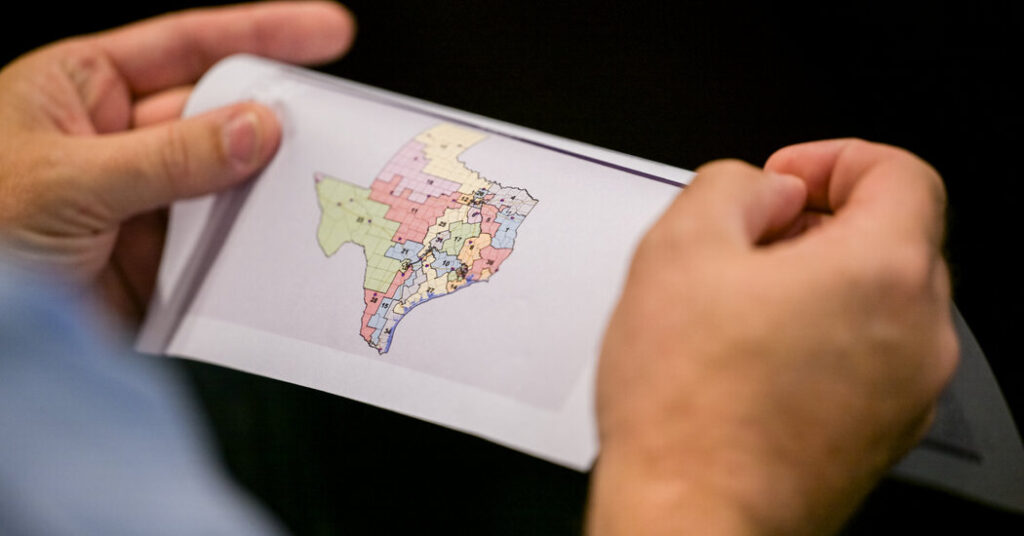
On Thursday, by contrast, the court’s conservative majority allowed Texas to use voting maps made to disadvantage Democrats in the 2026 election, without a hint of constitutional difficulty. To the contrary, the majority chastised a lower court for not taking the state at its word that politics, not race, motivated the maps. The court, it said, had “failed to honor the presumption of legislative good faith.”
In the space of a generation, then, the Supreme Court’s attitude toward partisan gerrymandering has shifted from tolerating it as a necessary evil to embracing it as savvy politics.
Things looked different in 2004, when the justices split 4-1-4 in Vieth v. Jubelirer over whether federal courts were capable of separating ordinary politics from intolerable power grabs at odds with democracy.
Four justices said that federal courts lacked the institutional competence to decide which gerrymanders were unacceptable. In a series of dissents, four other justices proposed three different standards to decide when gerrymanders had crossed a constitutional line.
Justice Anthony M. Kennedy was in the middle, writing in a concurring opinion that he had not yet been able to find “a manageable standard” to determine when lawmakers had gone too far. He said he was unpersuaded by the standards the dissenters proposed but open to identifying suitable ones.
“I would not foreclose all possibility of judicial relief,” he wrote, “if some limited and precise rationale were found to correct an established violation of the Constitution in some redistricting cases.”
But he said he did know one thing.
“If a state passed an enactment that declared, ‘All future apportionment shall be drawn so as most to burden Party X’s rights to fair and effective representation,’” he wrote, “we would surely conclude the Constitution had been violated.”
That hypothetical enactment anticipated a real one in Texas over the summer. The state told the justices in an emergency application that “two primary goals motivated the map drawing: protecting Republican incumbents and finding five new strongly Republican seats.”
In an unsigned opinion on Thursday, over the dissents of the three Democratic appointees, the majority protected the state’s new maps, overturning a lower court’s finding that race was improperly used to draw them. Indeed, the majority chastised the lower court for not taking the state at its word that politics rather than race inspired the maps.
In a concurring opinion, Justice Samuel A. Alito Jr., joined by Justices Clarence Thomas and Neil M. Gorsuch, wrote with seeming approval that Texas was motivated by “partisan advantage pure and simple.”
The shift in the court’s attitude has several overlapping explanations: a change in the makeup of the court, an avowed effort to withdraw from what Justice Felix Frankfurter called the “political thicket,” and greater public acceptance of legislative hardball.
The first reason may be the most significant. Almost as soon as Justice Kennedy retired in 2018, the court closed the door on federal litigation challenging voting maps aimed at achieving political ends.
“We conclude that partisan gerrymandering claims present political questions beyond the reach of the federal courts,” Chief Justice John G. Roberts Jr. wrote for the court in 2019 in Rucho v. Common Cause. The vote was 5 to 4.
But the chief justice did not say the practice was desirable. To the contrary, he indicated that extreme partisan gerrymandering was a violation of the Constitution, just one that could not be remedied in federal court.
“Excessive partisanship in districting leads to results that reasonably seem unjust,” he wrote. He added, quoting from an earlier decision, that “such gerrymandering is ‘incompatible with democratic principles.’”
In a 2019 dissent, Justice Elena Kagan noted how extraordinary that statement was.
“For the first time in this nation’s history,” she wrote, “the majority declares that it can do nothing about an acknowledged constitutional violation.”
The majority’s sheepishness in 2019 disappeared on Thursday, causing Justice Kagan to pine for “those innocent days — prior to Texas’ redistricting — when partisan gerrymanders seemed undemocratic or at least unsavory, rather than a mark of political conviction or loyalty.”
Nicholas Stephanopoulos, a law professor at Harvard, said he found it curious that the majority on Thursday faulted the lower court “for not adopting a strong enough presumption of legislative good faith.”
“On the court’s own account, the legislature was engaging in ultra-aggressive partisan gerrymandering” that the court had previously indicated was unconstitutional, he said.
“A presumption of good faith,” Mr. Stephanopoulos added, “seems wholly inapplicable when the legislature is busy doing something unlawful, even if that illegality can’t be established in federal court.”
Martin S. Lederman, a law professor at Georgetown, wrote in an online forum last month that the court’s approach to partisan gerrymandering had been transformed.
“Let’s not lose sight of just how far down the rabbit hole we’ve descended,” he wrote. Texas, he noted, argued to the Supreme Court “unapologetically and proudly” that it was drawing districts to help protect Republican incumbents and elect more Republicans to the House.
“Is there any conceivable account of the U.S. Constitution, ‘originalist’ or otherwise, in which these two objectives are legitimate ‘primary’ state interests for any state actions, let alone the fundamental allocation of political power in the national government?” he asked.
The court seemed to signal on Thursday that it would also bless new partisan gerrymanders in blue states, notably California. Justice Alito wrote that the Texas map was “like the map subsequently adopted in California.” The unsigned majority opinion also noted the developments in California, where the state’s voters adopted a ballot measure to allow state officials to redraw their congressional map.
Travis Crum, a law professor at Washington University in St. Louis, said the references to California were telling.
“It is rare for the court to telegraph its thoughts so clearly in a case that is likely going to reach it in the coming weeks,” he said, predicting that California would be assured its redistricting plan could be used for the midterms.
But Pamela S. Karlan, a law professor at Stanford and a former Justice Department official in Democratic administrations, said she was not convinced that the three concurring justices would treat the two states the same when a challenge to the California maps from President Trump’s Justice Department and state Republicans reached the Supreme Court.
Adam Liptak covers the Supreme Court and writes Sidebar, a column on legal developments. A graduate of Yale Law School, he practiced law for 14 years before joining The Times in 2002.
The post The Supreme Court, Once Wary of Partisan Gerrymandering, Goes All In appeared first on New York Times.