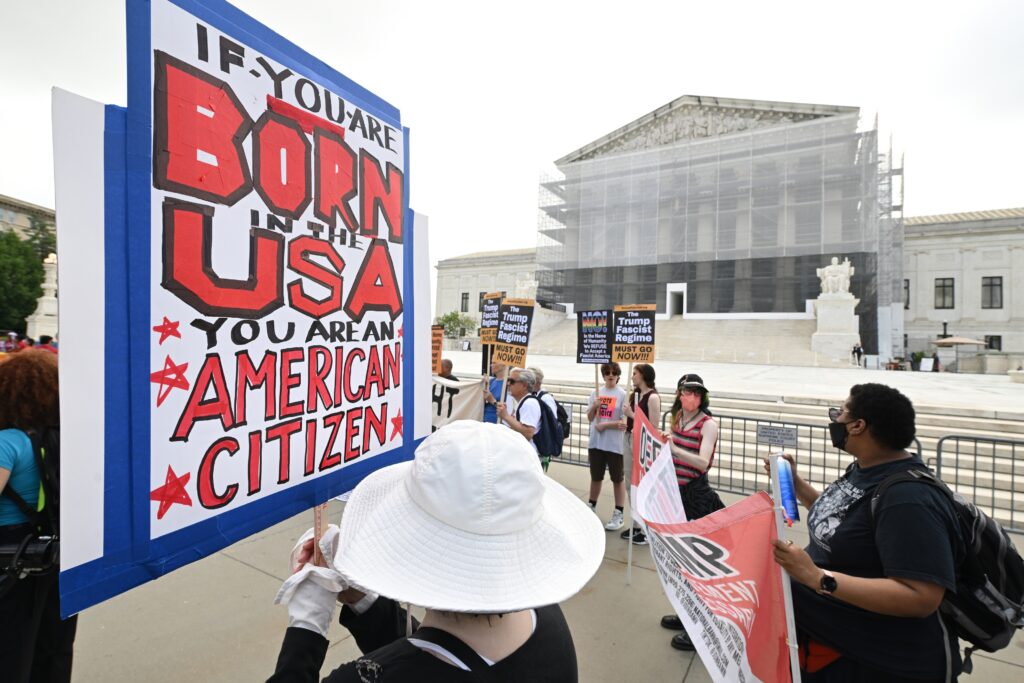
The Supreme Court announced on Friday that it will hear a case examining the legality of President Donald Trump’s ban on birthright citizenship, a high-stakes test of the controversial policy that could redefine who is considered an American.
The justices have yet to set a date for arguments, but the high court has taken the case in time to render its decision by June or July, when the current term ends.
The Trump administration asked the justices to take up the case on an expedited basis in September after lower courts found the policy, a key component of the president’s anti-immigration agenda, unconstitutional and blocked it.
On the first day of his second term, Trump instructed government agencies to stop issuing citizenship documentation to children born to parents who were in the country illegally or visiting temporarily. The move challenged the long-settled view that the 14th Amendment confers citizenship on any child born on U.S. soil.
Solicitor General D. John Sauer wrote in a filing with the high court that reading was “mistaken” and the president was attempting to restore the “original meaning” of the constitutional amendment, which was ratified in 1868 after enslaved people were freed following the Civil War.
The amendment provides that those “born … in the United States, and subject to the jurisdiction thereof” are U.S. citizens. It overturned the Supreme Court’s infamous Dred Scott decision, which denied citizenship to Black people.
“The Citizenship Clause of the Fourteenth Amendment was adopted to grant citizenship to newly freed slaves and their children — not to the children of temporary visitors or illegal aliens,” Sauer wrote.
Sauer said birthright citizenship is a powerful incentive for illegal migration; presents national security concerns, because some people illegally enter the United States to carry out hostile acts; and facilitates “birth tourism” — foreigners traveling to the United States to have babies so their children can be U.S. citizens.
Most legal experts reject the Trump’s administration’s interpretation of the 14th Amendment. In a landmark 1898 case, the Supreme Court ruled Wong Kim Ark, a man born to Chinese immigrants in San Francisco, was a U.S. citizen under the 14th Amendment.
The day after Trump issued his executive order in January, Washington state and three other states challenged it in court. A federal judge issued a preliminary injunction against the ban, which was later upheld by an appeals court.
In June, the birthright citizenship case reached the Supreme Court in a separate case. At that point, the Trump administration did not ask the justices to rule on the substance of the policy, but rather on the narrower question of whether lower courts could issue nationwide injunctions.
In a 6-3 ruling, the justices sided with Trump officials and limited the orders.
Soon after, a group of individuals represented by the ACLU filed a class-action lawsuit against the birthright citizenship policy in New Hampshire. A federal judge issued a preliminary injunction in that case, but before an appeals court could render a verdict on that ruling, Trump officials petitioned the Supreme Court to hear the case.
The New Hampshire case is the one the Supreme Court decided to hear.
Cecillia Wang, ACLU’s national legal director, said in a statement, “we look forward to putting this issue to rest once and for all.”
“No president can change the 14th Amendment’s fundamental promise of citizenship,” Wang said. “For over 150 years, it has been the law and our national tradition that everyone born on U.S. soil is a citizen from birth.”
Roughly 250,000 babies were born to mothers in the country illegally or on a temporary basis in 2023, the latest year figures were available, according to the Center for Immigration Studies, which aims to curb immigration.
The Supreme Court has set up a blockbuster term, agreeing to hear a handful of cases on policies central to Trump’s agenda. In November, the justices appeared skeptical of the legality of the president’s sweeping tariffs.
On Monday, the high court will hear a major challenge to the president’s bid to fire a Democratic member of the Federal Trade Commission, which could reshape executive control over roughly two-dozen independent agencies.
In January, the justices will examine the legality of Trump’s move to fire Democrat Lisa Cook from the Federal Reserve, which occupies a central role in setting interest rates and guiding the economy.
The post Supreme Court will hear case on Trump’s ban on birthright citizenship appeared first on Washington Post.