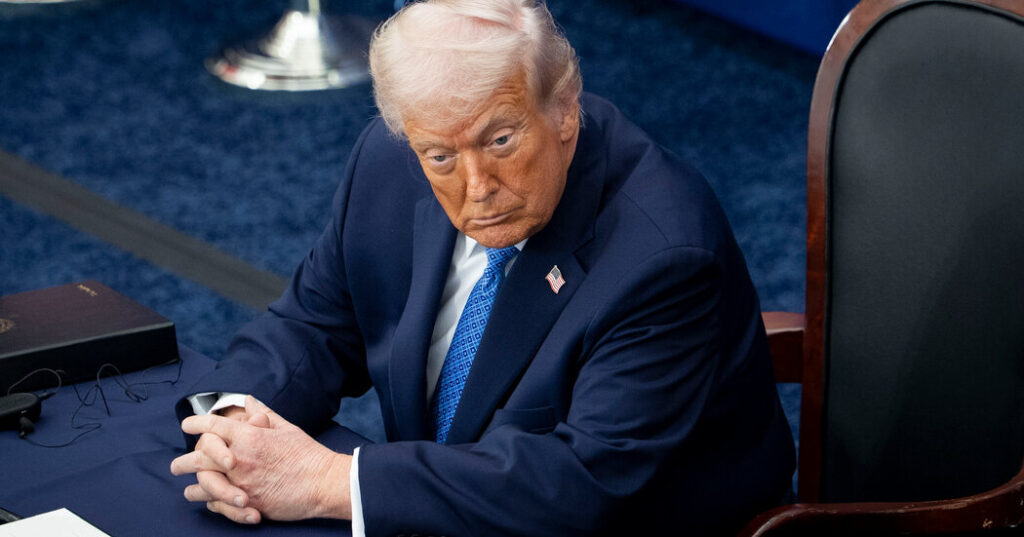
A political group tied to President Trump is quietly spending millions to help Republicans in Utah in the 2028 election cycle, offering a window into how Mr. Trump could keep wielding influence in his party even after he is no longer president.
The effort is focused on recapturing a House seat that Republicans anticipate will flip to Democrats next year. All of Mr. Trump’s other moves this year on redistricting are meant to help Republicans maintain control of the House after the 2026 midterm elections, which would help him stave off Democratic investigations and continue to advance his agenda.
The Utah effort, by contrast, would redound to Republicans’ benefit only in 2028, when Mr. Trump will be constitutionally ineligible to run for re-election.
As Republicans begin to consider a post-Trump future and cracks in his MAGA movement emerge, one under-the-radar question is what happens to the hundreds of millions of dollars that Mr. Trump’s political groups have raised since his 2024 election, in a highly unusual move for a term-limited president. Despite musing about running for an unconstitutional third term, he seemed to acknowledge this fall that he could not.
So the spending in Utah, which will support a ballot measure to repeal the state’s anti-gerrymandering law, may be one of the first tangible signs that Mr. Trump’s immense war chest could be put to use for Republicans even when it will no longer benefit him politically.
The Trump-allied nonprofit group, Securing American Greatness, has over the last six weeks put $4.35 million into a committee leading the Utah Republican effort, according to state campaign finance records. Asked for comment, a spokesman for the Trump group said it did not want to reveal its strategy.
“I think the president cares about the party after he’s no longer president,” said Adam Kincaid, the executive director of the National Republican Redistricting Trust. “It speaks to the fact that the president’s team is looking long term — not just to 2026, but 2028 and beyond.”
Utah Republicans hope to place a proposition on the ballot next year that would repeal a 2018 law that created an independent commission to oversee the implementation of new congressional maps, rather than defer that authority to the Republican-controlled State Legislature. After years of litigation, state courts ruled this year that the Legislature had violated the law by ignoring the commission’s proposed maps and instead using its own gerrymandered map, on which all four of the state’s House districts heavily favored Republicans.
A district court judge, Dianna M. Gibson, ordered Utah to use a new map for the 2026 election that includes a deep-blue Salt Lake City district that appears all but certain to flip to Democrats. State Republicans have criticized Ms. Gibson and are pursuing a variety of methods to overturn her decision.
One of those ways is through a ballot measure erasing the 2018 law underpinning her ruling, which passed by less than a percentage point. If the measure earns enough signatures to qualify for the ballot and passes next fall, the Legislature could revert to its old, Republican-friendly map without needing to hew to an independent commission.
The good-governance groups that brought the lawsuit aiming to throw out the Legislature’s gerrymandered map have criticized the new efforts to unwind their victory.
“Utah politicians are working hard to reframe the narrative and somehow persuade voters that partisan interests should be allowed to gerrymander,” said Emma Petty Addams, who leads the group Mormon Women for Ethical Government.
If Republicans are successful in reverting to the old map that favored their party, it would not take effect until the election in 2028, when Mr. Trump is at the end of his second term.
That has not stopped the president’s son Donald Trump Jr. from exhorting Utahns to help place the proposition on next year’s ballot.
“RINO judges & liberal groups are trying to STEAL two GOP house seats in Utah,” the younger Mr. Trump posted on X in October, sharing a link to sign up to collect signatures. “You can stop it!”
Robert Axson, the chair of the Utah Republican Party, who is leading the push to get the measure on the ballot, said in an interview that he was unaware of who was donating to Securing American Greatness. The entirety of the funding for Mr. Axson’s ballot group, Utahns for Representative Government, comes from the Trump-aligned nonprofit group, which has cut three checks to the committee, including one last week.
But Mr. Axson suggested that the support showed the president was committed to bolstering Republicans even after he leaves office.
“President Trump at times is accused of being very much focused on just his immediate needs and benefits,” Mr. Axson said. “I think this is an example that that’s not the case, that President Trump is engaged in building and leaving a legacy of principles and policies that he believes in.”
Securing American Greatness is a political nonprofit group set up last year by Mr. Trump’s aides at his super PAC, MAGA Inc. Unlike the super PAC, the nonprofit group is a dark-money organization that is not required to disclose its donors. Its current leaders are recent Trump political aides, and it donated $13.7 million to the super PAC this year.
After raising hundreds of millions of dollars since Mr. Trump’s election, his super PAC and nonprofit group are using some of the money to support his agenda, through measures including a multimillion-dollar ad campaign to promote his major domestic policy bill.
Some Republicans have been surprised by the extent to which Mr. Trump’s outside groups have vacuumed up so much of the capital in his party after his election. His advisers have said that he has done so, in part, because the money is on the table: The chipmaker Qualcomm, for instance, recently disclosed a $1 million check to Securing American Greatness.
Theodore Schleifer is a Times reporter covering billionaires and their impact on the world.
The post Post-Trump, What Happens to His War Chest? Utah Offers One Clue. appeared first on New York Times.