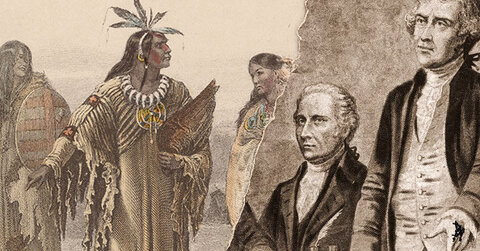
Have you seen Ken Burns’s series “The American Revolution” on PBS? Even if you haven’t, you may have seen the commentary that accompanied it: a scorching string of articles accusing Burns of drenching the series in wokeness.
In The New York Post, Rich Lowry deemed the series “a woke mockery” selling “romanticized history about oppressed groups.” Dan McLaughlin wrote in National Review that “Burns can no longer be trusted with telling our history as it is without trying to placate the extreme left’s fun-house narratives.” The Federalist contributor Adam Johnston wrote that “the docuseries is tainted by a healthy dose of ahistorical woke nonsense.”
To say I’m no fan of wokeness is to put it lightly, and the volume of condemnations like this almost put me off watching the series at all. But I did watch “The American Revolution.” It’s magnificent. So I thought it would be worth taking a deeper look at the criticism it ignited.
Many accuse Burns of propagating the idea that the founders got the idea of uniting the American colonies from the six-nation Iroquois Confederacy, rather than from careful study of the ancient Greeks and Romans. That claim is most closely associated with Donald A. Grinde Jr. and Bruce E. Johansen’s 1991 book “Exemplar of Liberty: Native America and the Evolution of Democracy.” In it, they say that an Onondaga leader named Canassatego counseled Benjamin Franklin and other colonists on principles of government that eventually formed the basis of the Constitution.
The idea is commonly called the “Iroquois influence thesis,” and has gotten around enough to be a part of some school curriculums. It has also, however, been pretty roundly refuted. The legal scholar Erik M. Jensen, for one, noted that though Franklin indeed noted the Iroquois alliance, his takeaway was merely that if such “savages” could pull it off, then so could English colonists. The anthropologist William A. Starna and the historian George R. Hamell have accused Grinde and Johansen of “a consistent pattern of misunderstandings, inaccuracies and outright misrepresentations of the historical record.”
Critics of Burns’s series heard an echo of the Iroquois influence thesis early in the first episode, when the narrator says, “Long before 13 British colonies made themselves into the United States,” the Iroquois had “a union of their own that they called the Haudenosaunee, a democracy that had flourished for centuries.” He then says Franklin “proposed that the British colonies form a similar union,” and that “the plan died, but the idea would survive. Twenty years later, ‘Join or Die’ would be a rallying cry in the most consequential revolution in history.” They also heard it in the series’s passing reference to Iroquois governance as democracy.
I didn’t. I certainly didn’t think that one moment in a single episode of a 12-hour series qualifies as swallowing the revisionist history hook, line and sinker, much less turning the series into a vehicle for its propagation. Anyway, Franklin was one of the smartest people ever to walk this continent. Would he really need the Iroquois’s help with the rather obvious fact that the colonies stood a better chance opposing the British as a united force? And as for democracy, the founders were steeped in classical treatises on government. Of course they were familiar with the concept. If it’s woke to make sure viewers know that the Iroquois were not simply small, unconnected bands of hunter-gatherers, then color me woke.
The series also highlights the Black presence in Colonial America to a degree it would likely not have until roughly this century, when exhibitions like “Slavery in New York” at the New York Historical in 2005 demonstrated what was news to many at the time: that slaves were a part of the economy of Northern cities. Burns’s series is informed by that fact, showing Black people as integral to Boston and Philadelphia as well as Charleston and Savannah. You can even see them in the documentary’s backdrop etchings: the Black boy standing amid the crowd on the street, or the Black servant in the window alarmed by the news that the British are coming.
The documentary teaches us that the American militia facing the British around Boston in 1775 was the most integrated one in this country until after World War II. Nearly one in 10 of the soldiers at Valley Forge were Black. A Black regiment of fifers played in Boston and a Black enslaved man, William Lee, served as Washington’s valet throughout the war. I for one didn’t know any of this, and am glad I do now.
This is “woke”? Nothing in the series struck me as virtue signaling. In fact, the opposite: The documentary scans a gravestone of the four men killed during the Boston Massacre, upon which we can see that Crispus Attucks, who was at least half Black, was listed next to last even though alphabetically he should come first. It passes without mention.
Another example: Critics note that Burns has it that African slaves “were captured,” accusing him of using the passive voice to obscure that a great many slaves were sold to whites by African traders. That is true, as I wrote recently. But Burns is telling the story of the Revolution — the competing allegiances, the birth of a sense of “Americanness,” the details of the battles and so on. The role of Africans in the slave trade falls rather far outside of the spotlight. Besides, the slaves were captured, one way or another.
The overarching message of this series is the founders’ pioneering anti-monarchical ideology and the horrors endured by those who fought for these ideals. Burns regularly reminds us of the contradiction between the founders’ insistence on their liberty and their comfort in keeping Black people in bondage. But anyone who concludes that he does it to shame the nation or perform his own moral superiority came in spoiling to see it that way.
“The American Revolution” is intelligently self-critical history of a kind most people worldwide are deprived of. Showing us what the era entailed for all different kinds of early Americans isn’t woke — it’s accurate.
One more thought: In the vein of the Fats Waller cabaret show I wrote about a few weeks ago, the third annual iteration of “The Season,” a lollapalooza of a cabaret show, is on Thursday. The M.C. is the New York City cabaret veteran Goldie Dver, and it offers not four or even a dozen but more than 30 of the city’s cabaret stars doing their magic. Plus, it’s a benefit for St. Jude Children’s Research Hospital. Chase the winter blahs away with a telethon’s worth of great music for a great cause.
The post People Are Crying Woke, and Somehow This Time It’s Not Me appeared first on New York Times.