To the Editor:
Re “Trump Anti-Somali Push Runs Afoul of Reality” (news article, Dec. 5):
I, a middle-aged Minnesotan, am reflecting on some of the Minnesotan role models I had growing up:
My deskmate in English class was an academic star, and she managed to work long hours at a grocery store on the side to support herself.
One of my friends in the school library could find humor and lightness in everything, even when I was a teenage curmudgeon and thought life was all bad.
My graduation class speaker spoke so beautifully about the value of education that I still think about that speech today.
These kids, the ones I grew up learning from decades ago, are all Somali Americans.
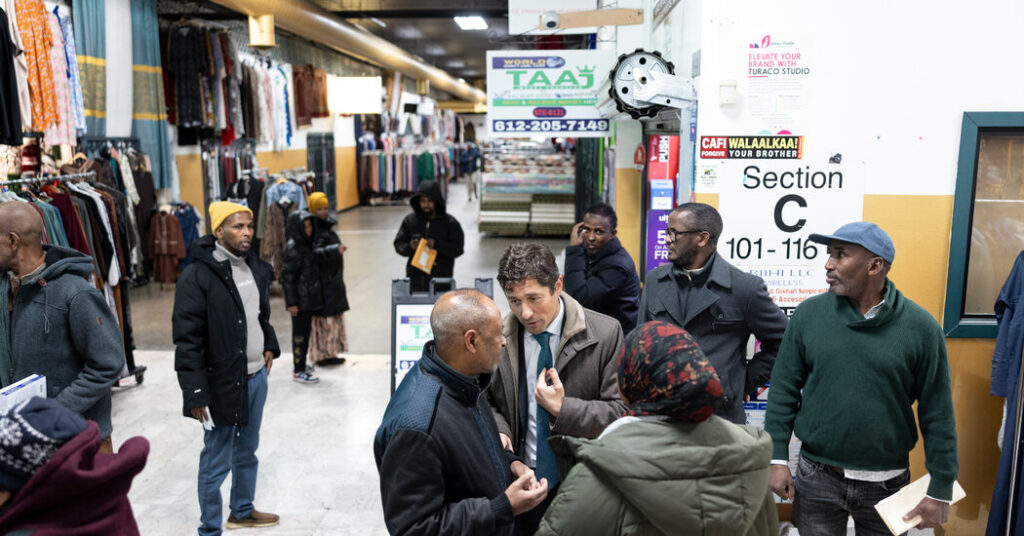
They are the same people who have since built careers that improved our community through organizing, philanthropy, medicine and more. They helped make Minnesota a place I wanted to move back to this year after decades away.
“Destroyed our country”? Quite the opposite.
Christa Anderson St. Paul, Minn.
To the Editor:
I work as a physician in a hospital in the Minneapolis area. Many of the doctors, nurses and support staff members who work there are from Somalia or of Somali descent. I have long been impressed by their hard work and good character, and consider myself fortunate to have such exemplary co-workers.
President Trump, I invite you to attend rounds with me at the hospital. It would give you the opportunity to form opinions of people based on who they are and not out of ignorance and prejudice.
Stanley Woolner St. Paul, Minn.
The Erosion of Academic Freedom
To the Editor:
Re “Regents at Texas A&M Vote to Regulate Discussions of Race and Gender in Class” (news article, Nov. 15):
It is appalling that the university leadership at Texas A&M has equated the censorship of its curriculum with “academic responsibility.”
Indeed, the university has a responsibility to uphold the ideals of higher education: freedom of thought, expression and discourse. In restricting the teaching of race and gender in the classroom, the university has betrayed these principles and infringed on its students’ right to an education free of censorship and discrimination.
For anyone monitoring the alarming situation on college campuses, this comes as no surprise. University students have become the latest target in President Trump’s relentless assault on academic freedom.
Texas A&M is one of several universities robbing students of open discussion, thwarting intellectual curiosity in the classroom. Students’ rights have come second to the political ideologies of state and federal governments.
University leaders must realize that they bear responsibility for their students, and not the government’s political agenda. It is up to university leaders to defend their student body and preserve the academic integrity of their institutions.
In rejecting attempts to influence their curriculum, university leaders can resist the erosion of academic freedom on campus. Political coercion has no place in the classroom.
Justin Mazzola New York The writer is the deputy director of research at Amnesty International USA.
A Prejudice Against Psychiatric Medication
To the Editor:
Re “Our Obsession With the Unmedicated Self Is Dangerous,” by Maia Szalavitz (Opinion guest essay, Nov. 17):
Ms. Szalavitz poignantly highlights a popular prejudice directed against people who depend on psychiatric medication to maintain their emotional stability.
The roots of this prejudice may be found in our Puritan heritage, which believed in a strong and logical connection between disease and personal sin. Puritan ministers would typically advise sick people to search their soul to discover what they had done to displease God.
Our modern puritanical prejudice holds that depressed people have not worked hard enough to discover the real causes of their suffering, and that use of an antidepressant represents weakness or indolence.
This destructive attitude puts one in mind of the maxim from the French moralist La Rochefoucauld (1613-1680): “We all have strength enough to bear the misfortunes of others.”
Ronald W. Pies Lexington, Mass. The writer is a psychiatrist.
The post My Somali Role Models in Minnesota appeared first on New York Times.