1 p]:text-cms-story-body-color-text clearfix”>
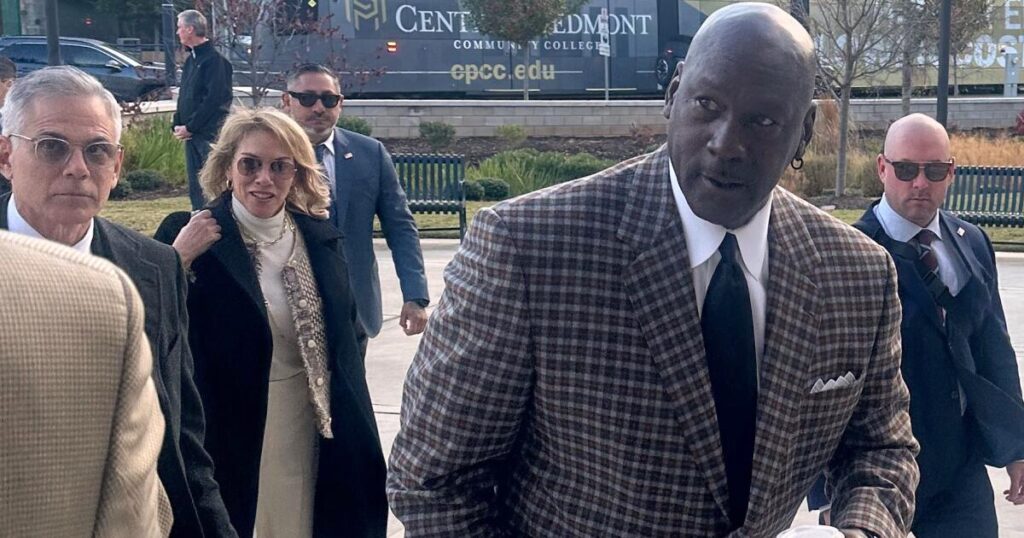
NBA legend Michael Jordan testified Friday in a Charlotte courtroom in an antitrust lawsuit challenging NASCAR’s revenue-sharing model and charter system. — NBA legend Michael Jordan took the stand in a Charlotte, N.C., courtroom Friday afternoon during an antitrust lawsuit against NASCAR.
Jordan is a co-owner of one of the two racing teams that sued the motorsports behemoth and its chief executive officer, Jim France, over the company’s revenue sharing model. The France family is the private owner of NASCAR.
The lawsuit was filed Oct. 2, 2024, in the Western District of North Carolina by 23XI Racing — which is owned by Jordan, three-time Daytona 500 winner Denny Hamlin and Jordan’s longtime business advisor Curtis Polk — and Front Row Motorsports, which is owned by entrepreneur Bob Jenkins.
Those two teams were the only ones out of the 15 charter-holding Cup Series organizations that did not sign a new agreement with NASCAR in September 2024 after two years of heated negotiations. All the teams had been seeking more favorable terms.
“Someone had to step forward and challenge the entity,” Jordan told the jury on Friday. “I sat in those meetings with longtime owners who were brow-beaten for so many years trying to make change. I was a new person, I wasn’t afraid. I felt I could challenge NASCAR as a whole. I felt as far as the sport, it needed to be looked at from a different view.”
23XI and Front Row are represented by top antitrust attorney Jeffrey Kessler, who helped NCAA athletes win cases that ushered in college sports’ NIL era and helped U.S. national women’s soccer players secure a landmark equal pay settlement.
“The France family and NASCAR are monopolistic bullies,” the complaint states. “And bullies will continue to impose their will to hurt others until their targets stand up and refuse to be victims. That moment has now arrived.”
The outcome of the trial could have a massive impact on stock car racing and the sport’s premier league. Here’s how we got to this point.
2
Michael Jordan and NASCAR
p]:text-cms-story-body-color-text clearfix”>
Jordan is considered one of the greatest basketball players of all time. An NCAA champion with North Carolina in 1982, Jordan went on to lead the Chicago Bulls to six NBA titles in the 1990s and was named the NBA Finals MVP all six times. During that stretch, he won five league MVP titles and became a cultural phenomenon.
Since retiring as a player in 2003, Jordan has become a highly successful businessman, with a net worth of close to $4 billion. He was the controlling owner of the Charlotte Bobcats/Hornets from 2010-2023 and still retains a minority ownership in the team.
Hamlin has said he met Jordan at a Hornets game around 2008 or 2009 and the two became friends. A decade or so later, Hamlin says, he saw an online rumor that the two of them were trying to purchase stake in a race team. He forwarded the link to Jordan.
“He’s like, ‘not true,’” Hamlin said, “‘but if you want to make it true, let me know.’”
In September 2020, Jordan and Hamlin announced they were starting 23XI Racing — pronounced “twenty-three eleven” for the No. 23 Jordan wore for most of his basketball career and the No. 11 car that Hamlin continues to drive for Joe Gibbs Racing. Jordan is the controlling owner and Bubba Wallace is the team’s driver in the No. 23 car.
“Growing up in North Carolina, my parents would take my brothers, sisters and me to races, and I’ve been a NASCAR fan my whole life,” Jordan said at the time. “The opportunity to own my own racing team in partnership with my friend, Denny Hamlin, and to have Bubba Wallace driving for us, is very exciting for me.”
The team now has three full-time cars (driven by Wallace, Tyler Reddick and Riley Herbst) and one part-time car (driven by Corey Heim) in the Cup Series. It has won nine Cup Series races, including Wallace’s victory in the Brickyard 500 this year. In addition, Reddick advanced to NASCAR’s 2024 championship race driving 23XI’s No. 45 car.
3
What is the lawsuit about?
p]:text-cms-story-body-color-text clearfix”>
Since 2016, NASCAR has run on a charter system in which teams purchase charters to guarantee a car’s spot in all 38 races and a payout from the weekly purse. The charter agreements were renewed for four years in 2020.
In the years leading up to the expiration of those deals, all 15 teams had been seeking more favorable terms in the next charter agreement, including charters that are permanent rather than renewable and revocable, a larger percentage of revenues and a voice in NASCAR’s leadership.
Every team except for 23XI and Front Row ended up signing the latest agreements, even though they didn’t get the changes they sought. According to the antitrust lawsuit filed weeks later, many of the teams felt they had no choice.
“The teams knew that fielding a NASCAR car had become so expensive that it would be economically devastating for most of them to compete without the stability provided by the charter system and that they would suffer a complete loss of their enterprise values if the charter system was discontinued,” the lawsuit states.
“Faced with a take-it-or-leave-it offer, and no competing opportunity for premier stock car racing in the United States, most of the teams concluded that they had to sign. One team described its signing as ‘coerced,’ and another said it was ‘under duress.’ A third team said, NASCAR ‘put a gun to our head[s]’ and we ‘had to sign.’ A fourth described NASCAR’s tactics as that of a ‘communist regime.’”
The lawsuit seeks “permanent injunctive relief to end NASCAR’s exclusionary practices and restore competition in the relevant market,” as well as a large sum to cover legal fees and financial losses after the unchartered 23XI and Front Row cars were forced to qualify for every race in 2025 instead of having a guaranteed spot.
NASCAR has said it has done nothing beyond normal business practices and that increased payouts in the 2025 charter agreement prove it is not anticompetitive.
4
The trial and its possible aftermath
p]:text-cms-story-body-color-text clearfix”>
While attempts at settling the matter before the trial were unsuccessful, a settlement could occur at any time during the trial and, if needed, an appeal. Jury selection took place on Monday, with two potential jurors being dismissed after claiming to be huge Jordan fans.
Hamlin and Jenkins were among those who testified throughout the week, setting the stage for Jordan’s hour-long appearance on the witness stand in front of a packed courthouse. At one point, the Naismith Basketball Hall of Famer was asked why 23XI didn’t sign the charter agreements last year.
“One, I didn’t think it was economically viable,” Jordan said. “Two, it said you could not sue NASCAR, that was an antitrust violation, I felt. Three, they gave us an ultimatum I didn’t think was fair to 23XI.”
Jordan added: “I wanted a partnership, and permanent charters wasn’t even a consideration. The pillars that the teams wanted, no one on the NASCAR side even negotiated or compromised. They were not even open-minded to welcome those conversations, so this is where we ended up.”
If the plaintiffs win, the jury will determine the monetary damages, with Judge Kenneth Bell having the ability to adjust the figure. Bell will also have to decide what to do if a monopoly is found, with options that could include forcing the France family to sell the organization or parts of it, getting rid of the charter system or ordering permanent charters.
If NASCAR wins, its structure will likely remain the same. In such a scenario, it’s difficult to imagine 23XI and Front Row returning to a charter system it went to court to alter.
If NASCAR wins, it could mean the end of 23XI and Front Row.
The Associated Press contributed to this report.
The post Michael Jordan testifies in his racing team’s antitrust suit against NASCAR. Here’s how it came to this appeared first on Los Angeles Times.