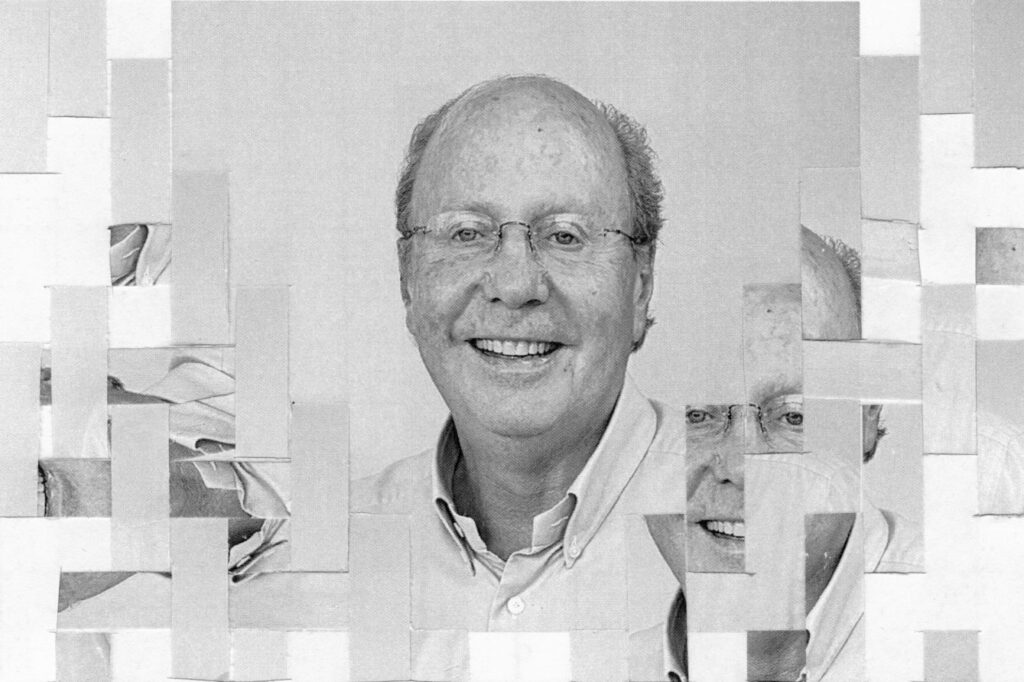
BALA CYNWYD, Pennsylvania — Three years ago, billionaire Jeff Yass’s political adviser sent him an email with the subject line: “Latest hit piece.” It was an opinion column eviscerating Yass’s outsize influence on Pennsylvania politics and calling him a “threat to democracy.” But Yass didn’t seem particularly concerned.
“I have an internal algorithm,” Yass replied. “The more they attack, the more I give. Add a million to my pledge.”
Yass sent a check to one of his political action committees that same day, not the first and far from the last million the Republican megadonor would spend trying to influence political campaigns.
With a net worth most recently estimated at $65.7 billion — making him the 27th-richest person in the world — Yass’s capacity to give is nearly limitless. For decades, he cut a low profile, but in recent years, he has repeatedly landed in the news. That’s partly because he’s a major investor in TikTok, but mostly because his political giving has soared.
Since 2015, Yass has donated more than $350 million to political campaigns, including tens of millions in 2025. He was the sixth-largest donor between 2015 and 2024, ahead of Elon Musk and just behind George Soros. His spending reflects the boom in political giving among the wealthiest Americans since 2010, the result of a string of court decisions that loosened campaign finance regulations.
But unlike many of his contemporaries, Yass, 67, is driven almost entirely by his commitment to a single issue: promoting vouchers and other school choice programs.
He argues that public schools are failing millions of children, and says those students deserve the chance to attend the school of their choice — private, religious, charter or traditional public — with taxpayer dollars. His views have made him a nemesis of the left and allied him with President Donald Trump, whom he once opposed but now supports, including with a contribution to remake the White House by demolishing the East Wing and constructing a $300 million ballroom.
His record shows the limits as well as the enormous influence of his checkbook. In his home state of Pennsylvania, where Yass has flooded the political system with cash for years, a voucher plan reached the top of the legislative agenda but has not been passed into law. But his contributions were critical toward the successful drive this year in Texas to create a $1 billion voucher plan in that state.
“I have come across what I think is a great way to relieve the suffering of tens of millions of kids,” Yass said in an interview with The Washington Post in the offices of Susquehanna International Group, the behemoth trading firm in the Philadelphia suburbs that he co-founded. “To most people it’s like if you’re a libertarian billionaire, you must be Lex Luthor trying to do something nefarious. If I gave to a hospital, you wouldn’t be saying that.”
To Yass, political spending when it’s on behalf of pro-voucher candidates is akin to charity, benefiting children and families who need a champion to face down teachers unions. “They needed a philanthropist,” he said. “I felt it was my role to be that philanthropist.”
But teachers unions and other critics see vouchers as an assault on public schools, which serve the vast majority of children. They complain that private schools face little accountability for the money they are given or their academic results. They also are allowed to pick and choose their students. In several states, critics note, most of the beneficiaries were already attending private schools when they joined the voucher program; some of those families may have struggled to pay tuition on their own, but for wealthier parents, it was a windfall at taxpayer expense. (Yass, for the record, thinks vouchers should go to all families — even those as wealthy as his.)
Critics say his giving represents an absurd amount of influence for one person, who can press his political agenda simply because he is rich.
“If you picture a man spraying a fire hose at the political system, that’s how he has reshaped how Pennsylvania politics work,” said Arielle Klagsbrun, a liberal activist who helps run a coalition of groups that oppose Yass, and who co-wrote the essay Yass was emailed about in January 2023. “This is the agenda of one billionaire trying to push his beliefs and whims on the rest of the state.”
But to Yass, political donations are much like a celebrity wading into politics. He compared himself to Oprah Winfrey, Taylor Swift and Bruce Springsteen, all of whom have, at times, let their fans know whom they were supporting. In fact, he said, the endorsement of someone like Swift is more powerful than even a billion-dollar contribution.
“No one would take away their right to free speech,” he said. “I am not nearly as powerful as Bruce Springsteen. If you want to shut me up, you have to shut him up, too.”
Yass’s economic and political instincts began to form in his 20s, when he read economist Milton Friedman’s seminal work, “Capitalism and Freedom.” He came away convinced of the value of free markets and idolizing Friedman himself. Yass even reached out to him for advice as a young trader, wondering if a controversial type of trade he was pioneering was moral. (Friedman said it was.)
From there, he built an enormously successful business, leveraging a mathematical mind that he first applied to professional poker and the racetrack and then to the stock market.
His firm, Susquehanna International Group, applies probability reasoning and computer algorithms to make lightning-fast trades in stocks and options — investing millions of its own dollars every day and generating huge profits for the firm. The company now has offices in 12 countries, employing more than 3,400 people. It functions as part of the market itself, providing buyers and sellers for stocks and securities.
Its headquarters are set in this suburb just outside Philadelphia, surrounded by chain restaurants like TGI Friday’s and Panera Bread. Yass himself isn’t showy either. He wears sneakers and no tie to work and volunteers that his striped oxford shirt cost him $95. His modest office features a faded blue corduroy couch bought in 1982. Asked how it feels to be among the world’s richest people, he demurs. “It happened gradually,” he said. “My life is more or less the same.”
By the 1990s, Yass had become a significant donor to the Cato Institute, a libertarian think tank, and was invited to a conference in Napa Valley where Friedman was a speaker. Over dinner, Yass asked Friedman for some more advice: If you had a lot of philanthropic money, how would you spend it? His answer: school choice.
Soon after that, Yass and his wife, Janine, began thinking more deeply about education in Philadelphia. They sent their sons to the Haverford School, a private school for boys on Philadelphia’s Main Line, where yearly high school tuition today costs nearly $48,000. At school cocktail parties, they got to know David Hardy, who worked at the Community Academy of Philadelphia, the city’s first charter school.
Before long, Hardy and the Yasses decided to create a charter school of their own. Boys’ Latin opened in 2007, promising to deliver a classical education. Janine was deeply involved, but Hardy said Jeff helped, too, particularly in navigating legal challenges and school bureaucracy that, in his view, both fails children and resists charter schools that could pose competition.
“Poor Black and Brown children in this city get screwed educationally,” Hardy said. “We need more options, and Jeff understands that.”
Yass estimates that he’s donated about $15 million to Boys’ Latin, mostly to acquire and renovate the property. But he concluded that running a school could only accomplish so much. “It’s not sustainable. You have to fund it forever,” he said.
He then moved into politics. One of Yass’s first conversations was with then-Sen. Barack Obama in 2007. Yass donated $2,300 to his presidential campaign and met with the future Democratic president in Obama’s Union Station office in Washington. Yass came away encouraged that Obama would back school choice if elected. His administration did strongly support charter schools, but Obama opposed a voucher program for children in D.C. — to Yass, an early sign that the Democrats would not be reliable partners.
Still, the first major beneficiary of Yass’s political giving was Anthony Williams, a pro-school-choice Black Democrat from Philadelphia. Yass bankrolled his campaign for governor in 2010 and then mayor in 2015. Williams lost both contests in the primary.
Over time, Yass grew ideologically committed to private school vouchers for both low-income families and those like his own. But he emphasized the benefits for kids trapped in bad schools, and rattles off woes and dangers of the Philadelphia public schools. He also looks at education culture war fights and imagines them all going away. If a child is bullied because he is gay, he says, he can just choose an LGBTQ-friendly school instead.
Yass also began speaking publicly about his views. At a conference sponsored by Philadelphia Magazine in 2016, he pitched his versionof a school voucher that would give parents in the city 100 percent of the per-pupil taxpayer funding — enough, he said, to pay private school tuition and open savings accounts for their children, which he now estimates would total $250,000 by the time a student turned 18.
“We would have the best schools in the history of America,” he said. “We would have entrepreneurs flocking to work here.”
Talking with The Post, he grew animated as he pitched the same idea, this time using New York City as the example. “That’s it,” he said after detailing his math. “Every single nickel I’ve ever given is based on that.”
This idea is more complicated than he suggested. Public schools have fixed costs, so diverting the full per-pupil cost when students leave the public schools could hurt those who remain. Entrepreneurs might flock to the city, but it’s unclear how many would offer better options. (Hoping to address this problem, Yass and his wife have also donated more than $50 million through the Yass Prize to education innovators, mostly working outside traditional public schools.)
Yass also confidently told The Post that studies of voucher programs show “overwhelmingly” positive results. Several early studies of targeted voucher programs have indeed shown positive results on standardized tests, and some research shows positive impacts on other metrics such as college enrollment. But most research over the past decade or so shows either no effect or a negative impact on test scores for larger-scale programs. Some charter schools struggle with low test scores just like traditional public schools do. That’s at least partly because educating children with many needs and few advantages is a challenging task.
Yass maintains that these programs help children. But he also says he doesn’t really care what the studies say or how children perform on tests. He takes the libertarian point of view that all parents should be empowered to choose the school — public or private — that they want for their children, no matter what.
“If the mother or the parent wants the kid to go from one school to another, who the hell is anyone to tell them not to?” he told The Post. “I don’t care what the studies say.”
At the time of that 2016 speech, Yass was just getting started. After disappointing results backing Williams, he turned his attention to the Pennsylvania legislature. Soon, he was giving at a scale the state had never seen before.
“We thought if we can get it done in Pennsylvania, a purple state, it will be a fantastic experiment for Pennsylvania,” he said, “and a fantastic experiment for the country.”
Once Yass decided to focus on Pennsylvania politics, he did so with gusto. In 2018, he gave $3.2 million in political contributions in the state. By last year, that had grown to $35 million.
No other individual giver comes even close to Yass’s Pennsylvania totals during this period — he spent five times as much as the second-largest donor, according to totals compiled by the nonprofit group Transparency USA. His donations have supported candidates from city council to governor and go overwhelmingly to Republicans but sometimesto Democrats, such as moderates facing more liberal primary opponents.
Yass has funneled most of his Pennsylvania contributions through a string of related political action committees, stipulating in writing that the money be spent to advance school choice, said Matt Brouillette, his political adviser, who keeps him informed about news coverage and manages the PACs.
Heading into the 2022 elections, Yass saw opportunity. Republicans already controlled the state House and Senate. If they could elect a supportive governor, they felt confident that Pennsylvania was ready to enact a school voucher program. Yass spent $22 million to back candidates across the state.
But a redrawn legislative map helped Democrats take control of the House by one seat. Yass’s money supported Bill McSwain for governor, who lost in the GOP primary; Democrat Josh Shapiro won the general election. The Democrats had been boosted by the teachers unions in the state, which represent about 213,000 people. In 2022, state and national teachers unions spent about $4 million on Pennsylvania elections.
Nonetheless, Yass remained hopeful about the voucher plan. Shapiro had publicly signaled support for vouchers, and Yass had an inside line to him: Joel Greenberg, co-founder of his company, had known Shapiro for years and was optimistic the incoming governor would support legislation offering vouchers to students attending the lowest-performing schools. Greenberg was named to Shapiro’s education transition team, though in a foreshadowing of things to come, so were representatives of the state’s big teachers unions, who strongly opposed all types of vouchers.
As the legislative session opened in January 2023, Yass-funded PACs funneled money into attacks, sending mailers to voter homes in nine targeted Democratic districts.
First-term Democrat Arvind Venkat had won his suburban Pittsburgh district the year before despite $305,000 in ads opposing him from a Yass-funded PAC. But as the 2023 legislature opened, Venkat, who opposed vouchers, faced another onslaught of mailers. At the time, the House was out of session ahead of a special election, which became fodder for political attacks. One showed a doctored photo of him skiing under the heading “Rep. Venkat’s 2023/2024 Work Calendar.” (“I don’t ski,” Venkat said.) Another said he was holding up money for families, children and schools “because he won’t get back to work in Harrisburg.” (Brouillette said Yass was not consulted on the strategy or the content of these mailers.)
As the session unfolded, House Democrats dug in on vouchers, and a stalemate over the issue kept the budget in limbo for nearly a month. Amid high drama in Harrisburg, Shapiro bent to opposition from his fellow Democrats. The House approved the budget passed by the Senate, which included vouchers, but only because Shapiro promised to line-item veto that provision, which he then did.
“It was a dramatic failure,” Yass said. “We thought we had it.”
Yass kept funding candidates in the 2024 election, aiming to help Republicans seize control of the legislature and, he hoped, revive the voucher debate. But the results were again disappointing. All nine House Democrats targeted by Yass PACs won their races, though Brouillette takes credit for helping to defend four vulnerable Republicans, picking up a state Senate seat and winning three statewide races.
Still, while vouchers have yet to become law, Yass’s spending has reshaped politics in Pennsylvania. “For over a decade, Republican legislators were not talking about vouchers, and then out of nowhere they make it a priority issue. What happened? One person decided to throw around tens of millions of dollars,” said Eugene DePasquale, the current state Democratic Party chair, who lost his 2024 campaign for attorney general after Yass-related PACs spent nearly $12 million supporting his Republican opponent.
Some of Yass’s allies say his outsize checkbook and influence are just the reality of politics today.
“The playing field is not level, never has been,” said Williams, who continues to champion school choice as a member of the Pennsylvania state Senate. “The more money you have, the more leverage you have. Does it concern me? I guess I’m so used to these leveraged positions that I don’t spend a lot of time thinking about it. I would just get frustrated. I’m not saying it’s fair. I’m not saying it’s right.”
While vouchers remain stalled, Pennsylvania has steadily expanded a sort of backdoor voucher program. The state offers two tax credits that reimburse donors up to 90 percent of the money they give to scholarship programs, which help pay tuition for students to attend private schools. The cap on total tax credits available each year has climbed from $185 million in budget year 2017-2018 to $680 million this year.
A company controlled by Yass received $6.8 million in tax credits through this program from 2020 to 2024, state data shows, leading to criticismthat he is personally benefiting from policies he espouses. Yass replied that this is nonsense — the donations still cost him more than he gets back from the state. (His credits total 90 percent of the $7.5 million he donated.) Without the tax incentive, he said, he never would have donated so much.
But Yass’s failures in Pennsylvania got him thinking about focusing on other states.
“We have all this opposition,” he said. “Why not go where we have the wind at our back?”
Texas was the only big Republican-run state without a school voucher program, an embarrassment that Republican Gov. Greg Abbott was determined to change. In 2023, he called the legislature into a final special session to force the issue.
The effort failed, with 21 state House Republicans joining Democrats to block the measure. Many of the GOP opponents were from rural areas, where public schools are at the center of the community and there is little clamor for alternatives. So Abbott hatched an unusual plan: He’d back pro-voucher Republicans to challenge these lawmakers in the GOP primaries the following year.
The governor needed money to help power the challengers, many of whom were taking on veteran lawmakers. Yass heard about the effort and called Abbott. “How can I help?” he asked.
The answer was money: Yass gave $6 million to a political fund controlled by the governor, which Abbott’s campaign calledthe single largest contribution in Texas history. He later gave $6 million more. Yass told The Post he realized “this could be the Super Bowl of school choice.”
Yass also donated $5.7 million that year to the Texas AFC Victory Fund, the political arm of the American Federation for Children, a school choice advocacy group that spent $8 million working to defeat the anti-voucher Republicans. His donation dwarfed all other contributions to the group.
Most of the anti-voucher Republicans were defeated, and in April, the newly voucher-friendly Texas legislature approved a $1 billion program.
“Jeff had a big impact. Without him and the governor, I don’t think it would have gotten done,” said Brendan Steinhauser, a Texas-based GOP strategist who has worked on school choice for a decade.
In Texas — as in Arizona, Florida and other states — the program is open to all families regardless of income and no matter how good or bad their public school is. Yass supports that policy, although he talks about the program as a savior for those trapped in failing schools. (Still, for political purposes, he’s willing to limit the programs, as the proposal in Pennsylvania would do. “It’s too easy to demagogue. Why does the rich guy get it?”)
Not all of Yass’s forays into other states have been as successful as they were in Texas. He backed a 2024 effort to amend the Kentucky state constitution to allow vouchers. It failed, with 65 percent voting no, which Yass blamed on poor wording on the ballot. (The pro-voucher side also lost ballot measures in Coloradoand Nebraskalast year.)
He continues to field calls from Republicans across the country looking for money. The night before he spoke to The Post, his phone rang and it was Virginia Gov. Glenn Youngkin (R), asking for help with legislative races this fall aimed at pressuring candidates to back school choice. “I just gave $250,000,” he said.
Next up are the 2026 midterms. Yass has written big checks to GOP gubernatorial candidates who are enthusiastic about vouchers — $10 million to a super PAC supporting Vivek Ramaswamy in Ohio and $5 million to Byron Donalds in Florida. He told The Post he is also looking at contests in North Dakota, South Dakota, Georgia, Mississippi and Tennessee.
And after years of opposing Trump, he has morphed into a supporter. In 2024, he spent millions of dollars backing at least four of the primary challengers to Trump, hoping to keep him from winning the nomination again. He wrote in a Wall Street Journal op-ed that year that Trump was better than then-President Joe Biden on school choice issues, but that he had never given money to Trump and didn’t plan to.
After the election, Yass changed his mind. He donated to defray the cost of Trump’s presidential transition committee and then, in early 2025, gave $16 million to MAGA Inc., a Trump-aligned super PAC. He also attended a White House event early this year, and later gave to the ballroom project.
Yass explained his reversal by saying Trump has turned into “a true champion” of school choice. He pointed to a provision in the recently passed tax law that creates a federal tax credit for donations to scholarship organizations, modeled on programs like Pennsylvania’s. He also credited Trump with helping to pass the Texas voucher bill. Neither of those victories were in place when he made his first donations, but Yass said it was clear Trump was working hard on the issue.
His support for Trump coincided with the president’s decision to allow TikTok to continue operating in the United States, despite concerns about its Chinese ownership. Yass’s firm owns 15 percent of the social media platform’s parent company, ByteDance, and the two spoke briefly just before Trump changed his position. Yass says they only discussed school choice and that he has never lobbied Trump on TikTok.
“Hey hey! Ho ho! Billionaires have got to go!” chanted about 50 protesters marching to Susquehanna’s front door. The group outside Yass’s office in late September wasn’t an unusual sight. All Eyes on Yass, a coalition of education, labor and civil rights groups, has worked to turn Yass into the state’s prime villain, creating an online “Yass tracker” that allows voters to look up whether their state elected officials have received money from Yass-funded PACs.
This specific protest focused on Yass’s spending against three Democratic state Supreme Court judges who faced retention votes in November. Yass was trying to oust them in hopes of flipping the court into GOP hands. He was disappointed again, when voters opted to retain all three.
It was the 12th demonstration since 2022 organized by All Eyes on Yass. In a year when Musk’s role at the White House prompted intense criticism of billionaires in politics, this group stands out in its singular and persistent focus on Pennsylvania’s richest man.
“We’re here with a simple message: Billionaires like Jeff Yass can’t steal our elections,” said Raquel Jackson-Stone, 32, who works for a civil rights group called One Pennsylvania. “They don’t care about the same things we care about, like housing affordability and making our public schools better.”
The problem, Yass said, is that he’s “too big” for Pennsylvania politics.
“They’re able to find one person to vilify,” he said. “To them, corruption is anyone who disagrees with them. … They’re trying to intimate you. They’re trying to silence you.”
Yass rarely if ever interacts with people he disagrees with on this subject. He volunteered to The Post that in business, he advises his employees to seek out alternative points of view. “I always say, ‘Go find the smartest person who disagrees with you,’” he said.
But he said he has never had a personal conversation with a public education advocate to try to understand their point of view. “I would love to do that,” he said.
Yass also does very few media interviews, but he occasionally speaks publicly to friendly audiences and does not shy away from controversial statements.
In a 2021 conversation sponsored by the Adam Smith Society, part of a free-market think tank, he said that the U.S. is almost to the point where “no one” is hungry, cold or lacks basic health insurance.
“What’s the difference between a billionaire and a guy who’s making $100,000 a year? They’re both at home watching Netflix. And they’re both on their iPhones,” he said then. “The disparity between how rich people live and how poor people live in America has never been smaller.”
Government data shows that in 2024, there were 27 million uninsured Americans and in 2023, 18 million households were uncertain if they would have enough food. Wealth inequality has been rising for decades, with the richest families increasing their wealth at a faster rate than everyone else.
In the interview with The Post, Yass stood by his comments. He said the divide in America is not about money but about how much satisfaction people get from their work. “That’s the inequality. Wealthy, educated people enjoy their jobs. Lower-income people don’t enjoy their jobs.”
His confidence feeds his opponents but also his conviction to keep spending. If the criticism bothers him, he doesn’t let it show. He sees no problem with one man using money made on Wall Street to press a personal agenda. And he compares his influence not against that of other individuals but to teachers unions and other large interest groups that represent thousands of people each.
As Yass sees it, he’s the one fighting for the underdog — a billionaire speaking up for those who don’t have billions.
“It’s David vs. Goliath,” he said. “I represent David.”
Read the Billionaire Nation series
- How billionaires took over American politics
- The forgotten court case that let billionaires spend big on elections
- How George Soros changed criminal justice in America
- The top 20 billionaires influencing American politics
- We asked 2,500 Americans how they really feel about billionaires
About this story
Reporting by Laura Meckler, Beth Reinhard and Clara Ence Morse. Design and illustration by Tucker Harris. Graphics by Luis Melgar. Illustrations contain prop paper money.
Design editing by Betty Chavarria. Photo editing by Christine T. Nguyen. Editing by Patrick Caldwell, Wendy Galietta and Anu Narayanswamy. Copy editing by Vanessa Larson.
The post Meet the billionaire pushing taxpayer-funded school vouchers appeared first on Washington Post.