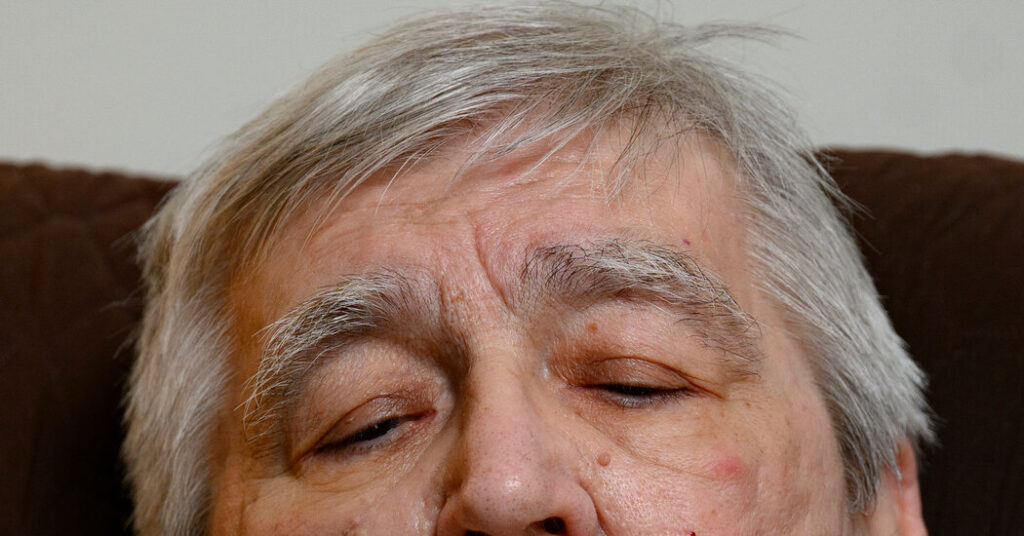
The calls start about 7 a.m. and continue until 6 or 7 p.m. On a recent afternoon, Steven Kurutz flipped through his phone’s call log. They were coming about every 14 minutes: 10:39 a.m., 11:03, 11:06, 11:25, 11:37, 11:55, 12:06, 12:18.
When Mr. Kurutz, 80, answered, a recorded message asked about his Medicare coverage.
“My name is Laura from health care,” a chipper voice said. “We’re reaching out to seniors to ensure any unclaimed additional Medicare benefit. You have Medicare Parts A and B, right?”
This call, like most others, claimed to offer Medicare Part C, a type of private insurance, usually marketed as Medicare Advantage, that augments Part A, which covers hospitalization, and Part B, which covers outpatient services. Mr. Kurutz, who lives in South Park Township, Pa., already had the equivalent of a Part C plan. It was included in his retirement package with General Motors, which employed him as a truck repairman for 32 years.
After he pressed 1 for yes, a muffled male voice mumbled something about Medicare parts.
“I’ll be truthful with you, sir,” Mr. Kurutz said. “I can understand about every third or fourth word you’re saying.”
The person at the other end hung up. Eight minutes later, Mr. Kurutz’s phone buzzed with another unfamiliar number. His daughter, Daveen, said he receives between 50 and 60 calls each weekday.
Seniors have long been targeted by fraudsters claiming to offer enhanced Medicare plans or to be Medicare officials. Scammers phish for enough information to steal their identities or use their information to charge Medicare for bogus services from fake companies. The calls increase during the annual open enrollment period, Oct. 15 to Dec. 7.
For some, the calls are unrelenting, rendering their phones almost unusable. Others who receive calls later discover that their accounts have been compromised, even if they do not remember giving out personal details. The scammers seem to be trying to add to an existing trove of hacked information.
Most of the time, Mr. Kurutz ignores the calls. He checks his voice mail for messages from friends, doctor offices or his home health aide agency. If he wants to scroll Facebook, check his bank account or use the app that connects to his continuous glucose monitor, he has to swipe away constant call alerts. They are spoofed to appear as if they come from nearby towns.
Since a septic infection and resurgence of metastatic prostate cancer diminished her father’s mobility two years ago, Ms. Kurutz, a quality control analyst for artificial intelligence, has often worked from the second bedroom of his condominium. She said the constant calls had instigated her migraines.
Mr. Kurutz tries to keep his phone on silent, but — as is inevitable in the age of phone ubiquity — he sometimes uses it and leaves it on.
His family can’t set the phone to allow calls only from preapproved numbers, because that would filter out some medical calls. And changing his phone number seems unfeasible, given that every legitimate contact would have to be notified.
“I’m counting the days until open enrollment ends,” Ms. Kurutz said.
Medicare scam calls seem to be on the rise. Complaints about them to Better Business Bureaus have increased 40 percent over last year, said Melanie McGovern, director of public relations for the International Association of Better Business Bureaus. The Federal Communications Commission receives between 5,000 and 6,000 complaints annually about Medicare or Medicaid scam calls, a spokesperson said.
Clint Seiter, 75, of San Francisco, said he receives one or two Medicare-related scam calls an hour.
“It’s incredibly annoying,” said Mr. Seiter, a retired waste specialist for the Environmental Protection Agency. “I want to keep my phone open for legitimate communication,” but he often silences it to maintain his focus while working out at a gym in the morning and writing fiction in the afternoon.
“I have tried everything,” he said. “I have been angry and abusive. I have been polite and asked them not to call me.” He hopes that, somehow, the callers realize he won’t give out his personal information, mark him as a non-opportunity and stop calling.
Mr. Seiter said he was alarmed by how much information about him was out there. After he bought some Benjamin Franklin half dollars, he received a slew of dubious calls about rare coins, he said.
The Medicare scammers sometimes pursue people who do not qualify for the program.
Page McLain, 59, runs a landscaping company in Cayce, S.C. She said she often received calls asking about her Medicare coverage, though she is still six birthdays away from eligibility. Since the start of open enrollment, these calls have increased from two or three a day to almost hourly. They appear to be local and are impossible to distinguish from a potential new customer.
“I wear a headset when I’m mowing lawns and stuff, so calls come in one ear and I have to stop everything I’m doing, turn off my equipment and answer the call just to find out,” she said.
Usually, an automated voice asks, again, if she is covered by Medicare Parts A and B.
“I even went through the majority of the process one time, of course without giving up my personal information, just to see if I could get any kind of resolution or anything,” Ms. McLain said. When she finally spoke to a person, she said she didn’t have Medicaid and asked to be taken off the call list. The person, she said, hung up.
Common messages claim to offer a Part C plan or say a beneficiary’s card is expiring. Scammers have also impersonated doctor offices or claimed to need information to prevent an interruption of coverage due to the recent government shutdown.
In actuality, the Medicare program rarely makes unsolicited phone calls and usually precedes calls with a letter.
Scammers can acquire some of a person’s information from data leaks, the fruits of which are sold on the dark web, said Nicole Liebau, the strategic partnership and engagement director for the Senior Medicare Patrol, a federally funded agency that assists beneficiaries in cases of fraud. When they call, they may already have the target’s address, age, and Social Security or Medicare number, which lends them some credibility.
After some nebulous network of data brokers pieces together enough information on a Medicaid recipient, it might be able to charge a company that does not exist for products and services that the victim didn’t ask for, doesn’t need and may not ever receive.
Last December, Jan E. Smith, who is 80, spotted a large box delivered to her front porch in Clarksville, Texas. On it was a Florida return address she did not recognize, and inside were four support braces, two for arms and two for legs.
“I don’t need anything like that, so it was just perplexing,” Ms. Smith said.
The enclosed paperwork included her primary care physician’s name, indicating that the physician had prescribed it. She had not.
That month, Ms. Smith’s Medicare account was billed $714.83 by a mysterious company, said Eloisa Ramirez, a specialist with the Texas branch of the Senior Medicare Patrol whom Ms. Smith contacted for assistance. The company used a serial number that has since been associated with several deliveries of unwanted, unordered orthopedic equipment. The same company also charged $572.27 to Blue Cross Blue Shield, Ms. Smith’s secondary insurer, she discovered.
Ms. Ramirez found that Ms. Smith’s Medicare account had been fraudulently charged five other times that year for a mix of Covid-19 tests and diabetes-related supplies she never ordered or received. (Ms. Smith is not diabetic.) Their total was about $1,200.
Ms. Smith said she was not sure how anyone had received enough information about her to swindle Medicare. She receives “multiple scam calls every day” mentioning Medicare, she said. She usually tells them that she’s not interested or hangs up, she said, but she may have accidentally engaged one. Last year, several members of her family suffered medical issues. She was stressed and may have let her guard down, Ms. Smith said.
The costs of fraudulent Medicare charges are borne not just by the federal government, Ms. Liebau said. Secondary insurers or the Medicare recipient may be billed for portions.
They can also warp Medicare’s understanding of a patient’s health.
“If your Medicare number is compromised, there’s actually a higher health impact of you not being able to access certain types of care,” Ms. Liebau said. “You could have false diagnoses, records that show misinformation about your allergies, incorrect lab results.”
When hospices are fraudulently charged, Medicare administrators may think the recipient is dead or dying, she said, adding, “You can’t get curative care if you’re marked as receiving hospice and you didn’t even know it.”
The post Medicare Scammers Are Calling Seniors 50 Times a Day, Trying to Trap Them appeared first on New York Times.