This personal reflection is part of a series called Turning Points, in which writers explore what critical moments from this year might mean for the year ahead. You can read more by visiting the Turning Points series page.
Turning Point: More than 20,000 A.I.-generated songs — or around 18 percent of all new music added — are uploaded every day to Deezer, a leading streaming platform.
We live in an age of saturation and stimuli. Everything feels urgent, and nothing feels sufficient. Amid the noise, my soul begged for silence, and I felt stripped bare before endless demands: to be more, achieve more, to go further. It was no longer a question of achievement, but rather how to simply be, how to return to the most essential parts of myself.
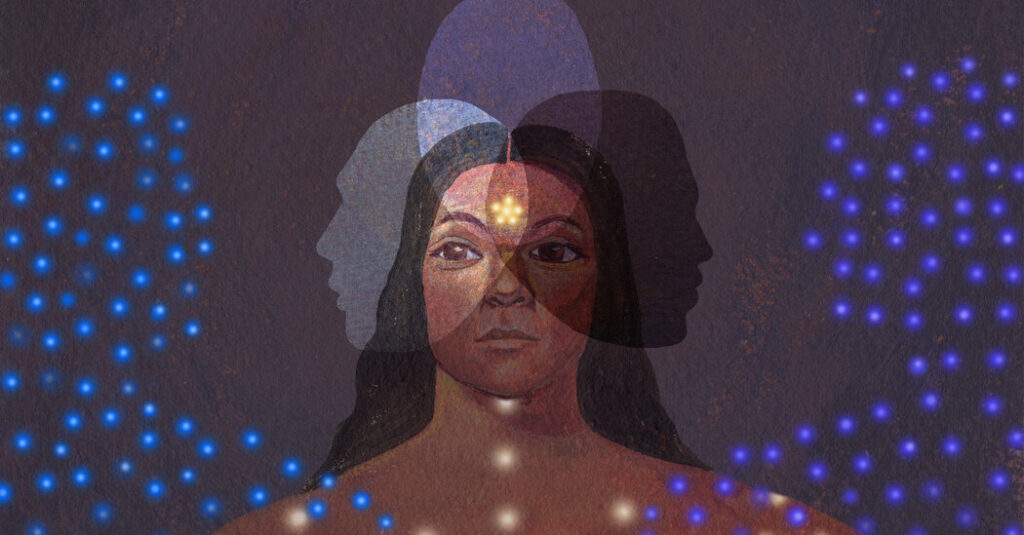
In the mirror, I see my past selves: the little 3-year-old girl who played pop star and dreamed of being an artist, the teenager who scribbled songs in secret, the woman who found her home in music. Now, on the cusp of 40, I can say that I have lived out those dreams, surpassing even my own expectations.
And yet I ask: How do I celebrate this new decade? Do I throw a party? Whom do I invite? There is both gratitude in me, and a readiness to let go. There are clothes that no longer fit my body and relationships that no longer serve this version of myself, and so a cleansing begins: what is released, what is reborn, what remains. One era ends, and another begins.
Something in me has shifted — my body, my mind, my priorities — and in its wake, an urgent desire for authenticity is born. This desire comes not from nostalgia, but from necessity, and so I return to the essential questions: Who am I? How do I wish to live the second half of my life? What will I keep, and what will I let go?
The answer came in the form of song. Days before my birthday, “Cancionera,” my most recent album, was born, and in it I found the key: to sing my truth, without adornment, without masks.
And so, I remembered that I was born a “cancionera,” a songstress. Not as a character, but as a way of being. Since I was a girl, I understood that my calling would be to sing of what I lived, what hurt and what healed. Music has been the driving force that has guided every stage of my existence, and in that authenticity — sometimes fragile, sometimes powerful — lay my roots.
I decided then to celebrate my 40s by creating an album and a tour with just guitar and voice. I wanted to return to the source, to song as an intimate ritual, to the analog, to the collective. And to the vulnerability of recording on tape, without retouches and without filters. Like one who returns to the playground with the happiness of childhood.
I gathered a group of creators willing to play. We recorded on tape, in full takes, the way it used to be done, with everyone together in the studio, letting imperfection play its part. We wanted to capture real, unrepeatable moments. We played like children in a music lab, without fear of breaking the rules, unabashedly showing our seams.
However, in the contemporary music industry, making an album involves much more. It involves creating a visual narrative, feeding social media, designing campaigns, generating clips, interviews, collaborations and constant content. An album no longer breathes on its own; it requires an infinite array of elements to exist and, above all, to be seen.
At first, that reality felt like an obstacle. How could I manage an authentic creation without being dragged down by the anxiety of having to produce something on every platform? How could I defend creative silence in a world that never stops talking? But instead of resisting those demands, I decided to transform that pressure into a creative challenge. If I was going to play the present game, I would play by my own rules.
That is how the concept of “Cancionera” as a holistic artistic experience was born. We would record an album on tape — an analog format, now almost obsolete — as the entire process was filmed in both digital and celluloid. Music and video would be born together, in the same space and at the same time. It wasn’t about putting on a show, but rather capturing with honesty an unrepeatable moment: the collective act of creating.
I didn’t know if that was the right decision, but something in me said, “keep going.” There were almost 100 of us in the studio, a recording room that seemed more like a movie set. The intimate became collective. The vulnerable, powerful. The uncertain, necessary. In that space, music became a bridge between worlds, between souls. The songs that emerged began to take on a confrontational tone, like “Mascaritas de cristal” (“Glass Masks”), in which I sing about being loyal to myself. The project was driven not by the pressure of external expectations, but by listening to that internal voice that, though it sometimes whispers, never lies.
In that organized chaos, I discovered what was most valuable: the human and cultural richness of each person who contributed to the project. From there, a clear direction was coming into focus, and I realized I was not walking alone. With Adan Jodorowsky as co-producer of the album and Bruno Bancalari as co-director of the video clips, the project’s identity burst into life, revealing our roots, the ways in which we celebrate and create.
This project taught me that authenticity and visibility can be reconciled, but finding and defending that balance is difficult. It demands patience, collaboration, exhaustive preparation and the freedom to break the rules once you’re in the game.
In an era of artificial intelligences and digital worlds, our greatest challenge will be preserving the tangible, human connection we need to flourish. That is why “Cancionera” is much more than an album to me. It is an act of resilience, a way of returning to myself, to my voice. It is a gesture of defense against a world that sweeps us toward the superficial, an attempt — valiant and sometimes inelegant — to live honestly in this present that washes everything away.
Songs save. Songs shelter. And, above all, they remind us of who we are.
Natalia Lafourcade is a contemporary musical artist, songwriter, singer and producer from Veracruz, Mexico. Since her debut in 2002, her music has earned her multiple Grammy and Latin Grammy Awards. Her most recent album is “Cancionera.” .
This essay was translated from the Spanish by Kendal Simmons.
The post Looking to the Past to Find My Future appeared first on New York Times.