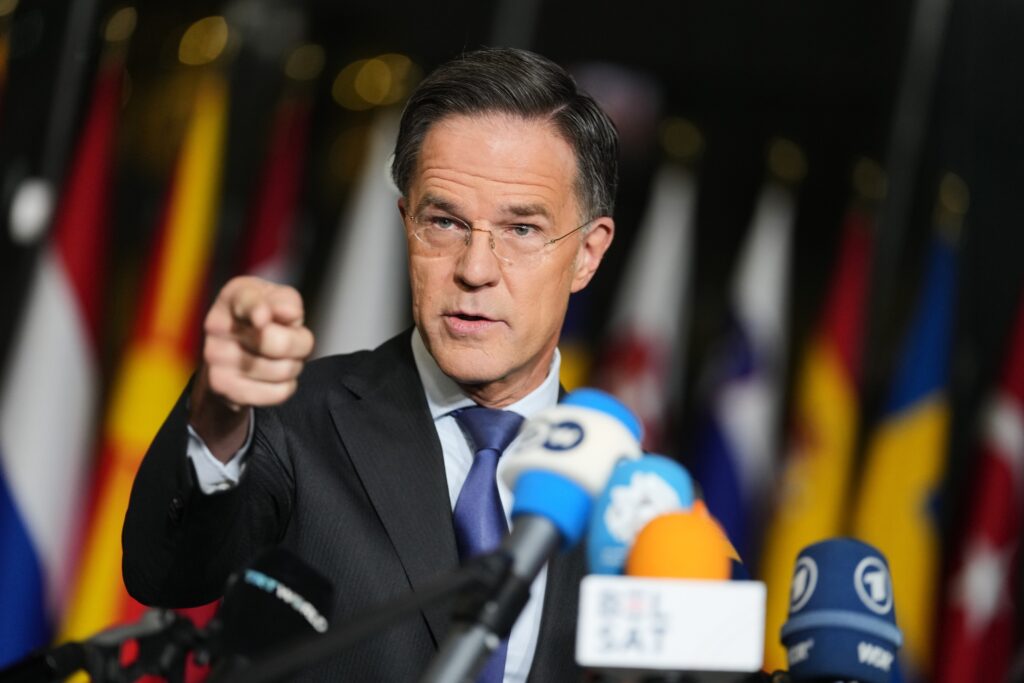
BRUSSELS — When NATO foreign ministers gathered this week to deliberate on a U.S. plan to end the war in Ukraine, they had neither the plan in hand nor Secretary of State Marco Rubio in the room to represent the alliance’s biggest, most powerful member. Rubio skipped the meeting as the White House held talks with Russia and Ukraine that have kept European allies sidelined.
The State Department did not give a reason for Rubio’s absence, but his decision not to attend the high-profile meeting only added to the quiet frustration among his European counterparts as President Donald Trump’s envoy Steve Witkoff and son-in-law Jared Kushner visited Moscow to discuss a plan with huge ramifications for European security.
It was here at NATO’s glassy headquarters that Trump rattled America’s partners during his first presidency by telling them that if they didn’t pull their weight, he could “do his own thing.” Now Washington appears to be doing just that, and not only in the Russia talks. In the Middle East, the Caribbean, the South Caucasus and pretty much everywhere else, Trump acts first, consults after — if at all.
In their plan for Ukraine, the president and his advisers have even seemed to position the United States as speaking not for the alliance — synonymous with American military might since its founding in 1949 — but as an independent arbiter, whose interests do not necessarily coincide with those of the other 31 allies, from Canada to Estonia.
“The spirit of the plan was: We are no longer an ally, we are a broker. We are not in this camp or that one, we are above that. It was perceived as a catastrophe by the Europeans,” said Claudia Major, a senior vice president of the German Marshall Fund, a Washington-based think tank.
“They don’t have to leave NATO to weaken NATO,” she said. “I mean, I’m a member of a gym but I don’t go.”
NATO Secretary General Mark Rutte, whose core job responsibility often seems to be to smooth over relations between Trump and other allies, told reporters there was nothing to worry about. The White House is “absolutely consulting enough” with European allies and he is “in constant contact” with U.S. officials, Rutte said as he convened the foreign ministers meeting Wednesday.
But Trump’s approach repeatedly has left European leaders in the dark, relying on leaks and news reports for the latest developments, then scrambling from afar to shape policy discussions in which their constituents and their continent have a far more direct stake.
Ahead of Witkoff’s trip, several diplomats at NATO said they weren’t sure which version of the plan he was taking to the Kremlin — an updated proposal reflecting changes from talks with Ukrainian negotiators, or something else.
European leaders are anxious and distrustful of the Trump administration. According to the leaked transcript of a phone call among leaders, published on Thursday by Der Spiegel, German Chancellor Friedrich Merz said repeatedly that the Americans are “playing games” while French President Emmanuel Macron warned that Washington might “betray” Ukraine.
American exceptionalism — including unilateral decision-making and military action — is nothing new. But for Europeans, it now hits closer to home. After supporting the U.S. in many conflicts, including by sending troops to Afghanistan and Iraq, some allies feel bitterly slighted by Trump’s limited regard for their priorities.
European leaders were already alarmed by Trump’s interest in renewing economic ties with Russia, along with the president’s uncertain commitment to Europe’s security.
In an earlier bid to end the war, Trump invited Russian President Vladimir Putin to Alaska and seemed open to Russia’s demands for Ukrainian territory, prompting several European leaders to race to the White House for a meeting.
Last month, Witkoff floated a plan for Ukraine that many European officials found out about in the press. The proposal triggered alarm not only for the concessions it demanded of Kyiv but also because it mentioned using Russian frozen assets held in Europe, as well as restricting NATO expansion and the European Union’s ability to accept Ukraine as a member.
The initial, 28-point plan appeared to get revised after meetings between U.S. and Ukrainian negotiators. European diplomats expressed relief that it was revamped and said they had received U.S. assurances that NATO and E.U. questions would be addressed separately.
But Trump’s constant freelancing has cut to the heart of European apprehension that Washington does not share their dark assessment of Putin’s ultimate intentions, which they see as undermining European democracies and weakening NATO.
The negotiations also feed a fear that Trump shares with Putin a vision of the world in which Washington and Moscow get to decide the fate of others.
“You have this idea behind it that the great powers decide, and the smaller ones have limited sovereignty, and they are informed afterward,” Major said. “There is a certain intellectual dissonance,” she added, in the U.S. wanting to potentially do business with Russia while most NATO leaders describe Russia as their biggest threat.
Still, some European diplomats say the only option in the immediate term is to keep getting in Trump’s ear — because even if he were willing to consult more, Putin is not.
“The fact of life is the only ones capable of negotiating an end to the Ukraine war are the U.S., for the simple reason that Putin will not sit at the table with anyone else,” said a NATO diplomat, who, like others, spoke on the condition of anonymity to discuss sensitive security issues. “This causes a lot of discomfort for many Europeans, but it is a fact of life, so as long as the Americans listen to us.”
“I think it’s fair to say these are the most consequential negotiations for European security of this century,” the diplomat added.
At this week’s NATO meeting, the United States was represented by Deputy Secretary of State Christopher Landau — who earlier this year questioned the need for NATO, calling it “a solution in search of a problem” in a post on X that he later deleted.
A State Department official, speaking on the condition of anonymity to discuss Rubio’s travel, said NATO was “completely revitalized” since Trump secured a European pledgeto increase national defense spending by allies. Rubio has “already attended dozens of meetings with NATO allies, and it would be completely impractical to expect him at every meeting,” the official said.
NATO foreign ministers typically meet two times per year, with ambassadors stationed in Brussels meeting far more frequently.
“I totally accept him not being able to be here,” Rutte said of Rubio, who is juggling multiple jobs in the administration. Rutte also told reporters that he hears from “all allies that they’re completely committed” to NATO’s political doctrine that Russia poses the biggest threat to the Western alliance.
Several European diplomats acknowledge privately, however, that they encounter conflicting messages among those in Trump’s circle — seeing Rubio, for example, as more aligned with their ideas and Witkoff as too close to Moscow.
The Kremlin regularly criticizes input from European officials on the negotiations, casting them as warmongers seeking to perpetuate the conflict with their backing of Ukraine.
Putin declared this week that Russia is ready for war with Europe “right now if Europe starts it,” drawing consternation from European ministers, who said this was proof that they should funnel more money to Ukraine and their own militaries.
The increasingly tense rhetoric is fueling European calls to take charge at NATO in case the U.S. shrinks its dominant role, including in the command structure and quick-response plans.
European leaders must “adjust to a new reality” in which U.S. interests don’t necessarily match theirs, said Giuseppe Spatafora, an analyst at the E.U.’s Institute for Security Studies and a former NATO policy adviser.
“This opinion is becoming more popular among European leaders,” as the leaked phone call suggested, Spatafora said. “They thought that relentless engagement would avoid the worst outcomes, which it did, or could have slowly shifted Trump’s needle. I don’t think the latter happened.”
Ukrainian President Volodymyr Zelensky, meanwhile, is dealing with a major corruption scandal that prompted the resignation of his chief of staff, and his negotiating leverage remains precarious. That’s especially because of a disagreement among E.U. nations on how to find fresh cash for Kyiv, now that the U.S. has halted direct cash assistance.
An E.U. plan to tap into some $200 billion in frozen Russian assets has run into stiff opposition from Belgium, where most of the funds are located.
Estonian Foreign Minister Margus Tsahkna said there was “very important momentum” in the U.S.-led talks, but he acknowledged early Wednesday, the morning after the American delegation went to the Kremlin: “We don’t know exactly what was discussed, and what will be the results.”
John Hudson in Washington contributed to this report.
The post In Russia talks, NATO allies fear Trump is doing his ‘own thing’ appeared first on Washington Post.