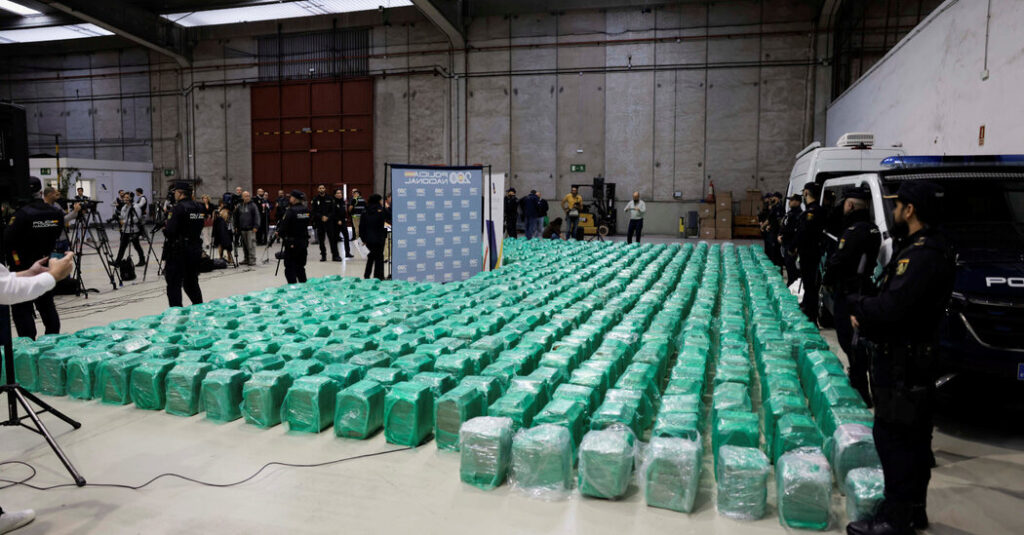
Across Latin America, the resurgence of cocaine is wreaking havoc, terrorizing and killing civilians as cartels battle each other and the authorities to produce the drug and smuggle it to the United States, Europe and beyond.
Almost nowhere has been affected by this more than Ecuador, now the world’s largest exporter of cocaine. Once a hub of stability, Ecuador does not produce cocaine — instead it serves as a trafficking route for criminal groups operating in Colombia and Peru.
In 2022 and 2023, Ecuador nearly fell to an international consortium of drug traffickers: an alliance of Mexican cartels, Colombian guerrilla groups, European mafias and local gangs. In that war, Ecuador found itself alone, while the United States mobilized to scale up assistance and save its ally.
Officials and analysts attribute this in large part because the United States had prioritized combating fentanyl over other drugs in recent years. The thinking, according to officials, was that cocaine deaths were negligible in comparison to overdoses from opioids, and what limited resources there were needed to be directed to confronting those drugs.
New York Times reporters traveled across Ecuador this year and embedded with the country’s Navy to see how this transnational drug alliance has affected the nation.
The U.S.’s shift in focus from cocaine to fentanyl has helped cocaine traffickers to thrive in Latin America.
Since President Trump took office in 2017 and through the Biden administration, the United States focused on battling fentanyl, leaving room for the resurgence of cocaine traffickers, particularly in Ecuador.
As a result, Ecuador faced an imminent takeover by criminal groups, prompting the United States to increase military assistance for the country. Despite this aid, Ecuador’s government is still struggling to maintain control, leading to an increase in violence and insecurity not seen just a few years ago.
Car bombs terrorize civilians, and gangs frequently clash with military troops. Officials describe a criminal culture so powerful that schoolchildren aspire to join gangs.
The Trump administration has started an aggressive military campaign in the region, targeting boats it says are smuggling drugs, but it’s uncertain whether these actions will have a significant effect on the growing cocaine trade. It’s also unclear whether that is Washington’s goal — instead, some administration officials have said the military buildup is actually aimed at driving Venezuela’s autocratic leader from power.
An alliance of criminal groups has turned Ecuador into a ‘cocaine superhighway.’
Ecuador was historically viewed as a hub of stability in comparison to its neighbors. In 2009, it distanced itself from the United States by closing a U.S. military base. Consequently, the American Embassy shut down its military office and primary State Department drug-fighting efforts in the country.
During Mr. Trump’s first presidency, Mexican cartels surged in power in the country as they began collaborating with Colombian groups and local gangs to traffic cocaine to Europe and the United States. These partnerships have also led to alliances with European mafias, according to officials.
Such alliances have transformed Ecuador into what American officials called a “cocaine superhighway,” with as much as 70 percent of world’s supply flowing through the nation.
“Cocaine came to be seen by many as ‘bad, but not going-to-kill-you bad,’” said Mike Fitzpatrick, the ambassador to Ecuador from 2019 to 2024. He said it is regarded by some as “one step up from marijuana,” in Washington, making it less of a priority.
But in Ecuador and other countries in Latin America, the drug has again become the main driver of terror and violence, killing and maiming civilians as it made its way to buyers mostly in the United States and Europe.
Ecuadorean officials say criminal groups seem to have endless weapons and funds.
Ecuador’s Navy is heavily involved in combating the country’s role as a cocaine export hub, but it faces significant hurdles because it is being outmatched by criminal groups, according to officials.
Despite increased security spending, Navy officials say that the criminal groups have vast resources and weapons, complicating their efforts. Young men driven by poverty are also easy gang recruits, while military training takes years. Corruption is widespread, and leaks have foiled past missions.
“This is an existential war,” said Giovanni Davoli, the Italian ambassador to Ecuador, who compared the fight to Italy’s struggle against mafias. “Ecuador is not a narco state but it needs help.”
Maria Abi-Habib is an investigative correspondent reporting on Latin America and is based in Mexico City.
The post How the U.S. Focus on Fentanyl Helped Fuel the Cocaine Trade’s Resurgence appeared first on New York Times.