Hong Kong put out one fire. Now it’s dealing with the next.
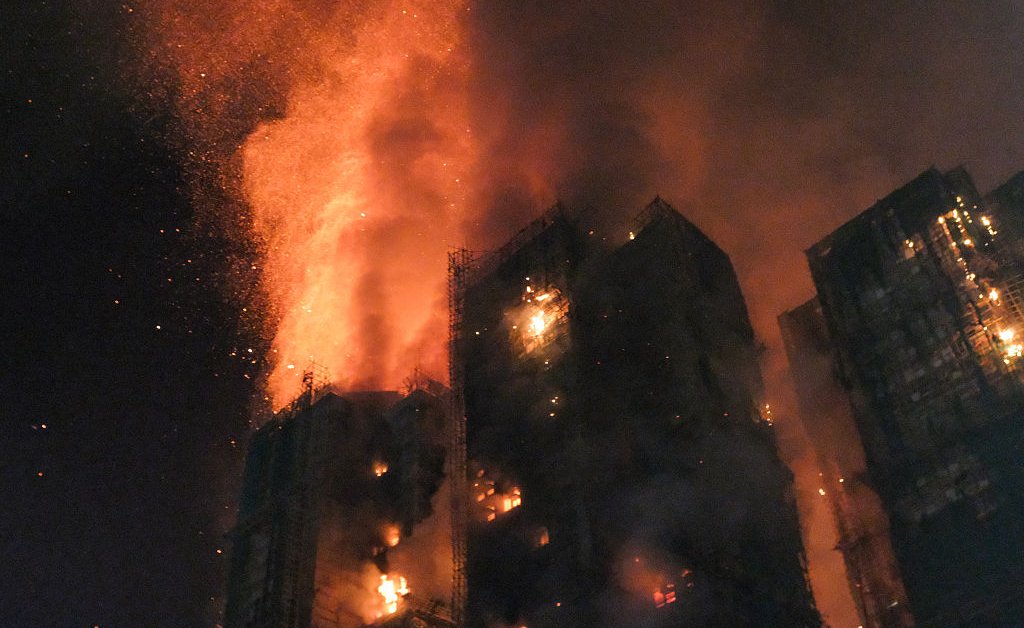
The first, an actual blaze in a densely-populated residential complex, took days to extinguish and killed at least 159 people; the second, sparks of public discontent fueled by grief and frustration, authorities are continuing to try to stamp out.
[time-brightcove not-tgx=”true”]
Since the fire at Wang Fuk Court broke out on Nov. 26, several individuals—not only those accused of having direct responsibility for the fire but also those who, according to the government, “impact Hong Kong’s social stability and endanger national security”—have been arrested.
“Some external forces with ulterior motives and anti-China elements have attempted to smear rescue efforts and incite social division and confrontation,” a spokesperson for the Hong Kong government said Wednesday in a statement, adding that the city will “not tolerate” actions which “disregard the current predicament, distort the truth, and especially criminal acts intended to incite hatred against the government.”
The government’s heavy-handed response to critics, which it has in the past used to quash pro-democracy movements in the name of national security, has renewed concerns from rights advocates.
On Nov. 29, China’s national security office in Hong Kong issued a strong warning against what it deemed “anti-China elements” reacting to the Wang Fuk Court fire, saying that “they have lost their humanity” and that under China’s National Security Law for Hong Kong and the city’s companion Safeguarding National Security Ordinance, they will be “held accountable and severely punished.”
Elaine Pearson, Asia director at Human Rights Watch, said Monday in a statement that the “fire raises serious concerns about the Chinese government’s crushing of what had been Hong Kong’s free press, democratic legislature, and vibrant civil society, and the impact on government oversight and safety.” Pearson added that it was “crucially important not to treat those demanding answers for the tragic fire as criminals.”
Among those swept up in the crackdown is Miles Kwan, a 24-year-old university student who was arrested on Nov. 29 on suspicion of sedition, according to local media. Kwan had initiated a Change.org petition urging a governmental response to “four big demands” after the fire: the resettlement of displaced residents, an independent probe into possible corruption, a review of construction oversight, and naming accountable officials. The day before his arrest, he and two unidentified others stood near a metro station, handing out flyers linking to the petition. On Monday, Kwan was released pending further investigation; the petition, which had garnered some 10,000 online signatures, also disappeared.
Former elected district official Kenneth Cheung was also arrested Sunday after he made online comments about the fire (in addition to other supposed incitements of hatred). Cheung has since been released on bail, though his passport was confiscated.
“I was surprised by my arrest by the National Security Bureau,” Cheung said in a statement to TIME. “I find this utterly baffling.” He added that since his case falls under the National Security Law, a gag order prevents him from disclosing specific details of the investigation.
Police also reportedly met with a solicitor Tuesday, just hours before he was set to speak to the media about the fire. The Hong Kong Free Press reported the conference, which was cancelled, was set to discuss “support for affected residents, the establishment of a commission of inquiry, potential bid-rigging, substandard materials, and the roles of regulatory bodies including the government.”
Volunteers providing aid to survivors have also been reportedly asked to leave sites near the fire. Secretary for Home and Youth Affairs Alice Mak said on Nov. 29 that “we understand everyone’s good intentions to help” but advised that volunteers and aid groups coordinate with the city government.
A volunteer told Sky News that “past incidents” have made authorities anxious about crowds forming: “They may liken this to previous events—the essence looks similar.”
The Hong Kong government appears to be wary of fomenting discontent that could snowball into mass demonstrations like in 2019, when widespread anti-establishment protests consumed the city.
With reports of official negligence possibly contributing to the fire, Eric Lai, a senior fellow with the Georgetown Center for Asian Law, tells TIME that the government has since “abused” national security legislation in a bid to try and put things under control—“to escalate this domestic crisis management to a matter of regime security.”
When city leader John Lee was asked about the arrests on Tuesday, he said the government “will not tolerate any crimes, particularly crimes that exploit the tragedy that we are facing now.”
The crackdown “reflects the suspicion of the central government and the local government about bottom-up kind of organizing,” John Burns, emeritus professor and honorary professor at the University of Hong Kong, tells TIME. “They are watching like hawks, for the slightest opportunity for any resurgence of opposition.”
The post How Hong Kong Is Trying to Stamp Out Sparks of Unrest After Deadly Fire appeared first on TIME.