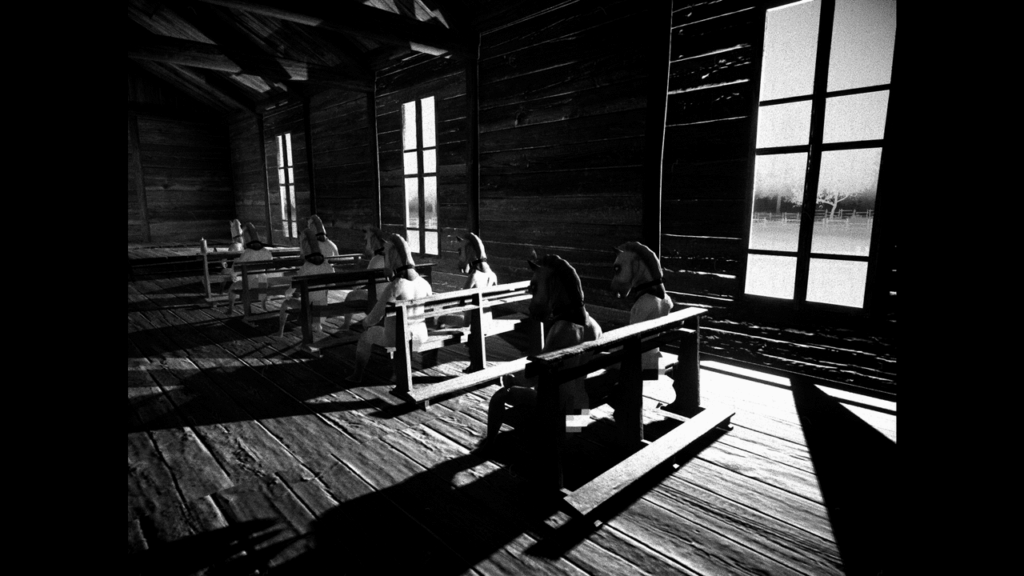
Shortly before the December 2 release of horror game Horses, developer Santa Ragione shared some news: the game would not be available on Valve’s mega platform, Steam. Valve had already banned an early, incomplete version of the game two years ago and offered, according to Santa Ragione, little clarification about why at the time. Then, hours before the game’s release, the Epic Games Store banned Horses as well. A day after the game’s launch, distribution platform Humble removed, and then later relisted, the title.
The public swiftly spoke out against these bans, and community support for the game’s developers has been plentiful. Many pieces have been written online about how the game doesn’t deserve to be shunned by the distribution platforms, and about how the game’s content is relatively tame.
But too few of these pieces engage with the content of the game on a critical level. Horses’ storytelling is clumsy, and its blase treatment of the sexual assaults (plural!) depicted in the game fails to elevate the game beyond more than a lazy commentary of sexual repression.
It’s difficult to untangle the circumstances and controversy surrounding the game’s release from the content of the game itself. As a writer, I think censorship of creative work is Bad. I think Horses has as much right to exist as any other game, and that the power of distribution platforms to ban and delist a game by a small studio should be a concern for everyone.
But the real problem with Horses is not that it’s too audacious for what is clearly intended to be an adult audience. Horses, for all the attention around its banning, is tedious and overreliant on pseudointellectual ideas. It confuses its own pretension for something profound. Even its shock value eventually wears off, making its three hour runtime feel like a slog. Conversations about whether or not it deserves the scandal are ultimately useless and wholly subjective. They’re a smokescreen for a game that, as brash as it is, feels like a bad student film.
Descriptions of sexual assault, as well as spoilers for the game to follow.
Horses is a story about subjugation. That has to be mentioned first, because at no point will the game let you forget this theme, which it hammers into its story as delicately as an early morning construction crew.
You play as a character visiting a farm for 14 days. During that time, you are expected to help out with chores such as upkeep, harvesting vegetables, feeding the dog, and caring for the game’s titular horses. But this is a horror game, and something sinister is going on. The “horses,” it turns out, are not equines but human beings, stripped naked, chained and collared, and forced to wear horse head masks. When they speak, which is rare, it’s in the halting cadence of someone who’s forgotten how to form proper sentences. The farmer who runs the joint expects you to keep them in line—whether that means keeping them from “fornicating,” or ensuring they work—by whatever brutal means necessary.
The horrors ramp up as days drag on. One “horse” appears to die by suicide early on. The “dog” you feed is not actually a dog, but another naked adult man wearing a mask to play the part. The game tries to be surreal and intentionally grotesque, with the particular aesthetic of an old black-and-white film. The game’s intentionally low quality graphics give every character the same dead-eyed stare and rubbery face. Texts cards deliver dialogue while characters flap their uncanny valley mouths, but it all often feels more harebrained than anything.
Although many of Horses’ characters are naked, their genitals are pixelated, meaning there is no actual nudity in the game, even during sex. Catching the game’s “horses” in the act reduces them to animalistic depictions, where one is furiously pumping away at the other bent over in front of them. (In case the game didn’t drive that point home, later it will give you a flash of two actual horses fucking in the wild.) The game is clearly aimed at adults, and many of its uncomfortable moments involving torture and forced labor clearly fit within the Mature rating it’s received.
Curiously, critics in the game’s early reviews have breezed past the game’s multiple sexual assaults, giving them either a perfunctory mention or nodding at the game’s “uncomfortable” material. These moments are implied, or happen off-screen (debatable, as the game’s first example does play out in front of you, even if it lacks a full shot of the crime), which apparently is enough to excuse their inclusion. But the game, which wants to be taken seriously, does a shoddy job with these parts of the story and never truly confronts the high level of sexual violence it subjects its characters to.
About halfway through the game, you as the farmhand witness brutal sexual assault, some parts of which play out as a series of closeups, and some parts that later happen off-screen.
Rape is a difficult subject that is still worth telling stories about in any medium. Assaults often happen without witnesses present; even in media, seeing the act itself is less important than acknowledging its trauma. But there is a difference between depictions that are handled with intention and care, versus those that act as a plot device or texture for the overall horror of the situation, which is what happens in Horses. The game wants to be a psychosexual drama, feeding the farmer’s childhood religious traumas into his shame-filled, modern-day fetish for chastity cages and watching others, as he says, “fornicate.” Yet Horses’ assaults serve no purpose other than to hammer home the brutality of this farm. The story does not benefit in any noticeable way from their inclusion. It simply gives one more reason to add another body to the game’s growing pile.
Despite your complicity as the main character in all of these terrible acts, Horses doesn’t offer any sort of moral resolution. The game ends in a mass escape where all of the crimes that have taken place are seemingly forgotten. It leaves all of that exploration of slavery, abuse, sex, assault, religious trauma, and subjugation hanging and feeling tremendously half-baked.
The debate over Horses’ delisting is emblematic of a bigger fight that’s taken place this year, when platforms such as Steam and Itch.io yanked down “NSFW” and “porn” games in July. Developers, players, and trade organizations have continued to be vocal about developers’ creative rights to make games that deal with adult content.
“Developers shouldn’t have to compromise their creative vision, but we also have to acknowledge that games exist within capitalist structures where access to platforms determines livelihood,” says Jakin Vela, executive director of the International Game Developers Association, a nonprofit supporting game developers. “The key is informed decision-making and understanding what each platform allows, what risks exist, and whether your artistic goals outweigh those risks.”
Still, Vela says, these removals have exposed the fragility of developers’ economic security. “We should be concerned whenever a system allows a creator’s livelihood to be cut off without transparency or recourse,” he says. The video game industry is highly consolidated, with a handful of platforms controlling access to the vast majority of players. “That imbalance creates a structural issue, not necessarily because platforms enforce rules, but because there are so few viable alternatives.”
Santa Ragione’s future should not hinge on its ability to exist on Steam or any other platform. A bad project should not spell the end of a developer who is, for all the criticisms I have of its game, trying to say something. That part of this story may still yet have a happy, or at least a survivable, ending. The Streisand effect is paying off for Horses. On the digital distribution platform GOG, where it’s still available, the game is a top-seller.
Horses needs to be defended against censorship. It is also a bad game that should be examined as such. But while the conversation around Horses is still stalling out about why the game is allowed to exist, or how it’s not that offensive, the better question is why we really care about it at all—and why, as players, we feel so reluctant to talk about its failings like any other piece of media.
The post Horses, the Most Controversial Game of the Year, Doesn’t Live Up to the Hype appeared first on Wired.