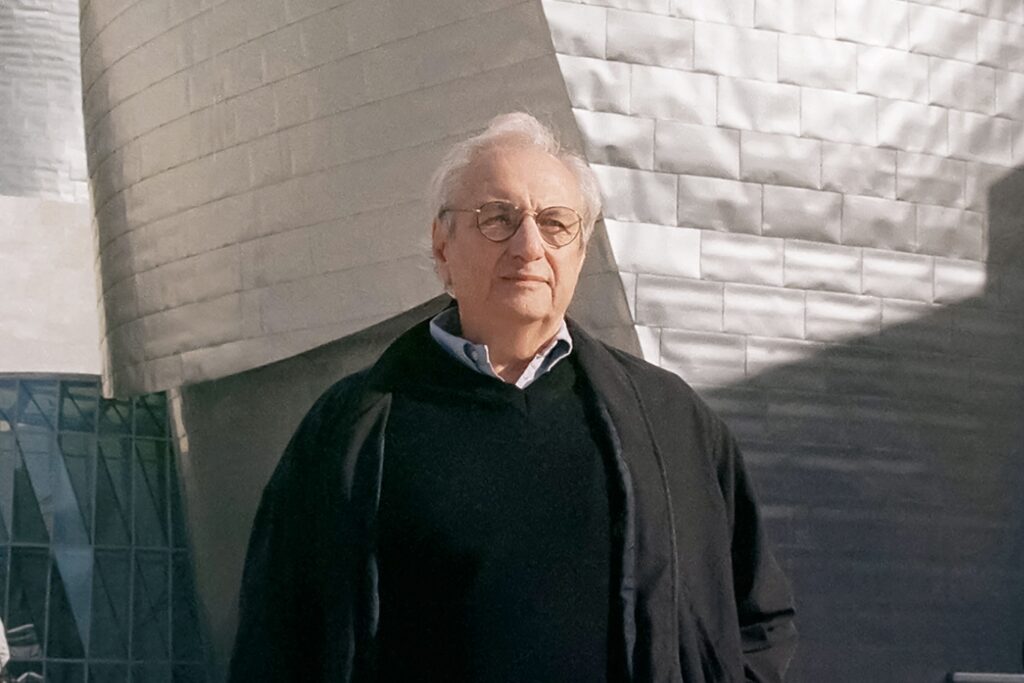
Frank Gehry, whose provocatively adventurous buildings — among them the Guggenheim Museum in Bilbao, Spain, and the Walt Disney Concert Hall in Los Angeles — liberated modernist architecture from its conventions and brought him the admiration of critics, peers and a broad, fascinated public, died Dec. 5 at his home in Santa Monica. He was 96.
The cause was a brief respiratory illness, said Meaghan Lloyd, the chief of staff at his firm.
Mr. Gehry was considered one of the most imaginative and expressive architects of his generation and ranked among the most important designers since Frank Lloyd Wright. His works became landmarks around the world, challenged the rigid formalism of modernist architecture, blurred the borders of architecture and sculpture, and impelled new methods of design and construction.
The Guggenheim Museum and Walt Disney Concert Hall — audaciously curvilinear monuments to high culture clad in shimmering titanium and steel — became Mr. Gehry’s ravishing signatures. Architect Philip Johnson, whose works epitomized modernist cool, once proclaimed Bilbao “the greatest building of our time.”
“Architecture is not about words. It’s about tears,” said Johnson, who broke down when he first beheld its soaring spaces. “I get the same feeling in Chartres Cathedral.”
The museum, which opened in 1997, draws upward of 1 million visitors a year and had such a transformative effect on its sleepy Basque town that cities the world over soon were lusting for the “Bilbao effect.”
“What Gehry was ‘good at’ was making architecture that both inspired thought and brought pleasure, making buildings that were unusual enough so that some confused them with art pieces and others found them merely bizarre,” Paul Goldberger, a Pulitzer Prize-winning architecture critic, wrote in his 2015 Gehry biography, “Building Art.”
The freaky angles, detached shapes and cheap industrial materials that Mr. Gehry favored early in his career induced outrage and wonder in nearly equal measure. On “The Simpsons,” he was lampooned as the architect who finds a spark of inspiration in a crumpled wad of paper. Time magazine noted that he was once viewed as “the world’s most famous strange architect,” a sentiment that compelled Mr. Gehry to title a lecture “I’m Not Weird,” in which he explained that he was foremost a professional attuned to deadlines, budgets and problem-solving.
In time, he became the quintessential “starchitect,” with a Pritzker Prize — his profession’s highest accolade — in 1989, billionaire clients, jewelry designs for Tiffany and a furniture line for Knoll.
Few other architects of his generation so dramatically redefined the boundaries of their craft. The rough-hewn look of his early phase evolved into a sophisticated and playful collage of folding, twisting and slanting forms engineered into existence through inventive use of computer technology.
One of his most whimsical experiments, designed in Prague in the early 1990s with architect Vlado Milunić, was a glass and concrete building nicknamed “the Dancing House” or “Fred and Ginger,” for the appearance it gave of swaying like ballroom dancers. The structure was controversially out of sync with the surrounding Gothic and baroque architecture, but it has also been described as a masterly emblem of the city’s post-Communist revival.
Some regarded Mr. Gehry’s works as outsize expressions of ego. In his book “Architecture of the Absurd,” former Boston University president John Silber skewered the Gehry-designed Stata Center at MIT as the “pièce de résistance of absurdity in architecture,” not least because of its massive cost overruns. The center, with towers bent like a soda can that leaned like the Tower of Pisa, developed leaks and drainage problems that resulted in a lawsuit against the architect and the construction firm that built it. A settlement was reached.
Other critics exulted in Mr. Gehry’s reenvisioning of architecture’s possibilities. “His aim is not to found a school, not to create a style,” Herbert Muschamp wrote in 1997, reviewing Mr. Gehry’s Bilbao design for the New York Times. “Rather, he is possessed by the gaga 19th-century notion that by exercising their imaginations artists can inspire others to use their own.”
Mr. Gehry was inspired by the West Coast art scene of the 1960s, in particular by the experimental painting and sculpture of Ed Moses, Ed Ruscha and Larry Bell, and later by East Coast avant-gardists such as Robert Rauschenberg.
Mr. Gehry’s home — a 1920s Dutch Colonial bungalow in a middle-class neighborhood of Santa Monica, California — became a prime testing ground for his breakout ideas.
He bought the “dumb little house with charm” in 1977 after his divorce and remarriage. Instead of tearing down the aging home, he juxtaposed old and new by wrapping the original dwelling in a second structure made of budget-friendly corrugated metal, unpainted plywood and chain-link fencing. He called the style “cheapskate architecture.”
A boxy skylight jutted up at an odd angle, asphalt covered the kitchen floor, and beams, joists and studs were exposed throughout. The house looked unfinished even when it was completed, in 1978.
The result was too freakish for many of his neighbors. One was so disgruntled that he regularly brought his dog to relieve itself on the property. But Mr. Gehry defended his design. He was poking fun at the suburban Southern California experience and reveling in what he called “symbols of the middle class to which I belonged.”
In 2012, the Gehry house earned the Twenty-Five Year Award from the American Institute of Architects, which declared it as influential in its time as Wright’s Fallingwater house in the 1930s and Johnson’s Glass House after World War II.
“The image of a defiantly ‘destroyed’ California house made of unexpectedly humble materials ignited responses as far as Europe and Asia,” the AIA jury wrote, adding that the building “ignited a forum to consider the relationship between art and architecture … further expanding the role of the architect in culture.”
Mr. Gehry — who also was a recipient of the AIA’s Gold Medal, its highest annual honor — had a self-effacing persona and rumpled appearance that masked his driving ambition and fear of failure. He spent years in psychoanalysis and let emotion flow through the radical spaces he created.
“I want buildings that have passion in them, that have feeling in them,” he once said, “that make people feel something, even if they get mad at them.”
‘Take an architecture class’
Frank Owen Goldberg was born in Toronto on Feb. 28, 1929. His father, Irving, was the son of European Jews, and he grew up destitute in New York before drifting to Canada. His mother, Thelma Caplan, was born in Poland and raised in Toronto; she tried to instill in Frank and his younger sister, Doreen, an appreciation for music and culture.
Irving struggled in business, selling slot machines until they were outlawed, then sinking a small furniture concern. The Goldbergs were often impoverished.
Some of Mr. Gehry’s dearest early memories were the hours he spent in his grandmother’s kitchen with a bagful of wood scraps for her stove arrayed before him. He used the odd bits and pieces like building blocks, erecting mini-cities on her floor. Her gift of a “license to play” would inform his choice of a career much as another memory — the carp swimming in her bathtub before becoming gefilte fish — would help inspire the fish imagery that became a motif in his work.
After his father suffered a heart attack, the family relocated to Los Angeles in 1947, seeking a more temperate climate. Mr. Gehry, then 18, juggled a day job driving a furniture delivery truck with night classes in art at Los Angeles City College and later at the University of Southern California.
His interest in architecture had begun in high school, when he attended a lecture in Toronto by the modernist Finnish architect Alvar Aalto. “He showed a bent plywood chair he’d designed,” Mr. Gehry told the Boston Globe. “I never forgot that.”
At USC, he struck up a friendship with his art teacher, the prominent ceramicist Glen Lukens, who took the pupil to see his new home being built. Mr. Gehry was infatuated. “Take an architecture class,” he recalled Lukens advising. “I have a hunch.”
Mr. Gehry enrolled in the architecture program, earning a bachelor’s degree from USC in 1954. The next several years were restless. He grew bored designing housing and large commercial projects for a venerable firm in Los Angeles. He quit in 1960, uprooted his family to Paris, and spent a year soaking up European architecture.
Upon his return to California, he opened his own practice. By that time, he was known as Frank Gehry, having taken a less Jewish-sounding name at the behest of his first wife, Anita Snyder, who feared antisemitism would hamper his rise. (Later in life, he said he regretted the name change but that it was too late to switch back.)
Mr. Gehry attributed the collapse of his first marriage in part to his commitment to business over family life. Through an expanding social circle that included Hollywood psychoanalyst Milton Wexler, he met moneyed and influential clients such as Oscar-winning actress Jennifer Jones and her husband, industrialist and art collector Norton Simon. The documentary “Sketches of Frank Gehry,” which aired on PBS’s “American Masters” series in 2006, was made by another close friend, director Sydney Pollack.
One of his most important East Coast clients was the Rouse Co., the force behind planned communities such as Columbia, Maryland. In 1967, Mr. Gehry codesigned for Rouse the Merriweather Post Pavilion, the Columbia performing space that proved a major stepping stone in his career.
In 1975, he married Berta Isabel Aguilera. In addition to his wife and their two sons, Alejandro and Sam Gehry, survivors include a daughter from his first marriage, Brina Gehry, and a sister. His daughter Leslie Gehry Brenner, also from his first marriage, died of uterine cancer in 2008.
Freed by technology
In the 1980s, Mr. Gehry’s innovations accelerated, most palpably in a house addition in Lyndhurst, Ohio, for insurance magnate Peter B. Lewis. The $5 million project grew into a mammoth complex that exploded with curves and fantastical shapes, including a building shaped like a horse’s head.
With a $82 million final price tag, the Lewis residence was never built, but it fostered a groundbreaking use of technology that would change architectural practice around the world.
To translate his tilting, swerving forms for builders, Mr. Gehry and his team adapted aerospace software for architecture. The system, known as CATIA, allowed his complex cardboard models to be scanned directly into the program, which would accurately project costs and produce detailed instructions for engineers. It also was creatively emancipating, enabling Mr. Gehry to simulate crumpling glass like paper or folding steel like velvet.
The technology was crucial to Guggenheim Bilbao and the Disney Concert Hall, where he molded polished metal into sensuous abstractions that evoked a ship’s billowing sails.
Bilbao vaulted Mr. Gehry into architecture’s pantheon because it was a practical success as well as an artistic one — an impossible achievement without the digital program’s precise calculations. “My building in Bilbao cost $300 a square foot with a budget of $100 million. I finished it on time and on budget,” he told Britain’s Independent newspaper in 2009, adding, “and it doesn’t leak.”
Disney was designed before Bilbao but opened later, in 2003, because of its complexity and economic and management woes. The $274 million project was saved through the intervention of the mayor, Richard Riordan, and billionaire philanthropist Eli Broad.
The concert hall was pronounced an acoustic as well as architectural triumph. Architecture critic Nicolai Ouroussoff, then at the Los Angeles Times, declared it a “sublime expression of contemporary cultural values” that affirmed Mr. Gehry’s place as “America’s greatest living architectural talent.”
On the journey to his landmark achievements — which include the Manhattan skyscraper 8 Spruce and the Louis Vuitton Foundation art museum in Paris — Mr. Gehry’s constant companion was controversy.
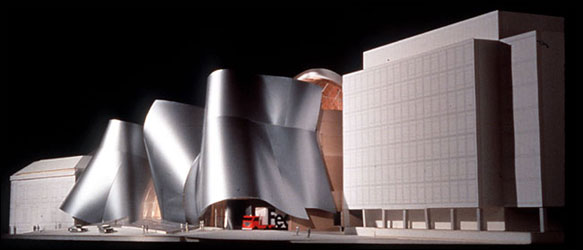
“Blobitecture” was one critic’s response to the anarchic forms of the Experience Music Project, a Seattle rock museum finished in 2000 for Microsoft co-founder Paul Allen.
Mr. Gehry’s plan for the Dwight D. Eisenhower Memorial in Washington was assailed by Eisenhower family members and other critics, with some comparing its large metal tapestries to the fences around Nazi concentration camps. Authorized by Congress in 1999, the memorial underwent substantial design changes, gained support from the Eisenhower family and was finally dedicated in 2020, to Mr. Gehry’s delight. Another ambitious effort, a $170 million addition to the Corcoran Gallery of Art, stalled in 2005 amid fundraising shortfalls and board squabbles.
In 2016, President Barack Obama awarded him the Presidential Medal of Freedom, the nation’s highest civilian honor.
Mr. Gehry, who into his mid-80s continued to receive high-profile commissions such as the Facebook campus headquarters in Silicon Valley, was sensitive to assertions that his buildings were pure spectacle. When skeptics said his designs pushed too far, he was unapologetic.
“You can learn from the past but you can’t continue to be in the past,” Mr. Gehry once said. “I cannot face my children if I tell them I have no more ideas and I have to copy something that happened before. It is like giving up and telling them there is no future for them.
The post Frank Gehry, who stretched architecture’s boundaries, dies at 96 appeared first on Washington Post.