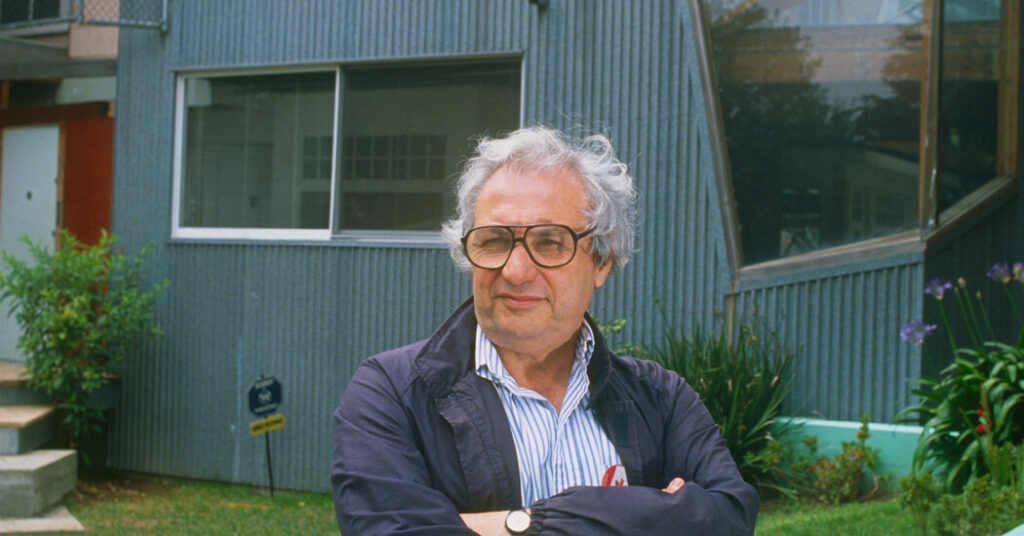
Like his buildings, the legacy of Frank Gehry, who died on Dec. 5, at age 96, is exceptionally complex: radical, shifting, multifaceted and often misunderstood. It’s easy to reduce his structures to their superficialities, shapes and materials. But they’re far deeper and expansive — as has been Gehry’s impact on people, buildings, cities and the culture in general. He helped disrupt architecture and art — worlds reluctant to change. But he also changed how we see the world, shifting our perspective and our sense of what we were open to. Here are insights from some of the people he touched during his eight-decade career.
These excerpts have been edited for space and clarity.
The Disrupter
When he came into his own in the 1960s and ’70s, Gehry — an outsider with a chip on his shoulder — shook up an elitist, dogmatic architecture establishment with an approach based on artfulness, irreverence and intuition that employed cheap, utilitarian materials to create original forms.
His own house in Santa Monica, in which he wrapped a pink Dutch Colonial in an off-kilter armature of corrugated steel, chain link and exposed wood framing, became the symbol of this approach. Such efforts were emboldened and inspired by the work and feedback of his close friends, artists who went on to become household names (Charles Arnoldi, Larry Bell, Billy Al Bengston, Robert Irwin, Ed Moses, Ken Price and Ed Ruscha, to name a few).
Charles Arnoldi, Venice artist and longtime friend
Art is one of these things where you have to try stuff. That’s what Frank picked up on. He’s not going to just make houses for people, he’s going to make architecture art. It had to be a personal statement. In the art world there are no rules. That’s how he approached things.
Us guys on the West Coast were doing things that weren’t traditional. We were the back of the bus. We weren’t looking at Europe and art history. We were exploring new materials like resin and foam and plastic. Frank liked that attitude. Why not use things like chain link? It’s about intuition. When something is speaking to you, you have to put it out in the world and hope it speaks to other people.
Larry Bell, Venice artist and longtime friend, now based in Taos, N.M.
Everybody was looking for the edge. Frank was scrambling for originality too. I think that’s one thing that gave him the most credibility with every artist that knew him.
Thom Mayne, Pritzker Prize-winning Los Angeles architect; founder of Morphosis
I identified with the approach to his house. It was a statement about a house as a status symbol — in a city where people spend well over $20 million on a house, right? He builds this thing, and it’s just fabulous. The asphalt floor. It’s very aggressive politically. It’s not really inexpensive, but it’s the symbol of something inexpensive. Using chain link is saying [expletive] you to marble. And I hugely respected him for that.
Scaling Up
As Gehry took on larger and more publicized projects, those in power often saw his work as chaotic, strange or disrespectful of convention. Eventually Gehry would instigate vast shifts in both the architecture profession and the culture at large.
The Temporary Contemporary (now the Geffen Contemporary) — a former police car warehouse converted into a sprawling art space for the Museum of Contemporary Art — demonstrated how designers could reuse industrial spaces to make provocative places for art and commerce. Buildings like the Chiat/Day offices in Venice, Calif., fronted by a giant pair of habitable binoculars designed by Claes Oldenburg and Coosje van Bruggen, demonstrated how architects could fuse art and architecture. The Guggenheim Museum Bilbao and Walt Disney Concert Hall, employing digital technology originally used in the aerospace industry, shifted the perception of how cultural buildings could revitalize cities.
Rockwell Schnabel, co-client, Schnabel House, Brentwood, a breakthrough residence composed of tumbling, free-standing metallic pavilions around a reflecting pool
It was difficult for me. I grew up in Amsterdam, where houses are little blocks on the canals. I was born in a house made of bricks. I said to Marna [his wife, who worked for a time in Gehry’s office], “But there’s no symmetry. What does he want to create for me? It’s got to be livable.” Marna had a background in architecture and design, so she clued me in before it started to be built.
Our neighborhood in the beginning had questions about it. In the end they began to realize we were dealing with a maestro. Somebody came by from a magazine and said “Where is all the great art?” Marna said, “You’re standing in it. This is the art.”
Marna Schnabel, co-client, Schnabel House
You can call it chutzpah, or stubbornness, but it’s not about that. It’s about [executing] the perfection you see in your head. That’s why I call Frank an inventor.
Rolf Fehlbaum, Chairman Emeritus, Vitra. Client, Vitra Art Museum (1989), Weil-am-Rhein, Germany, a precursor to the ebullient curved forms of the Guggenheim Museum Bilbao
I didn’t know what to expect. This realm of shapes was so new. I just trusted Frank. You see the beginning of a new architecture. Every building is an expression of yourself into the future. How does the building help you become what you want to become?
It gave the company a new campus and a new identity. At the time it was just factory buildings and a sculpture by Claes Oldenberg. It encouraged me to go to Zaha Hadid, Alvaro Siza, to ask all these people to cooperate [on new buildings]. That would not have been possible without Frank.
Richard Koshalek, chair, Selection Committee, Walt Disney Concert Hall. Former Director, Los Angeles Museum of Contemporary Art (MOCA).
I got approached by a series of lawyers. They came to my office at MOCA and said, “You can choose any architect from the competition, but you cannot choose Frank Gehry.” They said, “You can’t have a chain link cardboard concert hall.”
I threw them out of my office. As the design started to evolve and images were published, a lot more opposition came forward. A major leader at the [L.A.] Philharmonic looked at me and said, “Stop this bullshit.” This is a powerful man. He said, “Get the drawings for the Dorothy Chandler Pavilion and build the same building across the street.”
Blending Creativity With Practicality
Because of Gehry’s unusual forms, many assumed his works were not based in budget and other client needs. And of course, there have been well-publicized examples of his buildings’ failures, from cost overruns and leaky roofs to hotly reflective surfaces.
But in interview after interview, clients attested to the practicality of Gehry’s work, and his willingness to be receptive and flexible. His approach was honed early, working on shopping centers and housing complexes for Victor Gruen Associates.
Edwin Chan, former partner, Gehry Partners. Founder and creative director, EC3.
The media created this mythology that he made these scribbles and they somehow magically turned into one of those buildings. And it’s not true. It’s an incredibly disciplined and rigorous process starting before the sculptural aspects even come into play.
Frank, surprisingly, and most people don’t know this, is one of the most collaborative architects I know. Every client becomes a kind of creative partner.
And somehow he’s confident enough that ultimately by the time it’s done it’s his signature, while being at the same time very loyal to what each client is about. For example the Foundation Louis Vuitton building. If you put the company’s leaders in the psychoanalyst’s chair and were to just spit out what they were like, it’s that building.
Juan Ignacio Vidarte, former Director General, Guggenheim Museum Bilbao
People look at [the Guggenheim Museum Bilbao] and think, “It’s just a whim.” Like a flamboyant shape that is totally un-functional. Quite the reverse is true. It’s true Frank had a very clear vision in mind for the formal aspect and its connection to the city and the hills. But the museum was really designed from the inside out. The way works of art go through the museum. How they come into the storage space, the freight elevator. How they move into the galleries.
The building has not provided any kind of nasty surprises. The titanium doesn’t react. It’s there as it was 30 years ago. The magic is still there.
Richard Koshalek
I’ve been going to the Gehry archive at the Getty [Research Institute] and looking at Gehry’s interviews with all kinds of people at Disney Hall. Frank is questioning them, When you perform, what’s your experience? What’s the orchestra’s experience?’ Frank is constantly learning. I’ve never seen that in another architect to that degree.
A Fierce Competitor
According to some, Gehry’s tenacity and confidence had another side: a fierce competitiveness and unwillingness to share the stage, and a reluctance to nurture others with similar visions.
Paul Goldberger, author, “Building Art: The Life and Work of Frank Gehry” (2015)
He could be very prickly and sometimes very self-absorbed. He could also be very generous, and did a lot for a lot of people over the years. One thing he wasn’t great about was always nurturing the best people in his office. A lot of talented people were squeezed out. The best people ultimately needed to go off on their own. But in some cases Frank encouraged them to go before they were ready and lost the opportunity of having a really strong designer working under him.
Fred Nicholas, chairman, Walt Disney Concert Hall Committee. (Nicholas died on June 28, at 105.)
I was in charge of the Disney Hall project at the beginning and it went on for seven or eight years. I gave my whole guts, my everything, and I was very responsible for Frank getting that job.
And it made him. And the only thing that I ever wanted from him was acknowledgment, which I never got. He didn’t want to acknowledge anybody. We were all very emotionally involved. The one who came out as a hero was Frank.
Christopher Mount, curator, “A New Sculpturalism: Contemporary Architecture from Southern California,” at MOCA, 2013
He had agreed to be in it. We had picked objects. And at the last minute he decided he wanted it to be just about him. He couldn’t share the spotlight. He just couldn’t.
Joy and Connection
At the same time, what sets Gehry’s work apart most is its generosity. Its ability to express joy and connection. He was well positioned to connect such startling creativity to a wider audience. And he did so more effectively, experts say, than almost any architect has before or since.
Paul Goldberger
His career represents one of the very few times in all of American architecture and definitely in our lifetime where serious and cutting-edge architecture that had historical and academic interest also ignited an enormous public interest. Those lines don’t cross very much in architecture or really anywhere else in a sense.
Frank never wanted to get away from the idea that one of the things architecture should do is make you feel good. To make a comparison to music, Frank was always trying to do radical music that would nevertheless not seem atonal.
Edwin Chan
People are not afraid to say, “I want to touch it.” They can sit on it, they can play with it. It’s emotionally inviting.
Juan Ignacio Vidarte
His main legacy is the kind of freedom that he has given to the profession of architecture. An opening up of the imagination. Once you get into the building it breathes joyfulness and the right spirit to appreciate art. I think that’s something that every museum should have.
Lyndon Neri, co-founder of the Shanghai-based architecture firm Neri & Hu.
His architecture definitely gives you a certain emotional rush. He’s our Antonio Gaudí.
Heidi Duckler, founder of Heidi Duckler Dance, which in 2024 performed on an outdoor stair at the Fritz Burns Academic Center on the Gehry-designed Loyola Law School campus
So many people have never been here, are not aware of it. Every time you look at this place, you see more. It’s so Los Angeles. It has a sense of humor. An attention to surprise and whimsy.
Alejandro Perez, choreographer with Heidi Duckler Dance
This staircase was intriguing to me. The color. The depth of it. And also looking above at the sky. We were able to create a world on it. It already has a world of its own when you look at it.”
A Social Conscience
In his later years Gehry — who often said architecture should benefit everyone — designed a number of projects free of charge for those less fortunate. These included buildings for the Youth Orchestra of Los Angeles (YOLA) in Inglewood, Calif., the Make It Right Foundation in New Orleans and Maggie’s, a cancer center, in Dundee, Scotland.
In the Watts neighborhood of Los Angeles, he designed the Watts Campus of the Children’s Institute, a nonprofit that provides early education and family services across the city. It is a soaring, one-of-a-kind space fractured into flexible pieces and wrapped in greenery.
Deborah Riddle, former community relations specialist at the Children’s Institute
Kids are allowed to be kids in this building. They’re allowed to breathe and expand and be who they are, even while their parents are in a session. That’s not always available to them.
Tondalia Chandler, a Watts resident and one of the facility’s first clients. She goes regularly for therapy, as do her four grandchildren.
It’s very open. The energy is really high. It’s like, ‘‘wow, is this real?’’ It’s so welcoming. It’s something to uplift me every time I come in. A lot of the clients that come here, when they walk in, you can see they’re down. But once they get on the other side of the door, it’s like a button has been pushed. They light up.
The post Frank Gehry, the Disrupter, Opened Their Imaginations appeared first on New York Times.