Erik Bulatov, a painter and central figure in the Soviet underground art movement who superimposed Communist Party slogans on blue skies, sunny beaches and serene landscapes to illustrate the way state power and propaganda can distort reality, died on Nov. 9 in Paris. He was 92.
His death, in a hospital, was confirmed by his wife, Natalia Godzina Bulatov. The couple had lived in France since the early 1990s.
Before Mr. Bulatov’s canvases emerged on the global art scene in the late 1980s, during a period of greater openness in the Soviet Union, he lived a double life in Moscow, working as an illustrator of children’s books while secretly painting anti-Communist images in defiance of the state-mandated style of Socialist Realism.
“Our consciousness was very strongly deformed then,” he said in a 2024 interview with Blueprint magazine. “One thing was said, and something completely different was meant. They talked about valor, honesty, courage, but what was meant was simple toadyism. And I tried to express this contradiction.”
In one of his most famous works, Mr. Bulatov painted the Communist Party of the Soviet Union slogan — “Glory to the CPSU” — in giant red letters over a bright blue sky, the words acting as prison bars to restrict the view.
“The letters obstruct movement towards the sky, allowing the viewer to see only fragments of it and hinting at the existence of another life beyond social space,” the art historian Matteo Bertelé wrote in a catalog of Mr. Bulatov’s paintings edited by Matthias Arndt, a German art dealer. “Thus the text turns from a visual barrier into an ideological barrier.”
The painting sold at auction for $2.1 million in 2008, establishing Mr. Bulatov’s work as a major draw for art collectors.
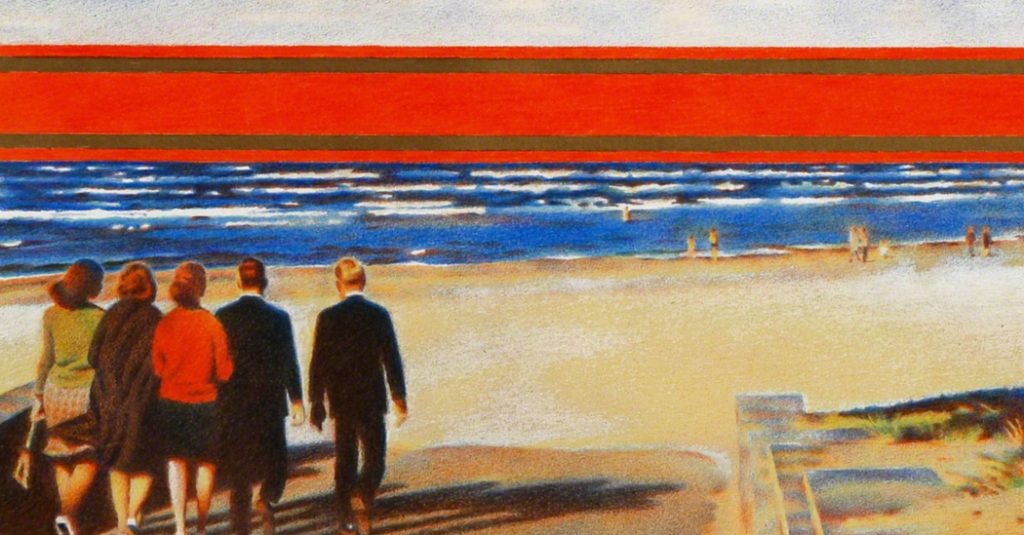
Mr. Bulatov viewed his canvas as a collision zone for two opposing spaces. In one, the social space, Communist ideology and state power are represented by red lettering and stark lines. In the other, the pictorial space, freedom is signified by shades of blue: the hot summer sky, the ocean on a cold day.
Both colors pervade his body of work.
In “Horizon,” people wearing suits and dresses walk toward a rolling sea, the blue sky in the distance obscured by a thick red ribbon evoking a Soviet military award. In “Welcome,” that word is superimposed in red over the image of a young woman beside a fountain.
The paintings are not without hope.
“I think that the worst thing that the Soviet propaganda has done — forgetting the lies and the nonsense — is to have persisted in brainwashing us into believing that the social world we inhabit daily is the only reality,” Mr. Bulatov once said.
For decades, few were able to view his artistic counterstatement.
In 1965, an exhibition of Mr. Bulatov’s paintings in the House of Culture at the Kurchatov Institute of Atomic Energy was shut down by authorities after less than an hour. A show three years later at the Blue Bird Café in Moscow lasted longer — a single night.
“Here I was a stranger,” he said in a 2023 interview with the Russian online newspaper Fontanka. “I could not show my works, let alone exist on them. It was a completely foreign state for me, simply hostile.”
Mr. Bulatov was able to show his works abroad after restrictions on artists were relaxed during Mikhail S. Gorbachev’s presidency. In 1986 and 1987, his paintings appeared in group exhibitions in London, Venice and New York. And in 1988, the Kunsthalle Zurich gave him his first solo show.
“Fame came to him quickly once these works were shown in museums across the world,” the curator Sergey Popov told The Art Newspaper Russia after Mr. Bulatov died. “Erik Bulatov created those paintings that we now rightfully consider great and which, without any doubt, changed the history of Russian and Soviet art.”
Though Mr. Bulatov was associated with the satirical Soviet Pop Art movement known as Sots Art, reviewers noted that his paintings were devoid of irony.
“In Bulatov’s work, the social dimension is represented in all seriousness: He does not employ an alien idiom to mock it,” the Russian art critic Yevgeny Barabanov wrote in the catalog of Mr. Bulatov’s work. “There is no irony in his work; irony is replaced by distance, by a viewpoint that enables him to see and recognize things.”
Erik Bulatov was born on Sept. 5, 1933, in Sverdlovsk, a city near the Ural Mountains now known as Yekaterinburg. His father, Vladimir, was the scientific secretary for the Great Soviet Encyclopedia, a series of reference books published from 1926 to 1990. His mother, Raisa (Swarz) Bulatov, was a stenographer.
Growing up in Moscow, Erik was constantly drawing, and his parents encouraged his artistic talent. When he was 9, he won first place in an art competition and was awarded a live rabbit. Unsure of what do with it, he opted instead for the second-place prize: a collection of stones.
After attending the Moscow Arts Middle School, he studied painting at the prestigious Surikov Art Institute and was mentored by Vladimir Favorsky, a graphic artist, and Robert Falk, an avant-garde painter whose work was attacked by Soviet leader Nikita S. Khrushchev.
The older artists encouraged Mr. Bulatov to think beyond the doctrines of Socialist Realist painting — even if it meant working in isolation.
“Falk became for me an exemplar of how the artist should conduct himself in social space,” Mr. Bulatov said in the catalog. “Without fuss, without becoming indignant, without trying to adapt, not reacting to anything, he went on with his work, peaceful and focused.”
For six months of the year, Mr. Bulatov illustrated children’s books; for the other six, he painted. Many underground artists led similar double lives.
“We all firmly understood that the Soviet regime would be around forever, and that there was nothing you could do about it,” Mr. Bulatov said. “But it was possible to risk not having anything to do with it, to try to depend on it as little as possible and thus liberate oneself from it as one was able.”
Mr. Bulatov married Natalia Godzina, a historian of classical dance, in 1978. They lived in New York for several years during the late 1980s before settling in Paris.
In addition to his wife, his survivors include two sons, Vladimir and Alexei Bulatov.
For Mr. Bulatov and other underground artists, working in secret was the only way to survive the monotony and oppression of Communism.
“To draw without permission — that was where our freedom lay,” he said.
The post Erik Bulatov, Russian Painter Who Undermined Soviet Propaganda, Dies at 92 appeared first on New York Times.