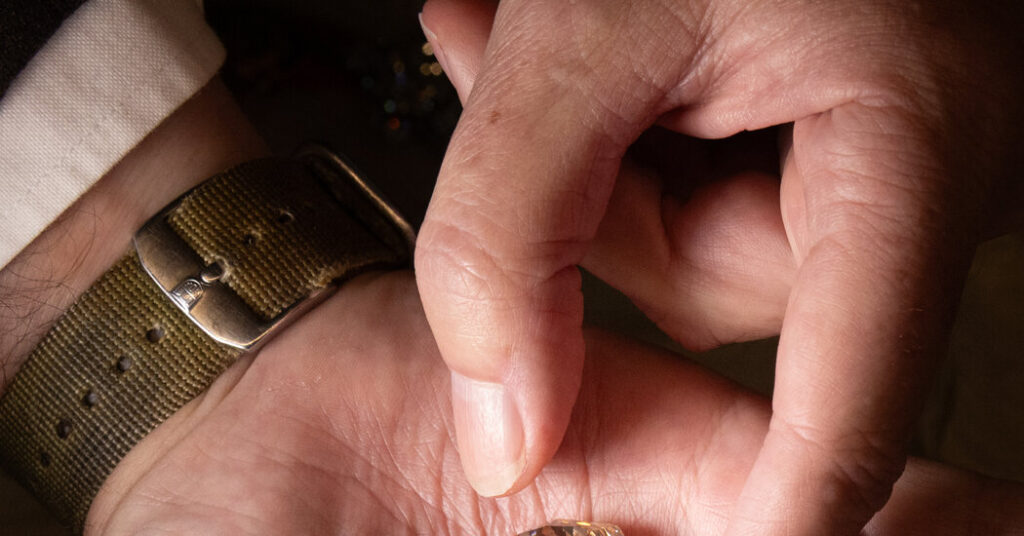
The Austrian government has established a commission of experts to examine whether the country has any claim on the Florentine Diamond and other jewels that recently surfaced in Canada, after having been thought lost or stolen for more than 100 years.
The commission was established in response to a New York Times article last month reporting that the cache had, in fact, been in the possession of the Hapsburg family since 1918, but was secretly kept in a Quebec bank after 1940.
The commission’s first meeting was held on Thursday.
“Whether any claims are made by the Republic of Austria depends on the Commission’s findings,” Andreas Babler, Austria’s vice chancellor and minister of culture, said in a statement on Friday. “I am convinced that the relevant expertise now gathered in this commission will bring this clarification.”
A centerpiece of the jewelry collection is the 137-carat Florentine Diamond, a celebrated gem whose disappearance led to multiple theories about its whereabouts and has been fodder for both novelists and filmmakers.
In reality, Charles I, the emperor of Austria-Hungary and a member of the Hapsburg dynasty, had the jewels shipped to Switzerland when the family left Vienna to live in exile there. The Habsburg family, which prefers the original German spelling of the name, later carried the jewels to Canada with them after escaping from the Nazis during World War II. (The New York Times uses an old, anglicized spelling of the family name: Hapsburg.)
The whereabouts of the jewels was kept a secret out of respect for a request by Empress Zita, Charles’s widow, according to three Habsburg descendants interviewed by The Times. They said that the empress, worried about the safety of family heirlooms, had asked relatives to conceal their location for 100 years.
Aside from its size and coloring, the diamond became well known for its rich history, which includes having been owned by the Medici family, the rulers of Florence.
Richard Bassett, a historian commissioned by the family to report on the gems, has said that they were listed in a separate inventory from that of the state crown jewels of the Hapsburg monarchy.
This position — that items taken by the family were the private property of the Habsburg-Lorraine house — was supported by a legal advocate for the imperial family in 1921, Bassett added, when the Austrian government put pressure on the Swiss government for their return.
Though legislation enacted by the First Austrian Republic in 1919 expropriated the Hapsburg family’s private property in Austria, Bassett said it had not applied to the jewels because by that time they were outside the country.
According to Bassett, signage at the Imperial Treasury museum in Vienna refers to the gems that Charles took with him into exile as those that had been “inventoried as personal jewellry.”
But Friday’s statement from the Austrian government described the gems as having been “taken from the treasury” and “taken abroad.”
Austria’s new committee — to be led by Wolfgang Peschorn, the president of the Financial Procurator’s Office, as chairman — will be comprised of Austria’s Commission for Provenance Research, which is part of the Federal Ministry of Housing, Arts, Culture, Media and Sport and “was commissioned to reconstruct the provenance and dislocation history of the objects,” a news release said.
The Habsburg family has said that it wants to display the diamond at a Canadian museum in the next few years, and that there is no plan to sell it or to speculate on the jewel’s monetary value.
Robin Pogrebin, who has been a reporter for The Times for 30 years, covers arts and culture.
The post Austria Forms Panel to Study Its Rights to Famed Florentine Diamond appeared first on New York Times.