This feature is part of a series called Turning Points, in which writers explore what critical moments from this year might mean for the year ahead. You can read more by visiting the Turning Points series page.
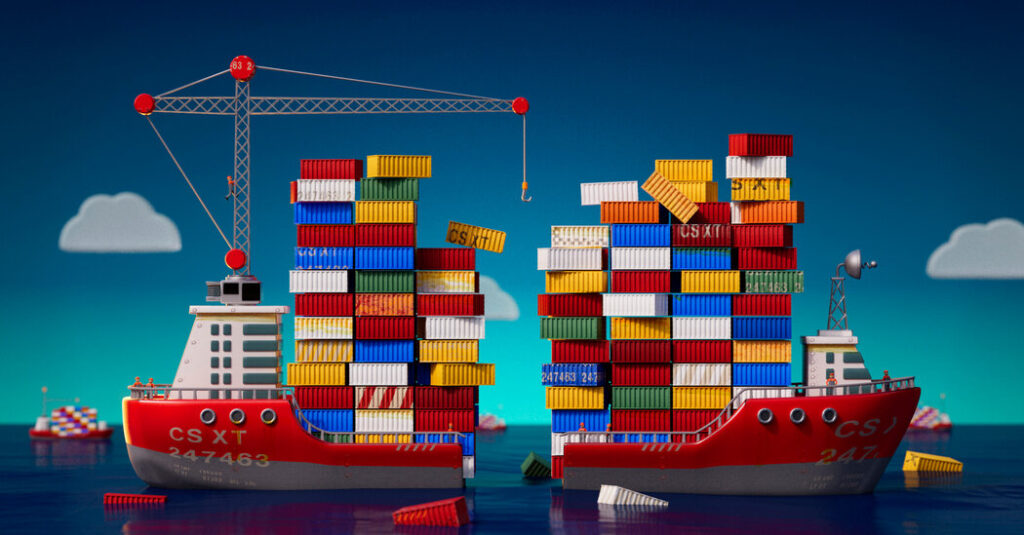
Global trade is undergoing a transformation. The model for international commerce developed in the post-World War II era is being upended by uncertain policy, unreliable infrastructure and rising demand for sensitive items like rare earth minerals.
Supply chains were already disrupted by the Covid-19 pandemic, when lockdowns resulted in a regionalization of trade patterns through practices like “friendshoring” and “nearshoring.” Since then, labor shortages, climate change and geopolitics have also impacted the transit of goods around the world. The change in shipping patterns has done more than cause prices to rise for consumers. It also has affected the operations of ports, the positioning of shipping containers and plans for business expansion.
As companies find ways to manage the current era of trade wars, are global supply chains broken for good?
We asked a group of experts to envision the future of supply chains and how changes to them will impact national economies. Their answers have been edited and condensed for clarity. — Lara McCoy
Aleh Tsyvinski: The Character of Globalization Is Shifting
Growing up in the landlocked town of Vitebsk, Belarus, one of my favorite pastimes was watching shipping containers roll by on trains and trucks. They were colorful, neatly arranged and carried the names of companies from distant lands. To me, they looked like giant toy blocks for adults. But containers are more than aesthetic curiosities: They are the building blocks of globalization.
According to the United Nations Conference on Trade and Development, about 70 percent of global trade by value travels by sea, and roughly two-thirds of that is containerized. In other words, nearly half of the world’s trade value moves in metal boxes. To understand containers is to understand the anatomy of global commerce.
One of the great pleasures of being a Yale professor is that you can turn your childhood fascination into research. With colleagues from Princeton University, the University of Virginia and the University of Rochester, I analyze the vast “megadata” trail every container leaves behind. Thanks to Freedom of Information Act releases, U.S. bills of lading — shipping manifests for every container — are available in extraordinary detail. We now have hundreds of millions of import records covering everything from your neighbor’s case of olive oil to precision instruments imported by major aerospace firms.
From these records, we built the Supply Chain Disruption Index, which tracks shocks at the product, firm and regional levels. The results show that supply disruptions peaked during Covid but have since subsided overall, although they remain above prepandemic levels. Firms have adapted — imperfectly, but enough to keep goods flowing. At the same time, we estimate that the current elevated level of supply chain disruptions costs U.S. public firms about $100 billion per year in lost market capitalization.
The picture darkens, however, when we zoom in on critical goods — items that have national security importance, high economic criticality, low substitutability and are heavily dependent on foreign sources. Using machine learning to identify critical products such as rare earths, we created the Blue Center Index of Critical Supply Disruptions. This index shows that while general supply chains recover from shocks relatively quickly, critical supply chains are affected much more severely and take much longer to stabilize.
This is the central vulnerability of globalization today. For everyday goods, the system bends but does not break, while for critical goods, a major geopolitical or economic shock can cause prolonged and severe disruptions.
What our analyses show is that the character of globalization is shifting. We are entering an era in which supply chains for critical goods, not consumer goods, will define economic security, especially for major shocks. The challenge for governments and businesses is no longer how to make trade faster and cheaper, nor even how to make supply chains more resilient overall, but how to safeguard the flow of critical goods.
Aleh Tsyvinski is the Arthur M. Okun Professor of Economics at Yale University.
Sabrina Chao: Globalized Trade Is Changing, but Not Coming to an End
A recent blog post by the World Trade Organization forecasts headwinds and a decline in the volume of world merchandise this year due to surging tariffs and a rise in trade policy uncertainty. Additionally, there is still a war going on in Europe and attacks on commercial ships in the Red Sea area. Global trade is facing serious disruptions.
For decades, globalized trade has lifted millions of people worldwide out of poverty. When a nation the size of the United States challenges established global trading principles and the intentions of agreements such as the Bretton Woods system and organizations like the W.T.O. are diminished, globalized trade is severely impacted.
But sometimes it is helpful to look back before we look forward.
The Smoot-Hawley levies in the 1930s, U.S.-Japan trade tensions in the 1980s and U.S.-China trade tensions between 2018-19 all destabilized global trade, resulting in rising costs for businesses and consumers, and in disrupted supply chains and trade patterns. Some industries benefited and found new routes and markets while others suffered. It is the nature of trade flows to change and adapt.
The shipping industry is not a novice when it comes to navigating changing trade measures. According to the International Monetary Fund, nearly 3,000 restrictive measures were implemented in 2023 alone — three times as many as in 2019. But, according to the W.T.O., facilitating measures had more than twice as much impact on global trade as restrictive measures in the period from mid-October 2012 to mid-May 2024.
The world’s commercial fleet, which counts more than 61,000 ships and 1.7 million seafarers, transports more than 80 percent of global trade by volume and approximately 70 percent by value. Our businesses and seafarers have navigated through wars, recessions, tariffs, sanctions and pandemics.
In the not-so-distant past, our fleet has supported trade through the Iran-Iraq War, the Iraq War, various trade wars, fighting in Libya after the death of Col. Muammar el-Qaddafi, Somali and Nigerian piracy, a paralyzing pandemic, Russian attacks on commercial ships in the Black Sea and attacks by the Houthis in the Red Sea.
Today, tariffs and wars are once again threatening and disrupting global trade, supply chains and shipping. However, around 87 percent of global merchandise trade is done outside of the United States, and while America is choosing a path of trade-restrictive measures, new trade agreements are currently being agreed upon and old ones are being revived across nations, economies and continents.
Globalized trade and supply chains are changing, and although they may be temporarily shaken, they are not coming to an end.
Sabrina Chao is the past president of global shipping association BIMCO.
Gene Seroka: We Need to Be Better at Anticipating Changes
The following is based on an interview with Lara McCoy. The interview has been edited and condensed.
The supply chain is changing right in front of our eyes. The United States has raised the price of trade, and we are starting to see countries look for other partners. It will be interesting to see the changes these new alliances bring to trade patterns. The largest trade lane for containerized cargo today is the intra-Asia route, although the trans-Pacific market between Asia and the United States is the most lucrative for service providers. That may change. Depending on supply and demand, vessel assets, capital investment and talent may go to other trade lanes that support the new partnerships we see growing day by day. I do not know if supply chains are irrevocably broken at this juncture, but they are changing. It is a bit early to say exactly what impact these changes will have, but likely it will be more expensive to do business with the United States.
This year, we have seen huge swings in cargo flow, and I see that continuing until we get some semblance of permanence in U.S. federal trade policy. In the absence of that policy, businesses have a very difficult time making personnel decisions, capital investments and even midterm strategic plans. We have to power through this to the best of our ability so when U.S. trade policy becomes a little more exact and cargo flow more predictable, we will be ready to handle it.
Having said that, we need to be better at anticipating changes in our industry overall. There are budget cycles, there are economic cycles and there certainly will be election cycles.
One way to be prepared for whatever change comes is investment — not only in infrastructure, the bricks and mortar, but also in technology and in our people. Along with the Port of Long Beach and the California Workforce Development Board, we are building the nation’s first goods movement training campus so that we can upskill and reskill dock workers as well as attract, recruit and retain talent for tomorrow.
One area I think should be explored as we look for new trade partners and supply chain patterns is agricultural exports. The biggest category of exports from the Port of Los Angeles is agricultural products — everything from wine and spirits to soybeans and alfalfa to almonds and walnuts. I can see some real upsides for participants across the supply chain to getting these unique products deeper into overseas markets.
As trade policy evolves and supply chains settle into a new rhythm, I think it is imperative that federal policymakers work closely with industry leaders to help power the U.S. economy going forward. We should have more engagement between business and government, and I am not seeing that yet.
Gene Seroka is the executive director of the Port of Los Angeles.
The post Are We Witnessing the End of Global Trade? appeared first on New York Times.